Politics & Government
Crowd Packs Conshy Planning Commission Meeting for Wawa Proposal
Developers, residents debate value of proposed Wawa to community.



After months of posturing and preparation, the debate over a proposed Wawa in Conshohocken finally went public Tuesday night, as the borough's Planning Commission considered the proposal for the first time. A crowd of at least a hundred residents, local officials, developers, and lawyers packed the Washington Fire Company for a three-hour process that will ultimately continue in the body's January meeting.
Representatives from developer Provco Pineville Fayette L.P., of Villanova, and Wawa presented first, framing the proposal as one that would revitalize the former E.F. Moore Chevrolet lot at 11th and Fayette Streets.
"We think this proposal presents a unique opportunity for a site that is just yelling for help," said Marc Jonas, an attorney for the developer, arguing that his client was one of the few with the money needed to properly teardown and clean up the site. "It will help meet the demand for retail use… [and] it will add streetscape improvements to the site."
Jonas and his team presented digital renderings of what the proposed Wawa would look like. A 4,100-square-foot convenience store would be set in the center of the 1.45-acre lot, with a canopy of ten gasoline pumps immediately in front of it. The island would be buffered from Fayette Street by a landscaped plaza area with pedestrian sitting space, along with an eight-foot sidewalk.
The proposed lot would have two access points from Fayette Street: a full entrance and exit driveway to the north, and a right-in and right-out only driveway to the south. A third entrance on Harry Street would allow two-way access, and offer another opportunity for exiting cars to use the 11th Street traffic light to head north on Fayette Street, representatives said.
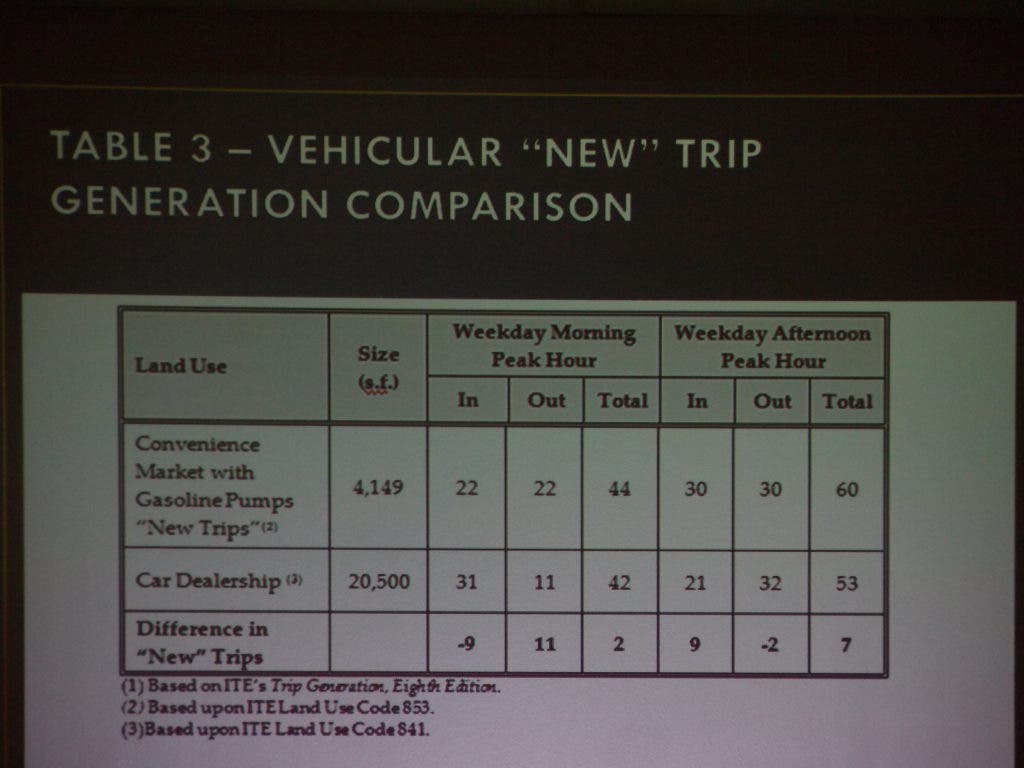
Developers also said the Wawa would bring 30 to 40 new jobs to the area without closing the company’s two nearest franchises, while generating minimal additional traffic. Casey Moore, a traffic consultant from McMahon Associates, Inc., said the Wawa would generate 182 trips during the peak morning hour and 248 during the peak evening hour, but stated most of those trips would be people who already drive by the site each day.
"Many of us can relate to that: you're driving to work and want to stop and get a cup of coffee or top off your tank. That's considered a 'pass-by' trip," Moore said.
Moore said that an October traffic study, which used industry-standard data from the Institute of Transportation Engineers, predicted only 44 "new" trips in the peak morning hour and 60 "new" trips in the evening, an increase of only about four percent of the total number of cars driving on Fayette Street.
However, many members of the public disputed the development team's assertions that the Wawa would have a positive influence on local commerce and walkability, and that it would minimally affect traffic.
"A 24-hour gas and convenience store is not what we want," said Alison Mathern, of the 1000 block of Harry Street. "It's simply unacceptable for a residential neighborhood… to allow something of this magnitude in this zone is really a slap in the face to anyone who has invested in Conshohocken."
Several local business owners, such as The StoneRose's Brian Pieri, said that while they didn't think the Wawa would drastically affect their business, that it still wouldn’t be appropriate for Conshohocken.
"Come sit outside my restaurant when the Getty station gets their gas delivered and let me know what you smell-- you'll smell gas" Pieri said. "My ears hear the loud truck, my eyes see the traffic getting in and out of that station when the trucks are trying to get in there."
By about a 3-to-1 ratio, members of the public spoke out with similar concerns about the Wawa, with some going further and predicting it would drive locally owned shops out of business. Several asked that the borough be more patient and wait for different proposals, such as mixed retail and residential use.
In addition to public comment, advocacy groups for both sides have organized petitions for the proposal. Representatives of Ceisler Media told Patch they've collected approximately 2,100 signatures in support of the Wawa from an online site and from community events such as the Soap Box Derby, and that 1,200 of them are from borough residents. However, borough staff said that only 36 signatures were garnered from the area immediately around the lot, and Ceisler representatives said they could not provide a list of the signatures to Patch.
In opposition, the Conshohocken Revitalization Alliance, a group organized by Tony DeFazio of DeFazio Communications, said they had collected 700 signatures against the Wawa through an online petition and by canvassing neighborhoods, but said that many of them were from residents in the immediate area and were visible online.
Proposed changes to the zoning code
Technically speaking, the development team is asking for a text amendment to the borough's code to allow the Wawa in the residential/office district in which the lot sits. According to the developer’s representatives, the proposed amendment has been constructed in such a way that it would not allow the development of other large commercial properties, by placing a restriction on the minimum distance required between such uses and forbidding the demolition of Victorian and 20th century-styled homes.
However, borough staff raised several concerns with the proposal. Elizabeth Lankenau, borough planner, said that while she believed the proposal had some merits, she didn't think it met the spirit of the 2007 Conshohocken Comprehensive Plan and 2011 Revitalization Plan Update.
"The [proposal], in my opinion, does not really propose a solution that is consistent with the legislative intent of [previous borough planning initiatives], or the existing streetscape character of upper Fayette," said Lankenau, adding that she believed the use was too high intensity and wished to see more specific traffic studies from Wawas in similar boroughs.
Conshohocken zoning officer Christine Stetler said that even with the text amendment, the proposal still conflicted with ordinances regarding signage, landscaping, and parking—problems that would need to be addressed by the developer or commission moving forward.
For their part, members of the Planning Commission remained mostly neutral in their questioning. After members Joseph Dougherty, Jr. and Aaron Weems recused themselves, the remaining trio of Matt Mittman, Brian Tobin, and chairman David Bertram were left to consider the proposal.
Mittman asked about lighting and if the proposed monument-style gas price sign could be placed parallel to the roadway. Wawa representatives replied that while lighting would be kept to a minimum and directed downward, that the sign was legally required to be placed perpendicular to Fayette Street and easily visible to drivers.
The commission will likely consider Tuesday night's discussion in the months before their next meeting on January 22, 2013. Ultimately, the commission can only decide to recommend that the text amendment be approved by Borough Council, which holds the power to approve the proposal.
Get more local news delivered straight to your inbox. Sign up for free Patch newsletters and alerts.