

About sixteen hours had passed since I had arrived in Haiti and now it was time to see the build site. Up with the roosters at 5:30 a.m., we loaded up the buses between 6:15 - 6:45 a.m. and headed to the site. We arrived a half-hour later and saw rows and rows of foundations waiting for us to shape into houses. (Habitat sent a pre-Carter Work Project build team to ready the foundations for the 400+ volunteers.) We also noticed the build site was behind more fencing with razor wire and was patrolled by arm guards. This was conflicting for many of us. It felt sad and even uncomfortable with all the class and race implications this separation brought. While all of these thoughts were going through my head, I kept reminding myself of why I was in Haiti.
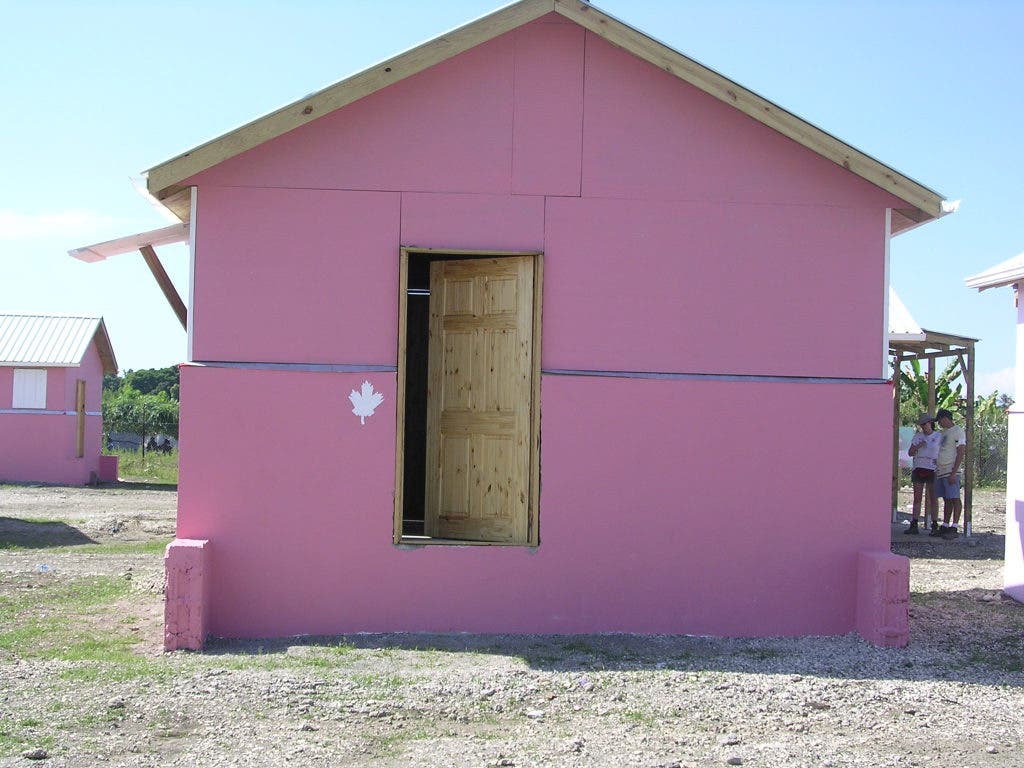
The teams were responsible for building two houses, each of which was 200 square feet. Many Americans have living rooms bigger than this but, for a culture that spends much of its daily hours outside, I was told this was very acceptable to the homeowners. The houses were not designed with kitchens or bathrooms. Haitians cook outside with wood and Habitat was building latrines for each house. (The latrine looked like an outhouse but with a big PVC pipe running the vertical length of it. I think it was constructed like a compost toilet like you sometimes see in campgrounds or state parks.)
We were encouraged to walk to the section that had 50 completed houses to better understand what we would be building. The group Haven (that I introduced in the last blog post) had built 50 houses the week before we arrived. (They left the "mark of the Irish" on some houses as evidenced by the shamrock!) Originally, the houses were to have two small bedrooms and a common space. In working closely with the community, Habitat learned the homeowners preferred just one bedroom (largely to give couples privacy) and a common area. The foundations were constructed in such a way as to allow an addition when the homeowners were "on their feet" and secure in their new houses and could save to build onto the house.
Find out what's happening in Springfieldfor free with the latest updates from Patch.
There was a great deal of work to do in the week. We were going to add 100 more houses to the 50 already built. Ultimately, Habitat volunteers will continue to build until there are 500 houses on the site. In fact, Habitat will have its Carter Work Project in Haiti again next year. President Carter told us that, "Lord willing" he and Mrs. Carter would be back. (Check out the Habitat for Humanity web site if you are interested in going to Haiti next year.)
After I checked out the completed houses I hustled back to the site to which I was assigned. I was "gung ho" to get started as I saw how much needed to be done. President Carter addressed us the evening before and asked us to minimize the time we spent taking pictures and socializing as we were here to work. If 87-year old Carter was going to work in the heat all week, certainly I - someone 40 years younger - had no excuse. It was time to work and make a reality that which I came to Haiti to do.