Neighbor News
Over 100 Trees For Easttown Township
Creating biodiversity while controlling stormwater runoff


As many residents are aware, earlier this year PECO Energy Company, Pennsylvania’s largest electric and natural gas utility, began a maintenance project in Bewyn. The purpose of PECO’s project is to retire aging infrastructure and replace it with safer, more reliable infrastructure that will better serve the community, according to Afia Ohene-Frempong, PECO communications manager.
As a result of that project, a significant number of beautiful large old growth trees, including ash trees, were removed in order to give work crews access. Since the removal of those trees, the Darby Creek Valley Association (DCVA) has worked with PECO to secure funding and support for the replanting of over 100 native trees and shrubs in Easttown Township.
“Input from PECO customers in Easttown provided PECO with an opportunity to examine the ways in which we can undertake the massive scale of electric delivery infrastructure upgrades now required in our region ... For Easttown residents, that examination led to our partnership with DCVA,” Ohene-Frempong said. “To broaden that commitment going forward, PECO has partnered with the Pennsylvania Horticultural Society Forestry Programs to support the planting of 10,000 trees per year across our service territory, offsetting PECO tree-removals due to electric system maintenance.”
Additionally, the utility recently applied for certification by Tree Line USA, a program of the Arbor Day Foundation, which recognizes utilities with best management practices working within community forests.
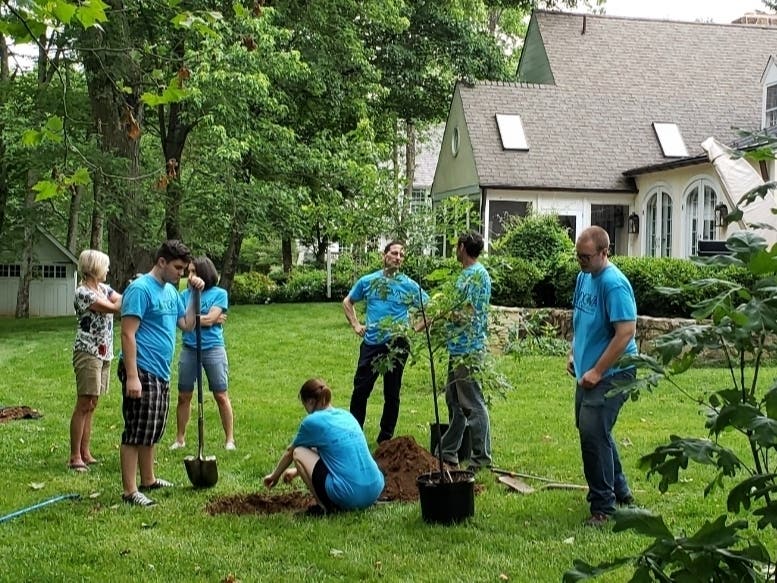
The first DCVA organized replanting began on May 29, 2019. Trees were planted at a private residence near a local creek to supplement the existing riparian zone and 24 trees were planted at the Upper Main Line YMCA. The project has continued since then with over 61 trees planted.
The goal of the tree planting is to control storm-water runoff and augment riparian zones. Trees act as a natural buffer to excess runoff, reduce flooding and the polluting of local streams.
Kate Goddard, DCVA board member, added that in addition to minimizing erosion and water runoff, riparian zones protect complex stream ecosystems that are home to fish, insects, invertebrates and other organisms. By keeping streams healthy, it benefits local residents by reducing potentially dangerous runoff situations that can cause harm to people and structures.
“One tree can absorb up to 100 gallons of water,” said Susan Miller, executive director of DVCA. “When the tree absorbs the water, the ground becomes dry and can soak up water instead of having runoff flowing across the top of the ground and can help prevent flooding. In order to preserve the biodiversity and the ecology of the watershed, native trees were selected.”
A majority of the trees have also been selected to increase the pollinator pathway, which is a pesticide-free corridor of land that provides native plant habitat and nutrition for pollinators such as bees, moths and butterflies.
Mindyjane Berman, a local resident, received 18 trees to plant on her property as part of the program. She became involved after growing concerned regarding the number of trees removed by PECO.
“We would like PECO to work with our environmental groups to come up with the most balanced environmentally friendly compromise to achieve PECO's goals for electricity service and maintenance and the environmental health of our township,” Berman said.
A second round of planting is currently scheduled to begin in late September, depending on weather conditions.
“For anyone who is concerned about extreme wet areas or runoff on their property, I would suggest they plant additional native trees and shrubs,” Susan Miller, DCVA Executive Direct, said. “For residents who have streams, it’s also crucial that they leave the riparian zones at the bank intact to prevent erosion and sheet flow pollution. This means letting the grass grow taller and allowing the growth of native plants.”
Besides tree replanting, another avenue to address environmental preservation when utility or other maintenance is required is for local municipalities to enhance their tree ordinances to address the removal and replacement of trees, Miller added.
“Enhanced tree ordinances assist in maintaining per capita of trees in the area and can include a percentage of native trees for replacements and restrictions on invasive trees in shrubs,” Miller said.
DVCA encourages residents to speak with local municipalities about environmental concerns or join local organizations such as the Shade Tree Commission or the Environmental Advisory Council. Residents who are interested in participating in tree replanting projects or other DCVA sponsored programs can contact the Darby Creek Valley Association by calling 484-222-2502 or emailing director@dcva.org.
Article By: Shanai Bemis
Find out what's happening in Tredyffrin-Easttownfor free with the latest updates from Patch.
About Darby Creek Valley Association (DCVA):
Founded in 1984, by residents in the Darby Creek Watershed, DCVA became a nonprofit watershed organization dedicated to the protection and enhancement of the watershed and its resources, including water, wildlife, historical sites, floodplains,wetlands, and riparian zones.