Sports
Philadelphia Curling Club President Is Here To Teach You All Things Curling
Club president Cody Clouser spoke with Patch about local Olympic curler Taylor Anderson-Heide, curling terms, tactics, history, and more.


PAOLI, PA — The 2026 Milano Cortina Olympic Games are underway, and that means its time to watch hours and hours of one of the most captivating winter sports: curling.
This year, the Philadelphia region is represented, in part, by 30-year-old curling star Taylor Anderson-Heide, a Broomall native.
>>>RELATED: These PA Athletes Are Competing In The 2026 Winter Olympics<<<
Find out what's happening in Tredyffrin-Easttownfor free with the latest updates from Patch.
Anderson-Heide's career highlights include gold medals at the U.S. Women's Championships in 2019, 2021, and 2021; gold at the 2025 U.S. Olympic trials; and silver at the 2016 World Junior Championships in Copenhagen with Sarah, among other silver and bronze medal placements.
She is a five-time national champion, twice in mixed doubles with Korey Dropkin in 2015 and 2018, twice in women’s curling on a team with her twin sister Sarah in 2019 and 2021, and once in 2025 as the lead for the Peterson sisters, on a team with two-time Olympian Tabitha Peterson as skip.
Find out what's happening in Tredyffrin-Easttownfor free with the latest updates from Patch.
But Anderson-Heide couldn't have gotten to the biggest stage for her sport without the Philadelphia Curling Club in Paoli, with 29-year-old Berwyn native Cody Clouser serving as its president.
Clouser has been curling since age 3, has competed in four national championships, and earned gold in the 2016 College National Championships, according to his biography on the Team USA website.
He comes from a curling family. "My father grew up curling, and then his parents were some of the first members at the Philadelphia Curling Club," he said.
The club was founded in 1957 at the Villanova University Ice Rink. But in 1961, the rink's roof collapsed in a snowstorm, according to the club's website.
"Some of the curling members crawled through the wreckage to retrieve the curling stones that survived," Clouser said. Then in 1963, members raised enough funds to buy land from the Philadelphia Water Company to build a new club at 65 Plank Ave. in Paoli, where it still stands and has undergone upgrades throughout the years.
Clouser came up playing with Anderson-Heide at the club and said when the winter games come around, the interest in curling spikes.
"It's the most watched Winter Olympic sport," Clouser said.
You might wonder, "How can that be?"
"That is in part due to the fact that there is a lot of content," he said.
Each game takes two and a half to three hours. Combine that length with the tournament style of play, which includes the round robin games and championship games. And of course all those games are played on three different levels: men's, women's, and mixed doubles.
All together, that makes for a ton of curling to watch.
"Originally that's part of the reason curling was added to the Olympics," Clouser said. "There's so much content with the curling that they were able to cut to it anytime they had a slow moment in another sport."
So if you're waiting to watch someone such as Warrington's Andrew Heo in a speedskating event but the feed cuts to curling, you know why.
Now you're watching curling all of a sudden. And you hear terms like "hack," "heavy," and "sheet" that may have you baffled.
Well, here's a bit of information courtesy of Clouser, a Berwyn native who, when not curling, is a consultant for PricewaterhouseCoopers LLP in Philadelphia.
"Hack" is the area from which the thrower, the person who sends the curling stone down the ice, launches the curling stone.
The sweepers, the people who you see furiously brushing the ice with brooms, will shout "heavy" or "light." This does not refer to the stone's weight, which averages 42 pounds. Regulations say stones must weigh between 38 and 44 pounds. More on the stones themselves later. Rather, the terms refer to the speed of the stone. "Heavy" means the stone is going farther down the ice than the goal, and "light" means the stone may fall short of the shot.
That determination will lead the sweepers to either ease up on the brushing or work even harder, which Clouser said is much more intense on the athletes than it might appear.
"One of the things to watch for is people putting pretty much their entire weight onto the broom," he said. "How you effectively sweep is by basically propping yourself up on that broom while sliding on ice and moving that broom as fast as you can. If someone kicks that broom out from under them, they're falling face first."
The ice lanes on which games are played are called "sheets." The Philadelphia Curling Club is a two-sheet club, which Clouser said limits the number of people and games possible. The Bucks County Curling Club in Warminster is a four-sheet club, he said.
Teams consist of sweepers, throwers, and a skip. The latter is sort of the coxswain of curling. They will plan and call shots before the stones are thrown. But each team member throws two stones, the skip included, typically throwing last.
"Part of the reason [they throw last] is you kind of want them calm and ready for their shots," Clouser said. "So you want them not sweeping and not getting their heart rate up."
But how do curlers navigate the ice without suffering the aforementioned face plant?
"You've got one shoe that's got a Teflon flat surface on the bottom, and Teflon slides really effectively over ice," Clouser said. "And then the other shoe has a gripper on the bottom. That allows you to push out of the hack, and that's what propels you forward."
And don't assume ice on curling sheets is like that of skating rinks. In fact, curling sheets don't get Zambonied at all. Instead, curling sheets are treated with a pebbler.
"It sprays small droplets of water on the ice," Clouser said. "And when you feel it, when you run your hands over it, it feels like little pebbles, which is why it's called pebbling."
Eagle-eyed curling viewers may even be able to see the bumpy surface of the curling sheets while rooting for Team USA in the coming weeks.
"Thanks to HD broadcasts these days, you can see the minute details of the sheets," he said.
Now we're into some of the physics of curling.
Clouser said the shoes and stones are sitting on top of all of these little peaks from all the small bumps created by the pebbler.
"That increases the pressure, which then melts the ice more easily, reducing the friction," he said. "It feels like when they're sliding out [on pebbled ice], they kind of have this really gentle feel, and the rock just keeps sliding and sliding and sliding."
When curling on flat ice, your stone isn't likely to go very far, he said.
As for the stones, they're all made from two specific types of granite harvested from a single quarry on an island named Ailsa Craig off the southwestern coast of Scotland.

Kays of Scotland, founded in 1851, has exclusive rights to mining two types of granite on Ailsa Craig and is the sole supplier of curling stones to the Winter Olympic Games.
One stone, Clouser estimated, costs roughly $2,000.
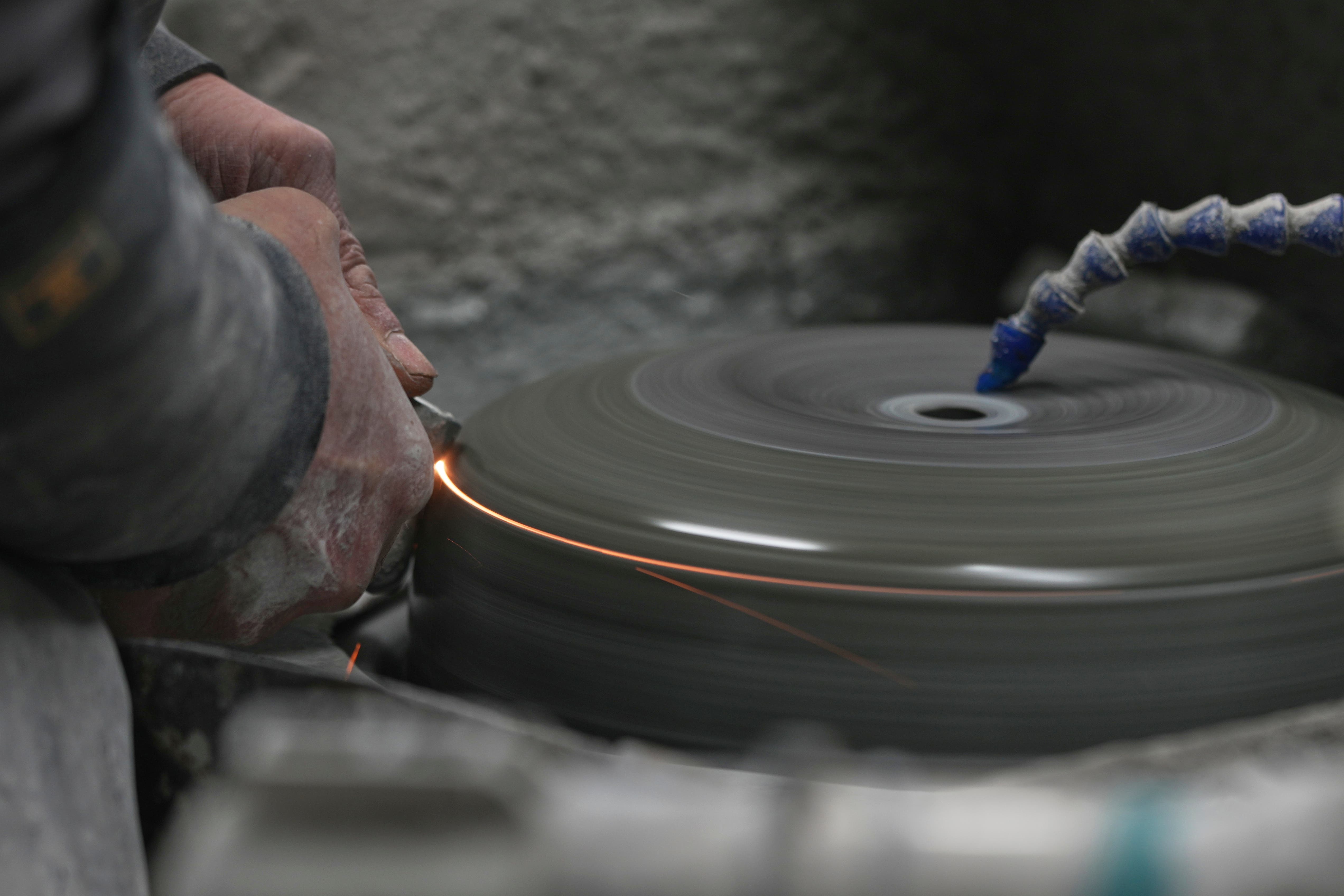
Of the two granites used, one is very damage resistant, and it's used on the outside of the stone. The other one is very moisture resistant and is used for stone's interior.
Stones slowly lose mass over time every time they hit other stones, and if stones were made with more porous materials, water would seep in, freeze, and potentially crack them, rendering them useless.
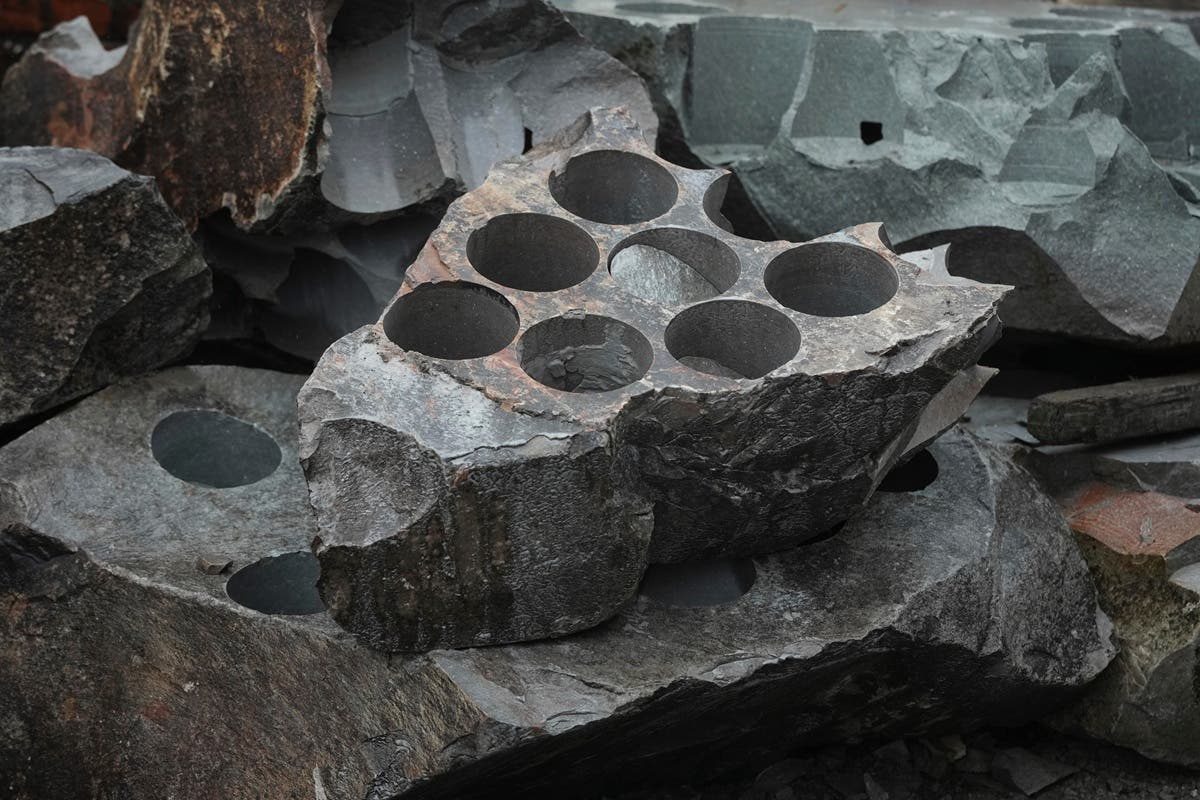
"Having moisture-resistant granite helps to make sure that doesn't happen, basically," Clouser said.
And curling is not like bowling, where you bring your stones. Curling clubs buy their sets of curling stones, and members use them. Olympic teams use their own set of national stones in the games.
And Anderson-Heide will be handling Team USA's stones, but her forte lies elsehwere.
"Taylor in particular is a very, very strong sweeper," Clouser said.
Clouser said Anderson-Heide and her sister started curling around 2000 and 2001. The twins have three other sisters, all of whom have curled competitively throughout their lives.
Anderson-Heide sisters Emily and Courtney were born in Puerto Rico, and they represented Puerto Rico in an event recently.
Their parents, Wayne and Arlene Anderson, are from Ontario, and Wayne Anderson is a large part of the Philly curling community, Clouse said.
"He's the one that coached all of us growing up," Clouser said. "We always went to practice at [Bucks County Curling Club] late at night, and there was a Perkins down the street. Wayne would always stop and buy everyone pie after practice."
Modern-day curlers might not be eating that much pie, however.
"I want to say over the last 20 years in particular, maybe a little longer than that, and maybe some of the older curlers will yell at me if I say this, but fitness has become a much bigger part of curling," he said. "There's a lot of great old videos of the Canadian National Championship back in the 60s and 70s where they're throwing on the ice, the cigarette is hanging out of their mouth, and they've got a glass of whiskey on the side of the sheet waiting for them."
Curling's focus on fitness mirrors golf's in a way. When Tiger Woods came on the PGA scene, he was notable not only for his skill but also for his fitness level.
In curling, effective sweeping is bolstered by increased fitness levels, giving players more control over the stones as they glide down the sheets. And that's not to mention the longevity needed for the more than two-hour-long games.
Fitness levels aside, Clouser encourages those interested in curling to contact the club, though during the games the Philadelphia Curling Club gets an influx of people hoping to get in on the curling fun due to the sport's spike in popularity.
"If you get the opportunity to try it, and then get to watch it, I think it adds to the experience," he said. "You realize how difficult some of these things are and why some of the shots are being called the way they're being called. There's so much more strategy, skill, and physicality involved than what people might assume."
He recalled the club hosting learn-to-curl lessons around the same time the 2018 Winter Olympics were happening, and the line to get into the club went out the door and around the street.
The club is planning to host some watch parties to root for Anderson-Heide, but Clouser said the time difference might make watch parties difficult to host and attend.
Get more local news delivered straight to your inbox. Sign up for free Patch newsletters and alerts.