Schools
School Board Hears Options to Reduce Medical Costs
The district heard two options on moving to self-funded medical consortia on Monday, which officials say could save the district more than $600,000 annually.

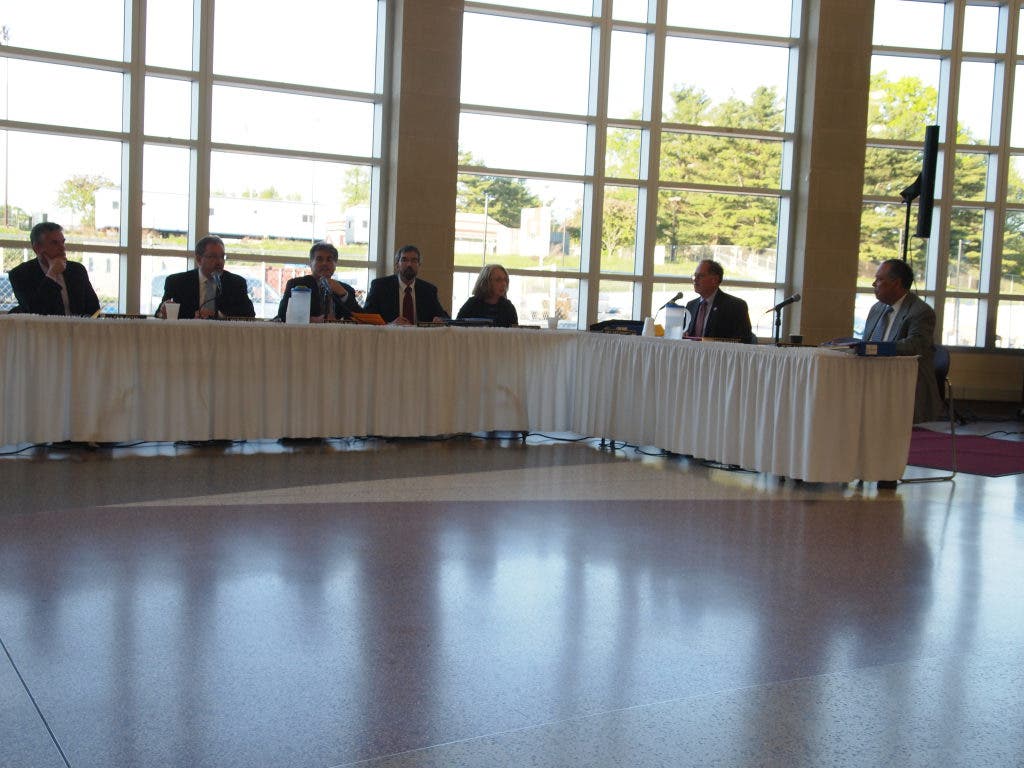
At past meetings, members of the Upper Dublin School Board and administrative staff had discussed changes to employees’ medical benefits as one way of cutting costs. As a budget item, medical costs are second only to salary in expenditures, making any potential decrease of costs a highly enticing option for the district.
At Monday's school board work session, members of the board heard two presentations from local health care plan representatives on how the board might make a move to self-fund their medical plans.
Any eventual move would also be contigent on approval from the district's labor union, which is currently under contract through 2014.
Find out what's happening in Upper Dublinfor free with the latest updates from Patch.
What is self-funding?
Upper Dublin School District is currently under contract with Independence Blue Cross (IBC) for medical plans. Self-funding would mean that instead of working directly with IBC, the district would instead create a fund from which to pay claims and work through a consultant or consortium to negotiate prices with IBC and other providers. In effect, the district would create a "middle-man" between itself and healthcare providers, in order to negotiate more competitive prices, eliminate administrative costs, and maintain flexibility in altering plans up or down to see immediate cost savings.
Door Number One: The MCIU SePAST Consortium plan
The board first heard from Stan Wisler, Director of the Montgomery County Intermediate Unit, along with consultant Robert Poore, on a "SePAST" Consortium Healthcare Coverage plan.
Find out what's happening in Upper Dublinfor free with the latest updates from Patch.
Wisler told the board that the consortium was currently working with roughly 20 area school districts that had expressed an interest in joining the body. Essentially, each district would make the move to self-funding, but would pool resources in the consortium to share certain costs and gain bargaining power.
"We developed an RFP process to send out to pharmacy benefit managers for costs, and from that we received seven proposals, and negotiated with the top three to get a very aggressive pricing structure for rebates and discounts," said Wisler.
The representatives told the board savings would be two-fold: immediate savings in administrative costs and long-term savings from continuous efforts to improve medical rates.
"Self-insured entities do not have to pay premium tax…today you're charged two percent premium tax on your PPO…we would negotiate provider administrative costs," said Poore. "Over time, districts may be able to save more as they determine their own priorities and work with the consortium for [solutions]."
In addition, the consortium would allow the district to keep its current medical plan. Representatives said each district would outline to the consortium the plan it wanted, and the consortium would work to develop that plan. If twenty schools wanted twenty different plans, the consortium would provide that, representatives said.
How much could the district save?
Michael Pladus, Upper Dublin superintendent, said the district would see significant immediate savings in administrative costs if they joined the trust on its July 1, 2012 start date.
"We're looking at an approximate savings range of eight percent to ten percent for medical benefits for the district, calculated at approximately 6 million dollars," said Plaudus. "That's a savings to the district of between $480,000 and $600,000."
What's the catch?
As administrators and union members began to question the plan, two potential catch points emerged. The first was concern over efficiency of the consortium, and the second were labor concerns over the duration of the contract and labor representation on the consortium's board of trustees.
"It would appear that districts [each having their own policy] would be a major inefficiency," said board member Michael Resnick. "One of the benefits of forming a coalition would be if we could somehow unify plans. Administrating 20 separate plans doesn't seem very efficient."
Doug Sample, president of the Upper Dublin Education Association, the district’s largest union, raised concerns over the consortium's power structure.
SePAST representatives told the board that a seven member executive committee would be the consortium's chief decision-making body, and there would also be a joint management-labor benefit committee to advise the higher body on benefit options. While there would be two union members on the executive committee, Sample wasn't sold that labor would have legitimate bargaining power.
"If we go with SePAST, the executive board has the power [to manage the trust] and make decisions on what's best for the group," said Sample.
However, Poore again said that labor would have significant representation through the benefits committee.
"We determined what the most important area was for labor, and that would be benefits," said Poore. "Therefore, the benefit committee has the power to be 50/50 representation, and labor is empowered to make recommendations in terms of what they feel should be the direction benefits take in the future."
In addition, Sample raised concerns over the district being locked into the consortium. After representatives said they didn't have the numbers on what the penalties for leaving would be, Sample produced the consortium's by-laws and stated them aloud.
"If you sign up for five years, and decide to leave after the first year, you have to pay a full year's worth of contributions for each program, and the second year you're required to pay 10 months," said Sample.
Door Number Two: The BuxMont Healthcare Coverage program
The second proposal came from PSEA solicitor Fred D'Angelo, who told the board about the “BuxMont trust,” a second body attempting to gain members from local districts.
D'Angelo told the board the main difference between this trust and the SePAST consortium was that there would only be two or three plans available for the district to choose from, thus limiting flexibility, but increasing long-term savings.
"The biggest similarity is self-insurance, we embrace self-insurance… because you immediately save on the cost of administration, and you also save because what you pay for your stop-loss insurance is less than what IBC would charge," said D'Angelo.
He further stated, “the dissimilarities are these: the real money to be saved is not the eight percent on administration… the real money to be saved is in training and educating your population, some of it through a carrot, some of it through a stick, in terms of reducing claims utilization."
D'Angelo said the program would rely heavily on giving teeth to wellness policies, such as requiring colonoscopies at the age of 50, mandatory cholesterol screenings once a year, and mandatory participation in a "heartcam" procedure. Employees who didn't follow the requirements would be penalized.
"If you don't do it, your share of the premiums, or your share of the cost-share plan, goes up dramatically," said D'Angelo. "The theory being if we get seventy percent of the people who participate in the wellness program…why should they be penalized by the thirty percent who just refuse to participate, who won't participate in changing behavior when they know it is harmful for them."
Employees would also be required to try over the counter medicines before being prescribed high end subscription drugs, D’Angelo said.
Labor power
As part of the BuxMont plan, labor would have equal representation on the trustee board, but individual unions would ultimately not have the ability to help craft the plans available.
"It is the trustees who have control over the benefit plan, it is the trustees who establish programs… and copays," said D'Angelo. "If [the teacher's union] wants to participate in this consortium, they have to cede that power to the trustees."
What now?
A tricky part of the proposals now falls into conflicting timelines for agreeing to participate. Both the board and union representatives said they would want to see the two or three plans that the BuxMont program will offer, but D'Angelo said it could be as late as February before a consultant is able to hammer out the details of the programs.
However, SePAST consortium representatives said they would likely need an answer by December 31, although that deadline had already been pushed back from late October.
The board could also choose to join neither plan and continue with with its current coverage, which may be an enticing offer, as IBC's first estimate for next year's medical costs shows a historically low reduction of 1.57 percent, or a decrease of $100,000.
Ultimately, the board will need the approval of the UDEA for any changes, as the union is presently locked into its current salary and benefit contract through 2014.
"We'd have to vote to go to SePAST, we'd have to vote to go to BuxMont, or we don't vote at all and we just stay where we are," Sample said.
What do you think about the proposals? What route seems best for UDSD? Tell us in the comments.
Get more local news delivered straight to your inbox. Sign up for free Patch newsletters and alerts.