Schools
Students Learn of Driving Danger as Part of Grant Funded Program
Students heard from Dr. Bryan Kane, of the Lehigh Valley Hospital, as part of "Project Ignition."

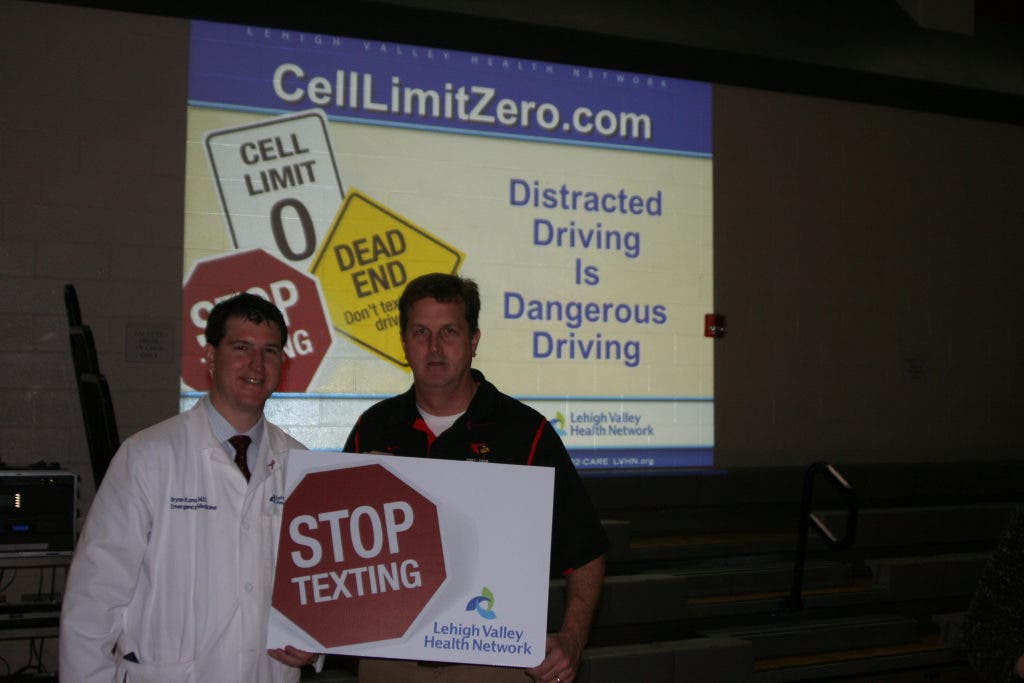

"The thing I need everyone in this auditorium to understand are these three things: for every American between the ages of 1 and 42, the leading cause of death is trauma. So that's your siblings, your cousins, and probably some of your teachers."
That was the sharp statistic Dr. Bryan Kane, of Lehigh Valley Hospital's trauma ward, used to start his presentation on the dangers of driving in front of hundreds of students in the Upper Dublin High School gymnasium Thursday morning.
"Of those Americans that will die because of trauma, the vast majority will die in a motor vehicle crash," Kane continued. "And for each and every high school student in the United States, the leading cause of death is a motor vehicle crash."
Find out what's happening in Upper Dublinfor free with the latest updates from Patch.
A bit scary? Perhaps. But these are the realities that Kane told the students he could personally attest to from his experience with teenage patients in his ward. Using stories from his own past and a number of video clips, Kane connected the dots for the students: inexperience, undeveloped reasoning centers in the brain, distracted driving, and the prevalence of underage drinking add up to the riskiest possible activity for teens.
Kane went on to say that perhaps the most prevalent danger of all of these was distracted driving, usually in the form of cell phone use, although discussions with passengers and fiddling with the radio also were risk factors.
Find out what's happening in Upper Dublinfor free with the latest updates from Patch.
"Four out of every five car crashes occur because the driver wasn't paying attention to what he or she was doing within three seconds of the crash," Kane said.
These statistics were not likely new to the students, but Kane also quieted the room through the use of video interviews with real life teenagers who had felt the effects of distracted driving. One interviewee was a young woman whose sister was killed in a car crash upon reading a text message that she herself had sent, and another was a young man who was disabled from a crash after he had typed the word "yeah" into his phone.
Another video challenged the students to count the number of passes a basketball team made under a bridge. Students cried out "13" upon completion of the video, but the film then rewound to show that a dancing bear had passed through the middle of the players: evidence that true multitasking isn't possible, Kane said.
The presentation was part of a school effort funded by a State Farm "Project Ignition" grant recently awarded to the district. The program, coordinated by the National Youth Leadership Council, selects 25 schools around the country to receive $2,000 to fund safety programs. In addition to the assembly, Upper Dublin students are also working to design awareness programs, such as creating posters and public service announcements.
“Distracted driving has become a major concern for us,” said Bret Stover, Driver Education Instructor at Upper Dublin High School and advisor of the Project Ignition campaign. “We want to take a proactive approach to prevent accidents by teaching students about the dangers of this behavior, rather than a reactive approach after a tragedy. Cell phones have become such an important part of our lives, but they are not compatible with driving.”
On February 24th, the school will also hear from Joel Feldman of Springfield, Pa., whose daughter Casey was killed by a distracted driver in 2009.
Upon competition of the Project Ignition campaign, the district hopes to be named as one of the 10 most effective programs and receive an additional $7,500 to fund longer-term campaigns.
Get more local news delivered straight to your inbox. Sign up for free Patch newsletters and alerts.