Schools
Wood Robotics Team Prepares for Nationals
The team will send 18 students to St. Louis to compete at the FIRST Robotics Championship.


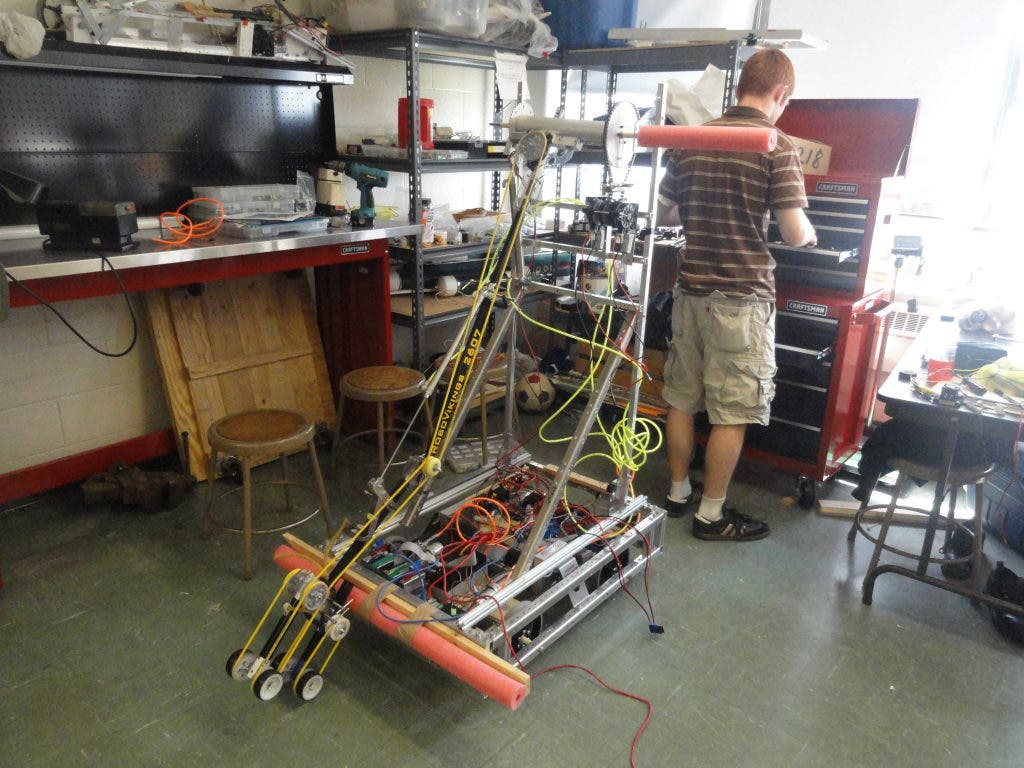


It's a bright, sunny Monday afternoon. Probably the nicest day of the year, so far. Since it's the day after Easter, most schools have off. Most teenagers are probably outside playing basketball somewhere or mowing lawns to make some quick cash.
In the case of a handful of students at Archbishop Wood, they are holed up in the high school, making sure that Goku and Ralph are ready for competition.
Who are Goku and Ralph? They are the two robots that the Wood Robotics Team used to win the Northeast Region FIRST Robotics Competition at Temple University earlier this month, earning the Robovikings a trip to the FIRST National Championship at the Edward Jones Dome in St. Louis, starting today and running through Saturday. It is the first time the Wood Robotics team has made it this far in its short, four-year history.
Find out what's happening in Warminsterfor free with the latest updates from Patch.
"We go in each year with the mentality that we will make it to nationals," said head coach and supervisor Thom Galie, a physics teacher at Wood. "But it's still unexpected to actually get there in just four years."
Like any good football team, the Robovikings have spent the last few weeks tweaking and revising the design plans and programming for Goku, a large, 30-pound device with a grabbing claw, and Ralph, a mini-robot attached to Goku.
Find out what's happening in Warminsterfor free with the latest updates from Patch.
The team received a kit with the pieces and the parameters for this year's game from FIRST in January and had six weeks to design and construct the robot before regional competitions began. Each year carries a different theme for the game, and every team throughout the country is given the same pieces and instructions.
This year, the theme is Logo Motion. The match is played by two competing alliances on a flat 27-by-54-foot field. At the national competition, more than 300 teams will be split into four divisions. Within each division, three-team alliances will be randomly formed and square off in head-to-head competition with another alliance. The object is to hang as many inflated plastic shapes (triangles, circles, and squares) on their grids as they can during a 2 minute and 15 second match. The higher the teams hang their game pieces on their scoring grid, the more points their alliance receives.
The match begins with one 15-second autonomous period in which robots operate independently of driver inputs and must hang tubes to score extra points. For the rest of the match, drivers control robots and try to maximize their alliance score by hanging as many logo pieces as possible.
If teams assemble the logo pieces on their scoring grids to form the FIRST logo (triangle, circle, square, in a horizontal row in that order), the points for the entire row are doubled.
The match ends with robots deploying minibots, small electro-mechanical assemblies that are independent of the host robot, onto vertical poles. The minibots race to the top of the pole to trigger a sensor and earn additional bonus points.
"This is the first time they had a mini-robot component," said Galie. "This is the most complex challenge in many years."
Fortunately, the Robovikings don't have to go it alone. The FIRST organization encourages what Galie calls "coopertition" and gracious professionalism. While the robots are on the floor, it's game on. But when teams are making repairs or are stuck with a design, competitors are expected to go out of their way to help out.
"If you need a tool or piece," said team co-captain Michael Czerwonka, "you go to the pit announcer, who will make the request over the loudspeaker. Within minutes, another team is there with what you need."
The Robovikings also share a mentor relationship with nearby Chestnut Hill Academy, which helped Wood reconfigure the arm after Regionals. The original rules stated that the tubes would be inserted through slots on the opposite end of the field. The robots would drive to the other end, grab a tube and bring it back to hang on the pegs.
However, some of the veteran teams discovered that nothing in the rules prohibited teams from just tossing the tubes over the walls and in the middle of the field.
"It not only cuts down on the time it takes to get the tubes," said Galie. "But you can also litter the field with tubes and trip up the other teams."
Goku was not designed for that kind of pick-up function, which is one reason the team did not place first in the New Jersey Regionals in Trenton, N.J., in March. They quickly recalibrated in time win the Philly Regionals and are still working on improvements.
"That's definitely one thing we improved on over the years," said Steve Hill, chief engineer for the team and one of the original members. "We've become much better at redesigning on the fly."
The team has doubled in size since it first started, from 10 to 20 members. While it hasn't exactly caught fire with the student body, compared to the football and basketball teams, the administration and outer community has been supportive.
"We're budgeted at about $12,000 a year," said Galie. "With the travel this year, we're up to $17,000. All of those funds we have to raise ourselves, through events like bowling nights or sponsorships. We hope to see that aspect get a little easier now, because everybody likes a winner."
Get more local news delivered straight to your inbox. Sign up for free Patch newsletters and alerts.