Health & Fitness
A Bit of Homegrown Modern Architecture in Bristol
In a town with Colonial roots, you might be surprised to find some interesting modern architecture right in its center.
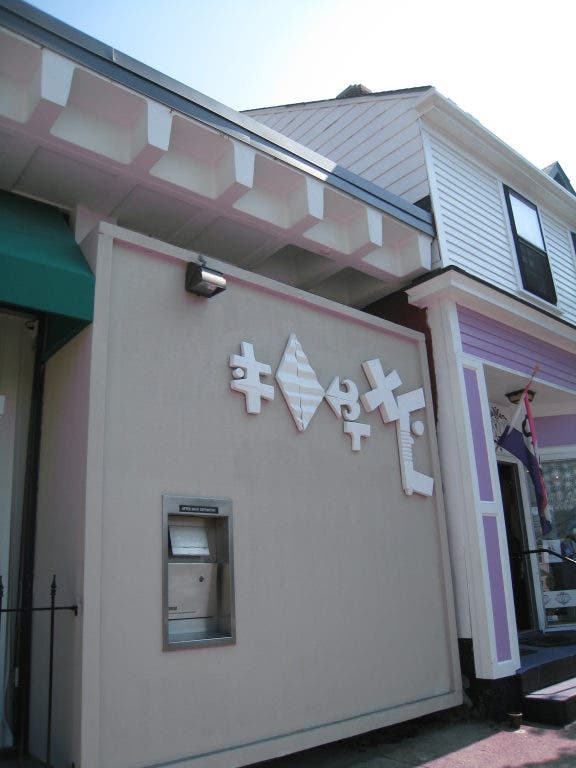


Have you looked — and I mean really looked — at Bristol's architecture? We are blessed with a full spectrum of really neat buildings.
Here's one of my favorites: The Building. Some of you probably know it as the Old Stone Bank (even though it's made of concrete). Yes, that's right, the one on the corner of State and Hope. That's me in front of it. Have you noticed the cool cut-outs? I hope so, because they're really fun.
I like it especially because of what it tells me about Bristol. Obviously, it is not a building from the DeWolfe period — the fact that it's made of concrete dates it to the mid 20th-century. 19th-century architects experimented with concrete as a secondary material. But they didn't start using it as a main building material until after World War I. The Guggenheim Museum in New York by Frank Lloyd Wright, completed in 1959, is one of the most famous concrete buildings. So is the TWA Terminal at JFK Airport, by Eero Saarinen, dating to 1956-62. Built in 1965, the Old Stone Bank was downright trendy.
Find out what's happening in Bristol-Warrenfor free with the latest updates from Patch.
For such a common function, the building was well designed. Its architect was Philemon Sturges, who was a Bristol resident. Sturges trained at Princeton and worked for an architecture firm called The Providence Partnership. He designed a number of significant buildings in Providence, but I think his best work is here in Bristol. In addition to designing the Old Stone Bank, he was the architect of our , into which he incorporated windows salvaged from a pre-existing Russell Warren house. He also remodeled the YMCA building--that's the Tudor-style building is in now--from its 1899 original to its present form.
The cut-outs are the best part of the building. They were designed by Hugh Townley. Townley was a sculptor (that's important--he wasn't an architect) who taught at Brown from 1961 to 1989. You can take a quick look at his other work on his website. The cut-outs give the building some texture and create interest. They also help you overlook some of the mundanities required for a bank building, like the night deposit box. They are a distraction, but in a good way. This is good modern design. It is interesting.
Find out what's happening in Bristol-Warrenfor free with the latest updates from Patch.
What does this building say about Bristol? Bristol in the 20th century was cosmopolitan and followed contemporary architectural trends. It wasn't afraid to take a risk on an important corner in town. And it was willing to invest in its infrastructure. The building also fits into the pre-existing historic buildings in its own, sometimes surprising ways. It doesn't dominate the streetscape, it contributes. This is good management of our town. I like that it says those things about Bristol, and it makes me feel good to walk by it and think about those ideas.
What is your favorite building in Bristol?