Health & Fitness
Meet Bristol's Original Star-chitect
The work of one of Bristol's first and most unique architects can be seen all over town.

Quick! Name one famous architect who worked in Bristol. Got one? Really?
While Bristol has a lot of great architecture, it's not overly well-known for its architects. Here, we are usually eclipsed by Newport. I'll bet you can think of at least one famous architect who worked there. Are you thinking of one now? Is it Peter Harrison?
Peter Harrison (1716-1775) was Newport's first professional architects. He was the first to design buildings that others would construct. Harrison designed a lot of important buildings like the Brick Market (1761ff) and the Redwood Library (1747-50). The key to his success was his library. He borrowed many of his designs from images in his architecture books. In fact, he was so literal in his copying that today we can match the picture to the building. Harrison followed the rules.
Find out what's happening in Bristol-Warrenfor free with the latest updates from Patch.
Bristol's answer to Peter Harrison was Russell Warren (1783-1860). Warren designed a lot of buildings that you would easily recognize. In addition to (1810ff), he also authored the (1838) and the Talbot House (1838). Those are the two Temple-like buildings with the very tall while columns on Hope Street immediately north of the Bank of America.
Warren was not a Bristolian. He was born in Tiverton and moved to Bristol in 1800 at the tender age of 17. After that, he split his time between Bristol and Charleston, SC, where he also practiced architecture. One of his more famous buildings in Charleston is the 1838 Edwin L. Kerrison House. Does it look a little like Linden Place….? Kinda sorta. Trade moved freely between all the major East coast cities in very complicated ways. So did ideas about architecture.
Find out what's happening in Bristol-Warrenfor free with the latest updates from Patch.
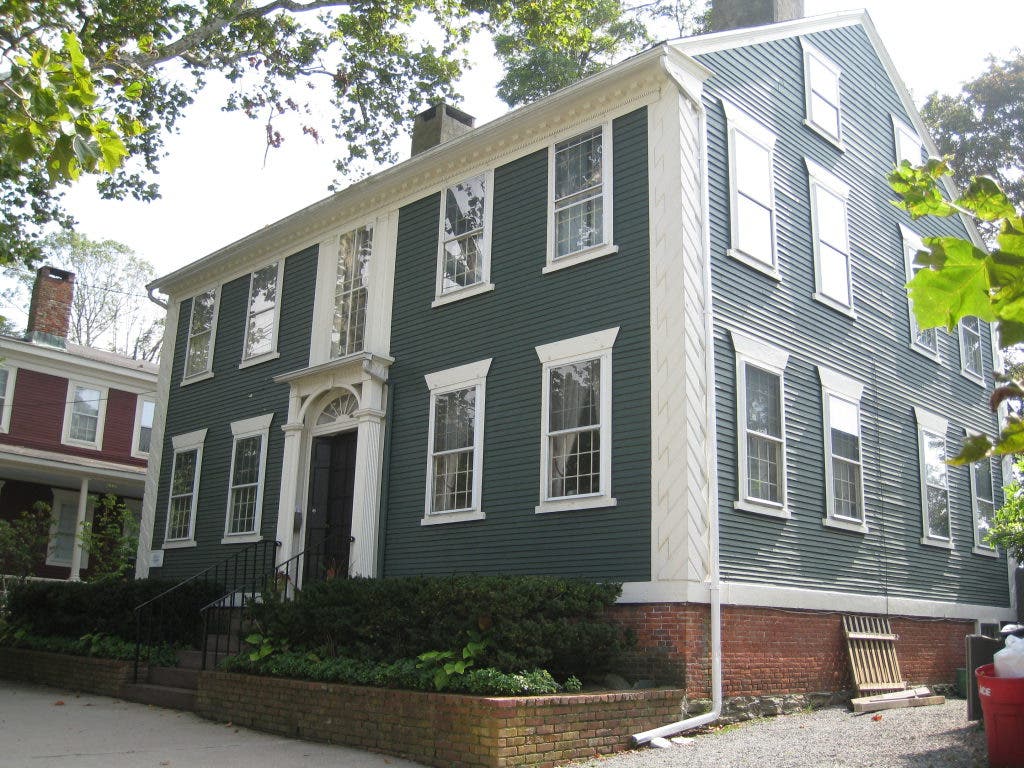
Warren surely also had a library, but he used it much more inventively than Harrison did. Warren liked to mix things up. My favorite is the William Van Doorn House, on State Street (1907-11). Look at the corner of the building. See the quoins? (Pronounce that “coins” as you read it). Those are the things that look like stone blocks running up the corner of the building. They look like they hold the building up, don't they? But, in fact, they do no such thing. They are just applied pieces of wood. At the Van Doorn House, Warren puts them on an angle, forcing them to reveal themselves as the pieces of decoration they really are. How subversive! How cool is it that Bristol's original really was original?
Warren is a fascinating character and I think we should all know him better. If you'd like to learn more, Linden Place Museum is sponsoring a talk and a bus tour by architectural historian Wm. Mackenzie Woodward. The lecture is Thursday, Sept. 29, at 7 p.m. at the and it is FREE. For more information, check out www.lindenplace.org/events.htm.