Health & Fitness
The Roots of Bristol’s 4th of July Celebration
The Bristol tradition of commemorating the anniversary of Independence Day began as a grass-roots movement of religious services to give thanks for the deliverance of the infant nation.
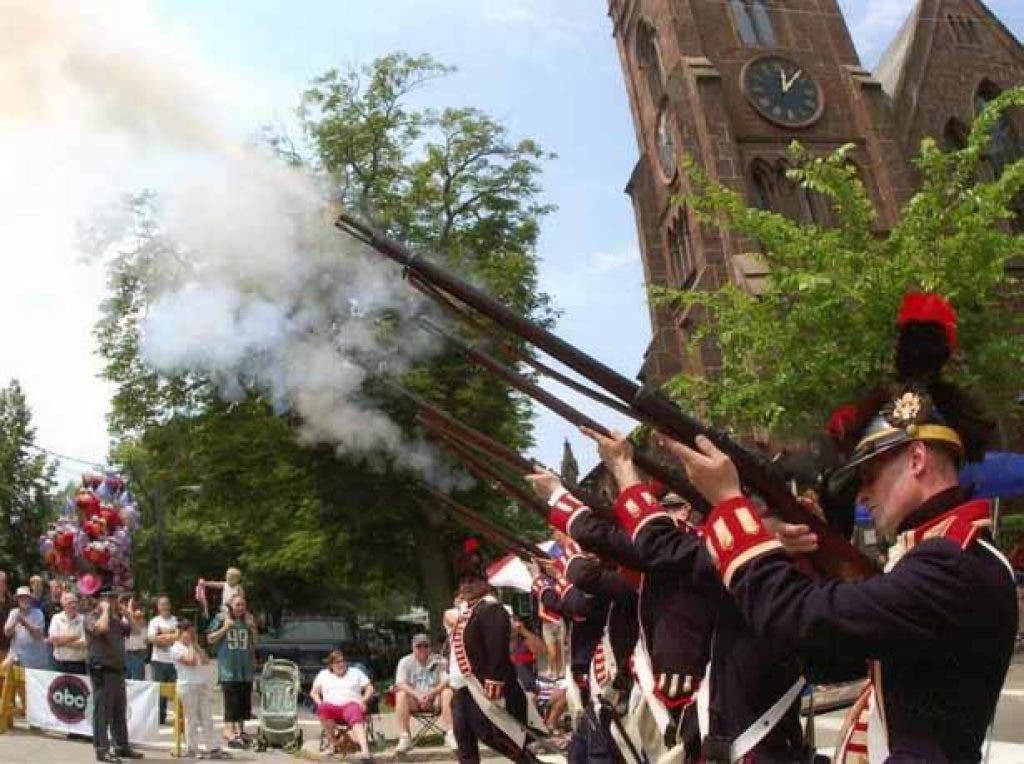
Records Reveal the Foundation of the Tradition.
The Bristol tradition of commemorating the anniversary of Independence Day began as a grass-roots movement of religious services to give thanks for the deliverance of the infant nation.
As the prayer services became popular with the citizens and the program expanded to include patriotic oration and honors to surviving veterans of the war, participants in the exercises usually met on or near the Town Common and proceeded in columns to the Congregational Meeting House.
Find out what's happening in Bristol-Warrenfor free with the latest updates from Patch.
Evidence is abundant and convincing that 1785 is the initial year of an observance of the anniversary of Independence Day in Bristol, Rhode Island. Rev. Dr. Henry Wight was the prime moving force behind those early observances. Rev. Wight was ordained as the pastor of the new (second building) Congregational Meeting House, during the building’s dedication on January 5, 1785. He was the sole pastor of the church until 1815, when Rev. Joel Mann joined him. Rev. Wight remained at his post until he retired in 1828; he died in Bristol, August 12, 1837.
Rev. Wight, a veteran of the Revolution, continued his ministry for nearly a half century, and we learn from W.H. Munro’s The Story of the Mount Hope Lands, published in 1880; “He took an active interest in the political questions of the day....” So, Dr. Wight, a patriot who was politically astute and a graduate of Harvard College (1782) had the credentials as an honored and educated citizen, among the few more than 1,100 residents of the town, to act as an organizing force.
Find out what's happening in Bristol-Warrenfor free with the latest updates from Patch.
Some early newspaper references give conflicting dates (see 1835 below), but the following two quotations document a firm date for the initial celebration of Independence Day in this patriotic old town. There are no other records of such authority extant that establish the date so unquestionably.
- 1785-1836: Dr. Wight gave an appropriate prayer at the exercises held at the Congregational Church for the fifty-first time. Gazette and Companion July 1836.
- 1785-1871: From the year 1785 to the present time, the anniversary of American Independence has with few exceptions, been duly observed by military parades, orations, and public processions. Phoenix*, March 11, 1871.
- 1835: Mr. Bayley, Editor of the Gazette reprinted a letter, written by a Bristol man, which had appeared in an earlier edition of the Providence Journal. It is from this writer's recording of his recalled observations of his hometown’s celebration of the Fourth of July that helps to date its origin. “...In a very fervent and appropriate manner Rev. Dr. Henry Wight, in his 85th year offered prayers to the throne of Grace.., it is stated that the present was the 45th time that he has offered the introductory prayer on similar occasions.” This statement gives indication of an observance in 1790. Plans progressed for the 1835 celebration of the day in the usual time honored way. James Clifford Hidden, Esq., accepted an invitation from the committee to arrange for the music at the hall, he selected some appropriate tunes and secured the aid of a full choir.
- 1835: Arrangements are also in the making by the several Sunday School Managers to have an address delivered to parents, teachers, and scholars. The Young Men's Temperance Society will also celebrate the day by having an address, and a public dinner. Gazette and Companion, Saturday, June 20.
- The Committee of Arrangements for celebrating the 59th Anniversary consisted of three gentlemen who answered the call to meet on June 15, they were: Jacob Babbitt, Jr., W’m B. Tilley, and J.R. Bullock. Gazette and Companion, July 4.
- The members of the Temperance Society, together with invited guests, sat down at half past one o’clock, to a dinner at Burgess’ Temperance Hotel. The table was loaded with all the luxuries and dainties of the season, served up in a very superior manner. Ardent spirits and wines of all kinds were excluded from the table and pure water and coffee substituted in their place. Gazette and Companion, July 11.
- 1836: The Gazette and Companion in its report concerning the 1836 celebration offers compelling evidence of an observance in 1785. The 4th of July was celebrated in this town with the accustomed honors and festivities. At ten o’clock the procession formed in State Street under the direction of Marshals Messrs., N. Fales and J.W. Dearth, in which the Independent Train of Artillery, the surviving soldiers of the Revolution, the civil and military officers of the State and a large and respectable body of citizens took respective stations; it then moved through several of our principal streets to the Congregational Meeting House. After a most impressive and appropriate prayer by the venerable Dr. Wight, himself an actor in our revolutionary scenes, and who officiated now for the fifty-first time Mr. J.C. Hidden admirably read the Declaration of Independence. Gazette and Companion, Saturday, July 9, 1836.
- Dr. Wight and Mr. W.H.S. Bayley must have known each other. There is an overlap of almost five years between the premier issue of Bayley’s weekly newspaper and Dr. Wight’s death. It is conceivable that the torch that fired Dr. Wight’s ability to organize was passed to Mr. Bayley. Each of these gentlemen controlled powerful platforms from which to promote and perpetuate the Fourth of July celebrations.
*The newspaper’s name PHENIX was spelled without the letter O until 1850.