Health & Fitness
The Roots of Bristol’s 4th of July Celebration: Part X
U.S. Navy warships present in Bristol Harbor for our Fourth of July celebrations are upholding a tradition begun on the Centennial of American Independence in 1876.
U.S. Navy warships present in Bristol Harbor for our Fourth of July celebrations are upholding a tradition begun on the Centennial of American Independence in 1876, when a three masted steamer, the United States Sloop of War JUNIATA, came to Bristol.
The one hundredth anniversary of the signing of the Declaration of Independence was cause for an exceptional celebration in historic old Bristol because the old town had felt the pains and anguish of the war firsthand; in 1778, the town was bombed, burned, and sacked by the British. For the centennial, the Arrangements Committee requested the towns-folk participate in a grand illumination on the Night Before. All the homes, shops, and public buildings in the central part of town were ablaze with Japanese lanterns. The crowning event of the festivities was the arrival of the town's first U.S. Navy visitor, the JUNIATA. The ship, a heroic Civil War veteran, arrived for Bristol’s celebration from Bermuda by way of Baltimore after returning from her European Station occupied since May 1874
The Phoenix exclaimed,
Find out what's happening in Bristol-Warrenfor free with the latest updates from Patch.
During the morning, the United States sloop of war JUNIATA, Captain S. Dana Greene, [commanding], arrived in our harbor from Bermuda . . . being finely decorated with flags, signals and streamers, attracting much attention by its beautiful appearance and adding much to the pleasure of the day. A representation of her compliment of 160 was present in the parade.
Although there are some gaps in the Navy’s presence in Bristol, Rhode Island, on the Fourth of July, eventually almost every type of warship from submarines to battleships, guided missile cruisers, destroyers, mine sweepers, and even seaplanes have graced our harbor over the years.
Find out what's happening in Bristol-Warrenfor free with the latest updates from Patch.
The next time a warship paid a visit to Bristol on the Fourth, was in 1910, at the specific request of Colonel S.P. Colt. It was the centennial of Colonel Colt’s mansion, Linden Place, when the Cruiser TACOMA steamed into Bristol Harbor with her guns booming a salute to the Fourth and (we assume) Colonel Colt. The TACOMA sent 125 men to march in the parade, some of whom later engaged the local naval reserves in a cutter race.
Visiting Bristol by the Spars of the USS LOUISIANA may not have been considered good duty, because on each of her visits in 1912, and 1913, she met with near catastrophe.
As she steamed slowly past the south end of Hog Island on July 1, 1912, the battleship stuck her prow into the sandbank called Middleground; she hung there for the rest of the day waiting for high tide to float free. Later in the afternoon at high tide and after her weight had been lightened by the removal of ammunition into a scow, she floated free and anchored off Bristol Ferry lighthouse.
Again assigned to Bristol for the Fourth in 1913, the LOUISIANA suffered a mishap, just as she was leaving Newport, an explosion blew off a valve bonnet below the waterline and threatened to sink the vessel. Divers plugged the hole, made temporary repairs, and the mighty ship came to Bristol for the celebration.
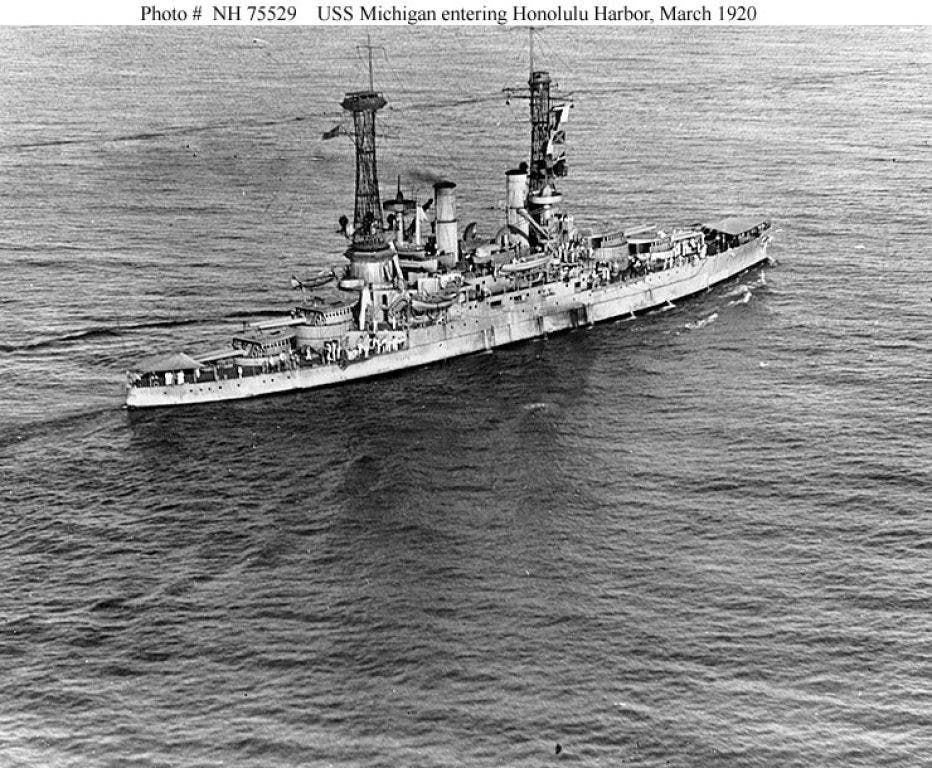
In 1915, the Battleship MICHIGAN anchored in Bristol Harbor and sent a contingent of 400 sailors and marines to march in the parade. The Fourth of July Committee entertained the commander, Captain Niblack, the officers, and visiting dignitaries including Governor and Mrs. Beekman at a clambake at Prospect Farm. There was a general inspection of the ship on Saturday and Sunday and thousands of citizens visited, and many were entertained at lunch with the officers.
The men from the MICHIGAN also enjoyed the hospitality of the town and made liberal use of their shore leave to live-it-up, as we read in the Phoenix,
Considering the reckless manner in which fireworks were discharged on the streets by the bluejackets from the Battleship Michigan it is fortunate that no serious accidents occurred.
The men from the ship were bent on celebrating in a big way and they did so. Large purchases of fireworks, rockets, etc., were made and not much attention was paid where or in what direction they were discharged.
The newsboys and boy scouts fared well by the generosity of the men of the battleship. Saturday night one of the scouts was met by several of the bluejackets who bought the youngster fire crackers, sky rockets, banners, candy, fruit, etc., until the boy could carry no more. The ship’s men also gave liberally to the boy scouts who held their annual tag day Saturday. The scouts raised $107.
There was a ball game on the Town Common between a picked team from Bristol and nine from the battleship, the game was the center of attraction for the afternoon. The Bristol team won 7 to 1.
Another battleship the USS KANSAS, was in Bristol in 1916, with a crew of eight hundred fifty-six men to help celebrate the Fourth. This year the ship was in full view from all the wharves; it was anchored just south of Pappoosesquaw Point (Poppasquash was still called by that name in 1916). For the past few years the ships were anchored southeast of Hog Island.
On the night before, Chief Marshal R.F. Haffenreffer, Jr., gave a dinner dance at the Hotel Belvedere in honor of the ship’s Commander, Captain Hutchinson, and about 20 of his officers. Members of the Town Council, the Fourth of July Committee, Marshals of Parade Divisions, and a few citizens of the town were also guests. After dinner the party adjourned to the sun parlor of the hotel and enjoyed dancing to the music of the six-piece Crown Orchestra. Many ladies from Bristol and nearby towns were on hand to meet and dance with the officers.
Captain Hutchinson returned the hospitality of the town by providing a concert by the ship's band from the balcony of the hotel for two hours in the evening and throngs of people enjoyed it.
The KANSAS’ Officers had planned to entertain a number of prominent citizens on board the ship on the afternoon of the Fourth with a dance, but bad weather put an end to those plans. However, Colonel Chessman chartered the steamer MINNIE V. POPE and took the Caledonian Societies, with their Scottish Pipe Band, to the battleship, where they spent the afternoon singing and parading the deck.
On the evening of the Fourth the KANSAS was dressed for the holiday. Thousands of colored electric lights were strung on her hull and from her fire control towers, which when lit presented the outline of the vessel; it could be seen for miles down the bay.
The boys from the battleship had plenty of money when they came ashore and considerably less when they returned. They didn’t exactly buy the town, although one storekeeper says two bluejackets came into his store about 11 o’clock on the night of the Fourth and wanted to buy all the fireworks he had, and set them off in the window. They agreed to pay for any damages. Needless to say that they were refused. As usual a police patrol of about 20 men from the ship on the night before the Fourth, kept good track of the men, sending some of them, who were a little unruly, back to the ship.
There was a base ball game on the Town Common on the afternoon of the Fourth between the Bristol team and a team from the KANSAS. Notwithstanding the fact that a drizzling rain fell during the entire contest, a large crowd watched the game. The game was interesting up to the seventh inning, when the score was tied at five runs. In the first of the eighth, however, the sailors hit the ball hard, and the Bristol team made many errors, the combination netting six runs, and giving the KANSAS men a victory by a score of 11 to 5.
In 1919, the Navy Department assigned two seaplanes from Chatham, Massachusetts to Bristol for the Fourth. People in this section had the opportunity of witnessing ‘stunts’ and some entertained the thought of possibly given the rare privilege of an aerial ride.
It was widely reported in 1920, that six destroyers visited Bristol for the Fourth. However, there is scant information about the visitors except the following report found in the Phoenix dated Tuesday, July 6.
A party of seven sailors, said to be from the U.S. destroyers created considerable disturbance on Bradford Street Sunday night. They fired Roman candles against windows and the home of Stephen W. Hopkins [a descendent of Stephen Hopkins the Rhode Island delegate to the Continental Congress who was a signer of the Declaration of Independence], and they threw a discharged Roman candle butt through a windowpane.
Uncle Sam’s Navy was represented in Bristol in 1922, but the names of the ships are unrecorded. We know that ships were here because the Phoenix report on the block party states,
Thousands of spectators watched the merry dancers. Sailors from the destroyers took part in the dancing and found no lack of Bristol girls for partners. The commanding officers of the two war vessels were much pleased with this feature of the entertainment for the `bluejackets' and said Bristol was one of the few towns visited where the men were entertained like citizens instead of being looked upon as mere sailors.
The 1923, celebration must have been an exciting one for the children of Bristol. In addition to the Destroyer USS WILLIAMSON, the first submarine boats to lend their support to a celebration anchored off the Church Street wharf; they were the Submarines 48 and 49. The submarines were visited by young and old and all who saw them were thrilled.
Chief Marshal Charles B. Rockwell, Jr., entertained ten of the ship’s officers at a dinner party on the night before, and Colonel Chessman provided a clambake for the ship’s crews after the parade.
The 150th anniversary of the Declaration of Independence in 1926 brought out one of the largest military contingents ever to take part in the parade. The Cruiser USS TRENTON was present and Army units and men from the Naval Training Station in Newport joined her officers and men. The parade was made extra long with the addition of many colorful floats.
A two day celebration was planned in 1928; the USS WRIGHT, flagship of the US Aircraft Squadron’s Scouting Fleet made her second visit to Bristol waters, accompanied by her tender TEALL and 11 seaplanes. Large numbers of citizens took advantage of the opportunity to inspect the ships and planes during a general open house.
In depression-ridden 1932, there was no town appropriation for a celebration, and there was no navy representation. But, on Monday, July 3, 1933, the Destroyer USS MANLEY dropped anchor in Bristol Harbor, and two launches were kept busy conveying visitors to and from the ship.
Members of the MANLEY’s crew crossed bats on the common with a team made up of players from the local Twilight League, and on the afternoon of the Fourth there were more sporting events to hold the attention of the thousand who lingered in town after the passing of the seven division parade.
The Destroyer USS HAMILTON came to Bristol for the first time in 1935, again in 1937, and in 1938. On her first visit a team from the crew took a sound whipping from the bats of Don Langello’s All-Stars, 9 - 0. The Phoenix attributed the sailor’s loss to the difficulties in holding baseball practice on shipboard. During the HAMILTON’s next two visits, the 100 men and officers dispatched from the destroyer were tended receptions by the committee and towns-folk, and they marched in the parade on the Fourth.
Also in 1938, 300 men, with a band and color guard from the Naval Training Station, and a detachment of soldiers from Fort Adams were a large part of the Grand Military, Fireman's and Civic Parade.
The official kickoff of the 1939, celebration was Sunday, July 2, with the arrival of the Submarines R-2 and R-10 into Bristol Harbor. The Phoenix exclaimed,
Latest of Uncle Sam’s undersea fighting forces, the R-2 and R-10 carry complements of three officers and 35 men each. They will anchor either at the Church Street or Yacht Club wharf and will be open for daily inspection.
The R-10 arrived at 3 p.m., and the R-2 at 7 a.m., July 4th. The two craft moored alongside each other at the Light House Service Pier (Coast Guard Aid to Navigation Station).
At 3 p.m., Wednesday, July 3, 1940, the Submarine USS R-4 and the Destroyer USS HUMPHRIES arrived to add their might to the two-day celebration. What a striking contrast in size and shape the two craft must have made as they lay silhouetted against the Poppasquash peninsular.
Because of the tense world situation at the time, with war clouds looming on the horizon, the visiting vessels were in a state of readiness, and acting under orders from Fleet Command a general public inspection was prohibited.
Few suspected that this year would be the last for US Navy representation in Bristol on the Fourth of July until 1946. This was least of all suspected by some members of the Fourth of July Committee who said; “We ought to write back (to the Navy Department) and ask them to send a whole flock of submarines.” Another committee member suggested that seaplanes and destroyers should be added to the flotilla.
With the war emergency ended, two returned veterans, the warships USS JOSEPH P. KENNEDY, JR., and the USS O’HARE were assigned to Bristol for the 1946 holiday. The 170th anniversary was dedicated to honoring the returned veterans of Bristol from World War II.
The KENNEDY came again in 1947, along with the Destroyer USS JOHNSTON, both ships anchored off Poppasquash Point.
Again the US Navy was well represented in 1948, by the sailors of the Destroyers USS RICH and USS PERRY. The sailors had no doubt heard about the ability of the Bristol baseball teams, because they sent advance word to the committee that they were “eager to grapple” each other in a baseball match, and they challenged any other teams that would like to try their luck. When the ships arrived on Saturday afternoon, they anchored off Poppasquash Point. Town Council President Rear Admiral Hoover (USN Retired), when informed that Admiral Price was in town for the Fourth, exclaimed: “Admiral Price is an excellent speaker and a fine gentleman. I am delighted that he is coming and I think we are very fortunate to secure him for the celebration. He has been my personal friend for many years.”
With the routine established of sending two destroyers to Bristol, the Navy sent a pair of ships each year, for ten consecutive years, 1946-1955. For the 175th Anniversary in 1951, the Destroyer Escort USS BRISTOL made her first of five visits to her anchorage in Bristol Harbor. This time, the Destroyer USS HYMAN accompanied her.
The 1959 celebration moved into high gear at 2 p.m., on the Third when the Destroyer USS GLENNON moored in Bristol Harbor, preceded by the booms of her saluting gun. Later, Commander David P. Wynkoop, Captain of the ship, and his executive officer LCDR Mariano Bucolo, a Bristol native, attended a reception at the yacht club. Others at the reception included town dignitaries and visiting foreign naval officers from the Naval Supply Depot in Newport. Following the reception, all the officers and guests attended a buffet supper at the High Street home of Edward and Marion Newbold. Marion, a veteran member of the celebration committee, was instrumental in organizing the first Fourth of July Ball.
There was a large naval presence in town for the 1961 celebration and parade. Both U.S. Navy land and sea forces were here to show the colors. The Destroyer Escort USS LESTER was our honored guest, and her crew formed the nucleuses of marchers for the Navy Division. The US Naval Supply Depot, Newport, entered a float which was a stylized missile fashioned entirely from colored tinsel paper that fluttered on its vehicle as it rolled along. Another US Navy float was entered by the Naval Underwater Ordinance Station, Newport, “A Torpedo Attack Guided by Sound.” The Station’s float and the Depot's float took first prize trophies. (Because of strict prohibitions, prizes of cash may not be accepted by US Military organizations; however a trophy may be accepted, a far less expensive alternative for the Committee.)
We learn from the Phoenix dated July 7 that one of the best marching groups was the Annapolis Midshipmen from the Cruiser NEWPORT NEWS berthed at the Newport Naval Base. Overall the Navy Division looked very smart and received the well-deserved applause of viewers all along the parade route.
The USS HAMMERBERG was Bristol’s guest from June 27 to July 4, 1964. Her commanding officer was Bristol native LCDR Lucien Capone, Jr. The HAMMERBERG is the only USN surface man of war commanded by a native Bristolian to anchor in Bristol Harbor during the celebration.
LCDR Capone was taken by complete surprise when at the Patriotic Exercises on the steps of Colt Memorial High School, his alma mater, Governor John H. Chafee read orders promoting him to full Commander. Capone eventually retired from the Navy with the rank of Rear Admiral.
1966 brought the USS BRISTOL here for the fifth time in her career. The Submarine USS TRINGA and the Destroyer Escort USS PIPER were also here for the celebration. All three ships had marching units in the parade, and they were joined by a contingent of U.S. Navy midshipmen from Annapolis and a platoon of Australian sailors whose ship was visiting Newport.
The visiting ship in 1972 was the USS KOELSCH from Newport. The committee rode to the naval base on buses and steamed up Narragansett Bay into Bristol Harbor aboard the KOELSCH. They were treated to a buffet style luncheon aboard the ship before taking the two-mile ride in a launch from the anchorage near Hog Island to the State Street dock.
The committee hosted two receptions for the ship’s officers and a picnic at Mount Hope Grant (King Philip’s throne) for the men and dependents of the ship. One hundred and eleven people were entertained at the outing.
Bristol native Rear Admiral Lucien Capone, Jr., was Marshal of the Navy Division for the 1975 parade. Marching units included men from the two visiting ships, the USS DASH and the USS ADROIT; Naval Officer Candidates from Naval Education and Training Center, Newport; The Officers Candidate School Color Guard; and the Northeast Navy Band.
The 1978 parade was awash as a drenching rain fell during the entire march. The 15-member unit from the Naval Education and Training Center, Newport, marched, dripping wet without the benefit of rain-gear; they wore uniforms of white short sleeve shirts, white belts, white caps, black pants and very shiny black shoes. “We just got the order not to were raincoats. So we didn’t wear them,” said Operational Seaman Specialist David A. Hirst, as others in his unit expressed obvious bewilderment at the order. They looked enviously at nearby members of the USS DASH crew, all of whom wore raincoats.
The U.S. Navy’s detachments from the Naval Education and Training Center to Bristol in 1980, marched with the companionship of fellow sailors from the visiting USS LABRADOR, a 102-foot torpedo retriever from the Naval Underwater Systems Center, Newport.
Although the HMS ESKIMO, a 360-foot British frigate docked in Providence rather than Bristol, she dispatched three crack marching units, numbering about 50 to the parade. The British Embassy brought in her Majesty’s Royal Marine Color Guard especially for the Fourth. Her Majesty’s Royal Navy Color Guard from the ESKIMO joined them. The crowd jumped to its feet all along the parade route to applaud the smart-stepping sailors and marines from the British ship, ignoring the fact that the British raided Bristol twice during the Revolution.
Two young boys, Robert Lewis, and his friend Gary Conway, both from North Branford, CT, who were visiting Robert’s aunt and uncle in Bristol were accidentally shanghaied by the LABRADOR.
The boys decided to pay a call on the on the Navy vessels docked at the Coast Guard Station across the street from the home they were visiting. Approaching the ships, the pair asked a crewman of the LABRADOR if there was going to be a tour, and the response was, “Yes we’re going on tour in a few minutes.”
Taking that as an invitation to come aboard and inspect the vessel, the boys took full advantage of the opportunity. Their ‘tour’ led them to the ship’s engine room where they became engrossed in conversation with another crewman. An hour and a half later the boys decided they had seen enough of the ship and climbed on deck only to discover rather than the familiar Bristol shoreline, a view of Newport as the ship headed out to sea.
When the boys asked when the ship was going back to Bristol, and the answer was that they were proceeding to New London, it became apparent to both the tourists and crew that something was amiss. The LABRADOR made a sudden unscheduled stop at the Newport Naval Base to put its two young stowaways ashore.
What a story the two lads must have told when they returned to Connecticut. Besides the shanghai, they could even boast of a second sea voyage aboard the Bristol Coast Guard's 21-foot launch which was dispatched in pursuit of the LABRADOR to retrieve them.
With the return to Newport of the big warships, Bristol looked forward to obtaining a significant navy vessel for the 1983 celebration; the town was not disappointed. The KNOX Class Frigate USS CAPODANNO, commanded by Commander Robert Anderson, brought his 10-year old fighting ship with a crew of 235 men and 17 officers to anchor near Hog Island on July 2.
The haze and stiff winds on the afternoon of the 2nd., caused the official marine welcome of the CAPODANNO to be canceled, but the Sunfish regatta from the yacht club went on as scheduled. The regatta sailed out of the harbor and around Hog Island. Reports were that the visiting sailors enjoyed the sight of the little craft skipping through the choppy water.
The CAPODANNO’s enlisted men were treated to a field day of food and sports at the Columban Father's grounds on Ferry Road.
At the Patriotic Exercises, on the morning of the Fourth, Town Administrator Thomas H. Byrnes, Jr. presented the seal of the town to Captain Anderson for display in the ship. The exchange of citations and plaques by the visiting skippers and high town officials has been a traditional ceremony since warships again began visiting this port after 1945.
The men of the CAPODANNO participated in the parade with a color guard and marching unit. The Officer Candidate School, Newport, provided a band and a 90-member marching unit and a color guard.
The Destroyer USS CONNOLE, Commander Roy Twaddle, Captain, was anchored off Poppasquash Point during the 1985 celebration. The officers and men of the CONNOLE received the usual hospitality of the town.
Commander Twaddle sent the following letter to the Phoenix:
Please extend the appreciation of the crew and myself to the marvelous men and women of Bristol who made this Fourth of July a most enjoyable and uplifting occasion.
My men were treated with warmth and respect, and at every opportunity the people of Bristol demonstrated how proud they were to be Americans entertaining American sailors.
Thank you very much for providing the CONNOLE the opportunity to share the finest Fourth we have ever experienced.
For the Bristol’s 200th Fourth of July celebration in 1985, the Frigate USS VALDEZ (named for Vietnam War hero Petty Officer Phil Isadore Valdez), commanded by Commander Lawrence L. Wagenseil, anchored off Poppasquash Point. As she dropped anchor, the 438-foot ship fired a 19-gun salute in honor of the town's celebration.
When the VALDEZ steamed into view of the Bristol Coast Guard station, crewmembers, many in dress-white uniforms, and more than 200 of their family and friends crowded the rail. It was a rare opportunity for the civilians to be aboard the ship while under way.
The Bristol extravaganza was in full swing by the time the men of the VALDEZ came ashore; in addition to the enlisted men’s party there were plenty of activities to attract their attention. The VALDEZ’s executive officer, Joseph White said that crewmembers' participation in the parade and other Fourth of July activities was strictly voluntary. Sailors and their families from Newport were served hundreds of hot dogs and hamburgers and all the fixin’s at the Columban Father’s grounds, and the officers and town fathers enjoyed a reception at the Bristol Yacht Club.
Beginning in 1876, with the visit of the Sloop of War JUNIATA, until the present day, U.S. Navy vessels have found a safe haven and a welcome port in Bristol waters. The Town of Bristol Rhode Island, embraced by the sea on three sides, with a history of ship building and sailing from the West Indies to Africa and the fabled Nothwest Passage, understands seafaring men and welcomes them not just on the Fourth of July but everyday.