Business & Tech
25 Years: Leonard a Hair Transplantation Pioneer
Dr. Robert Leonard, one of the foremost hair transplantation surgeons in the world, is celebrating his 25th year in business this year. His office is a fixture on the busy Reservoir Avenue corridor.


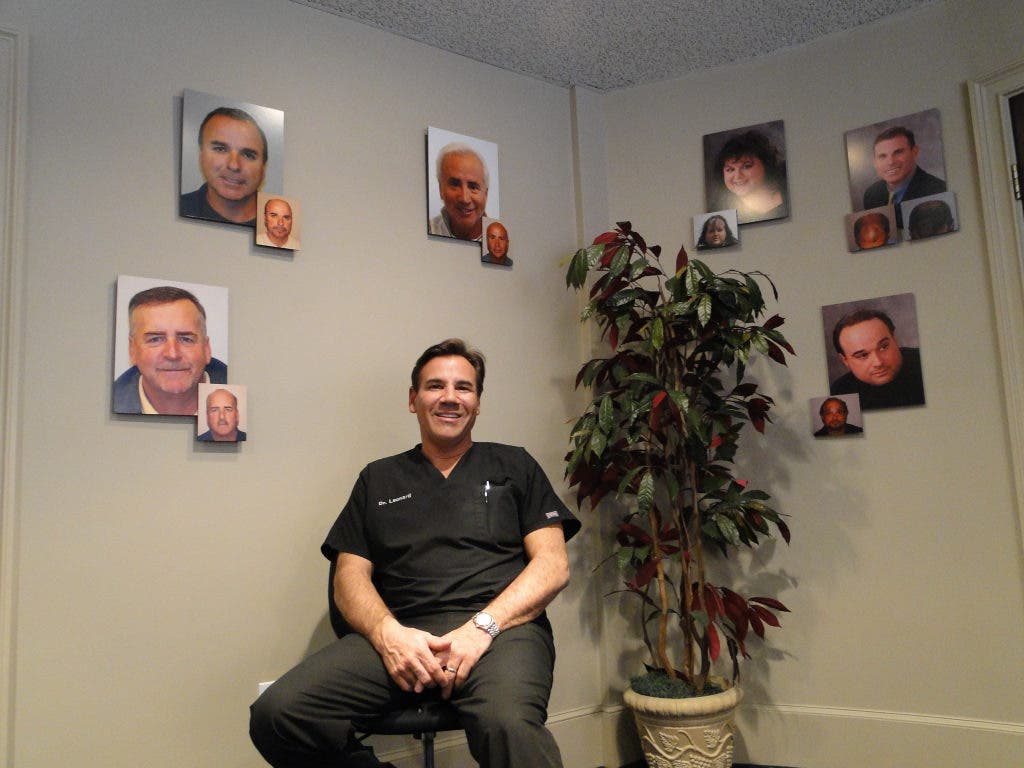


Dr. Robert Leonard, a man who sits at the top of an industry he helped pioneer, is celebrating 25 years in the field of hair transplantation this year.
Leonard is a highly-respected master of his craft — surgically moving two or three hairs at a time from one part of the body to another. He has remained at the cutting edge technologically as well as medically, as Rogaine, Propecia and laser therapy have become effective tools to slow, stop, and sometimes regrow hair.
It’s a field that has gradually legitimized itself to the general public and other medical practices after an early era marked by at-times misleading promotions or business practices. Today, doctors like Leonard offer personalized service and will turn away unsuitable candidates.
Find out what's happening in Cranstonfor free with the latest updates from Patch.
“Sometimes non-medical people, sales guys were involved and bringing patients to the doctor,” Leonard said. “Sometimes things were said to patients and they weren’t very accurate.”
Things have changed in 20 years and a lot of it has to do with Dr. Robert Leonard.
Find out what's happening in Cranstonfor free with the latest updates from Patch.
Early on, he and a group of other doctors realized the need for a society of fellows to impart a code of ethics and share best practices.
They established the International Society of Hair Restoration Surgery and it is now the biggest organization in the world for the field.
Leonard was a volunteer at the founding meeting in 1993 and was elected as a founding secretary. He was elected president in 1995 and has served on the board for years.
“I jump into something with both feet,” Leonard said in a recent interview at his office, which makes up for a lack of paintings with dozens of before and after photos of happy clients. “Things are a lot better than they were 20 years ago,”
Hair transplantation surgery was first performed by the Japanese in the late 1930s, Leonard said. They had refined a technique that “got lost to history after World War II.”
In 1959, an American doctor essentially created the field of hair transplantation when he proved the theory of donor dominance, which means if you transplant tissue, it will maintain its integrity and survive wherever its put.
Most people over 40 or 50 think hair transplantation means plugs, “big pieces of tissue from the back of the head, like pencil erasers and they grew in like a Barbie doll,” Leonard said.
Instead, the same miniaturization that shrunk computers from room-sized behemoths into iPhones transformed the field of hair transplantation surgery.
Yesterday’s plug is now a tiny graft of not more than three hairs. And with pinpoint microsurgery, any hair growing on your body can be moved to another part of your body leaving no scar, no trace.
“There are people that you know today that [have had hair transplantation] but you don’t even know it,” Leonard said with a smile.
When Patriots Quarterback Tom Brady’s car was spotted outside Leonard’s office last year, rumors swirled that the superstar quarterback was looking to preserve his locks long into retirement and when he's forced to ditch the gridiron hardhat for a different job. Leonard will neither confirm or deny or even acknowledge that Brady, a friend of Brady or anyone is a client.
But Leonard does have numerous high-profile clients, many who fly through T.F. Green Airport and take the easy trip over Route 37 to get to his office. They stay in local hotels and might go shopping in Garden City. It’s good for the local economy, Leonard said.
He bought his building, a former DEPCO property, from foreclosure after the credit union crisis in the early 90s and opened. It sits along a stretch of well-groomed, high traffic commercial road. Doctors and lawyers offices are interspersed between regal glass and brick towers.
“Moving to Cranston was the best move that I ever made,” Leonard said.
To say the person who seeks hair transplantation surgery is vain, or superficial, is to miss the point, Leonard contends.
Hair transplantation surgery is a way to “bring out the difference between what one feels inside to what a guy sees in the mirror: a bald guy looking back at him,” Leonard said. “That mismatch is corrected.”
It’s hard to enjoy living life when your sense of self image is sidelined. Psychologically, it affects someone’s drive, vigor, willingness to fully engage in the world.
It also affects how the world views you, Leonard said.
“When you see a guy wearing a cap he looks like a certain age, and when he takes it off, he looks much older,” Leonard said.
For a young man in his 20s, he might see hair loss in his father, uncles and grandfather.
“They know it’s going to be them some day,” Leonard said.
Rogaine, Propecia and laser therapy are ways to combat genetic hair loss. In most cases, the loss is stopped completely. Sometimes, hair actually grows back. About 66 percent of Propecia users see regrowth in the back of the head and Rogaine foam regrows hair about half the time all over the head.
Laser therapy is the most effective — and expensive. Ninety-percent of patients see a halt in the progression of hair loss and half see regrowth.
“These are tools that do an excellent job to stop the further progression of it,” Leonard said.
These treatments address the fact that hair loss isn’t actually hair loss. One doesn’t actually lose any hair. What happens is the follicle begins to shrink. What starts as thick, robust hair gets thinner and thinner, shorter and shorter. Someone who is bald still has these tiny hairs below the scalp.
Not everyone is a good candidate for the surgery. Someone with severe baldness and a small donor area will not be candidates, or have to settle with just the frontal area.
“I’m realistic with my patients,” Leonard said.
The most common transplantation procedures harvest from the back of the head. It begins with lifting the hair up and shaving a half-inch wide row of hair. Local anesthetic is applied and the doctor surgically removes a strip of skin with the follicles in it. It’s submerged in salt water and the skin is stitched up.
The stitches are hidden by existing hair. Leonard’s staff dissects the skin under magnification into tiny grafts of one to three hairs each. They’re organized in the salt water and after marking the transplant area, the grafts are surgically implanted.
After, a “shampoo and you go home no bandages nothing,” Leonard said.
A week later the stitches come out. The transplanted follicle will grow about a quarter-inch and then falls out.
After that, “the magic three months” go by and the follicle begins producing new, normal hair. It will continue growing as if it remained on the back of the head.
“God figured it out before we did,” Leonard said. “We just figured it out as far as a timetable.”
The field is constantly advancing in terms of technology and technique. Recent advancements include a method to extract individual follicles known as micrografting. Any hair on the body is a candidate for transplantation.
Hair transplantation services don’t come cheap. Neither does the cost of Propecia, at about $70 a month, or laser therapy, which can cost $1,700 to $3,500 for a year-long program. But for many people, the prospect of stimulating follicles to regrow hair and transplantation surgery is worth it.
“It’s a part of your body you have no control over,” Leonard said. “If you’re overweight, you can lose weight. With hair loss, there’s nothing you can do other than see me.”
And for 25 years, plenty of people have done just that.
Get more local news delivered straight to your inbox. Sign up for free Patch newsletters and alerts.