Arts & Entertainment
National Endowment for Arts Chairman Tours Rhode Island Philharmonic
U.S. Sen. Sheldon Whitehouse and National Endowment for the Arts Chairman Rocco Landesman talked federal funding with members of the Rhode Island Philharmonic Orchestra and Music School Friday.
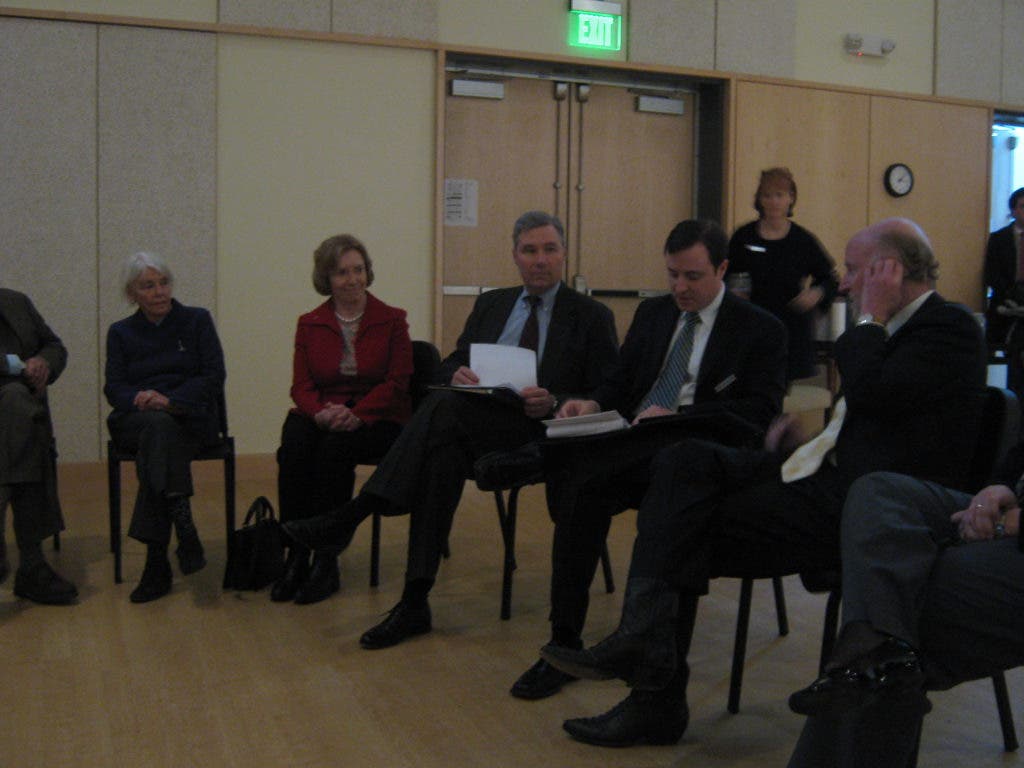


On Friday afternoon, U.S. Sen. Sheldon Whitehouse and National Endowment for the Arts (NEA) Chairman Rocco Landesman sat in a dimly lit performance hall in East Providence, watching Jonathan Elyashiv, Kendall Francis and Jonathan Gómez play the bass, the piano and the saxophone with the ease of professionals.
The performance hall was located in the Carter Center for Music Education and Performance, the Rhode Island Philharmonic Orchestra and Music School building on Waterman Avenue. The three instrumentalists, despite their advanced skill levels, are 17, 16 and 15, respectively. Two of them are students at . Elyashiv is undecided on where he will apply to college, but Gomez and Francis hope to attend The Juilliard School and Berklee College of Music.
Whitehouse invited Landesman to East Providence as part of a tour of the arts scene in Rhode Island. The visit was meant to highlight how artists can revive the economy and create jobs while also providing the intangible benefits of art to the community.
Find out what's happening in East Providencefor free with the latest updates from Patch.
After the performance and the tour, Whitehouse and Landesman sat down with the student performers, teacher and Executive Director David Beauchesne to discuss how Rhode Island can keep or increase its federal arts funding in coming years.
In this economy, securing funding can require showing the connection between arts organizations and job creation, Whitehouse said.
Find out what's happening in East Providencefor free with the latest updates from Patch.
“Because Washington’s focus and most of Rhode Island’s focus is on the economy and rebuilding the economy, we need to give examples where the link between art and jobs is strong,” Whitehouse said.
“Artists are entrepreneurs, part of the real economy,” Landesman said. He added that he saw Rhode Island as a center for the arts.
“On a per capita basis, there’s no question in my mind that Rhode Island has more people engaged in the arts than anywhere else in the country. Rhode Island is a huge player in the arts scene.”
His comments are consistent with a 2007 Americans for the Arts study which found that non-profit arts and cultural organizations in Providence generated $111.8 million of business annually and supported at least 2,759 jobs, Whitehouse’s office reported. And employment at Rhode Island arts businesses increased by 5.1 percent from 2007 to 2008, despite job loss in the state as a whole.
The Philharmonic plays this role in East Providence. With a budget of $4.5 million, the organization employs 26 staffers, 73 orchestra members and 70 faculty members and serves more than 150,000 students and patrons every year, Beauchesne said.
“It’s a big footprint in the community,” Beauchesne said.
Some may not recognize this footprint because the Philharmonic is an arts business, Beauchesne said.
“Anybody would be happy to have an organization in their community that has a four and a half million-dollar budget, yet sometimes arts organizations of that size are invisible,” he said.
Whitehouse and Landesman suggested that to become visible, arts organizations should become more involved in the local business community, attending meetings and interacting with business owners.
“You don’t think of yourselves as a constituent group, but you should,” Landesman said.
Of course, the arts provide more than jobs to the community. Without the Philharmonic, pianist Kendall Francis said he would lead a very different life.
Most of the other students in his high school smoke marijuana and drink alcohol regularly and “don’t seem like they’re going down the right path,” Francis said.
Without music education, he "would end up like all those other kids,” he said.
But the numbers matter when arts organizations need federal funding to keep these programs around.
Beauchesne said it would be a challenging year, but he was hopeful that the NEA would increase its support for the Philharmonic this year.
During fiscal year 2010, the NEA gave $1,212,500 in grants to Rhode Island arts organizations, Whitehouse’s office reported.