Schools
'Be Brave Enough To Tell The Truth': Christiane Amanpour At URI
Speaking to a sold-out crowd at the University of Rhode Island, Amanpour called on young journalists to bravely tell the truth.


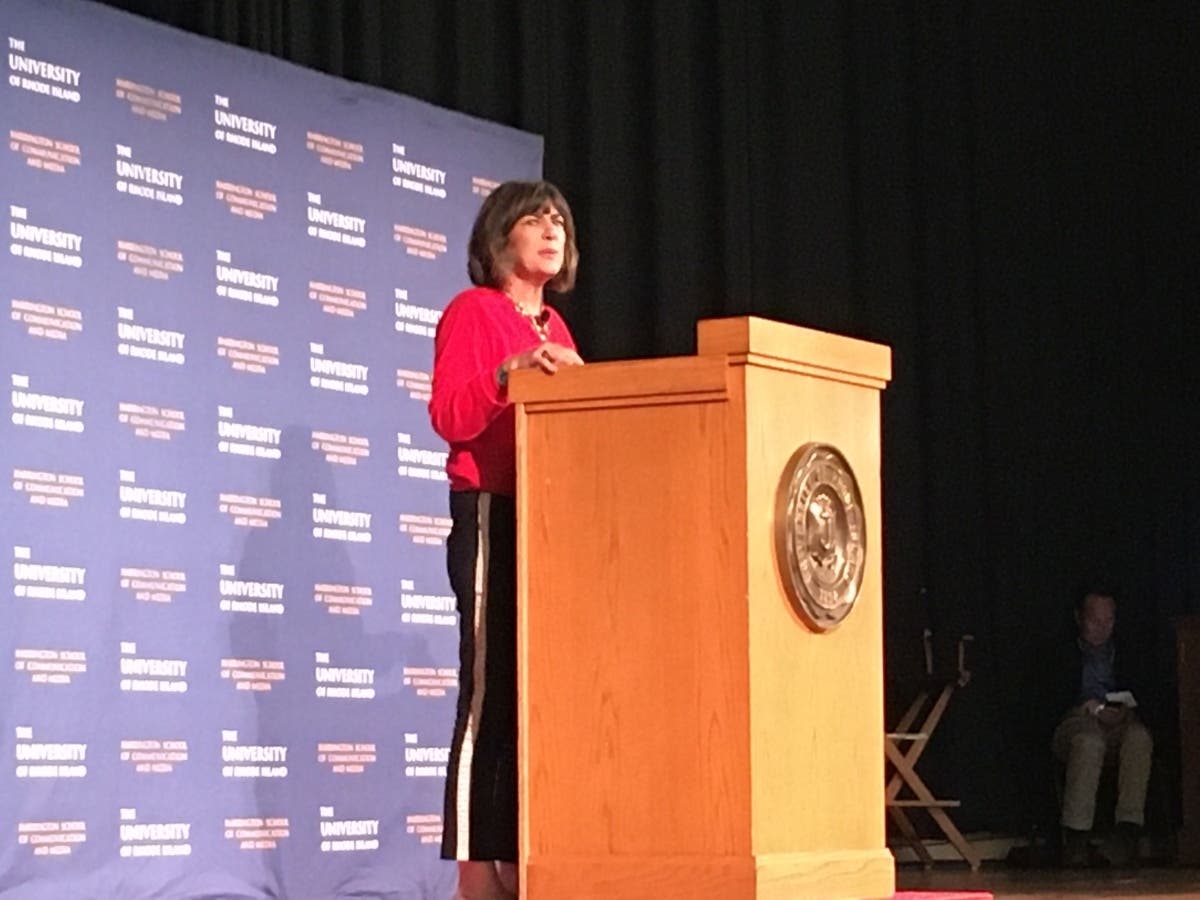
KINGSTON, RI — The University of Rhode Island's Edward's Auditorium was crammed full Thursday night for the Harrington School of Communication and Media's annual Christiane Amanpour lecture. This year's speaker was the venerated CNN correspondent herself, speaking to the sold-out crowd about her decades-long journalism career.
"If I have one message, it is to be brave enough to tell the truth," Amanpour said. "It's easier to go along to get along, but that's not our job. Our job is not to be liked and not to take the easy route."
Amanpour's motto has long been "truthful, not neutral," which she proudly wore emblazoned across her chest on her homemade sweater. While it came from her time as a CNN foreign correspondent in the 90s, the phrase rings especially true in today's political news climate, she said.
Find out what's happening in Narragansett-South Kingstownfor free with the latest updates from Patch.
From the first days of class, journalism students are told to seek the truth and report it. Journalists are always told to be impartial, to never take sides. But, sometimes, telling the truth requires taking a side, Amanpour said.
While covering Bosnian genocide in the 1990's, Amanpour was accused of taking the side of the targeted Muslims, not reporting impartially.
Find out what's happening in Narragansett-South Kingstownfor free with the latest updates from Patch.
"While the rest of the world turned a blind eye, we were the storytellers," she said. "I just told the truth, even though it was unsightly and unpalatable."
Objectivity, Amanpour argued, isn't the same as neutrality. By giving equal weight and coverage to both sides of a moral conflict, journalists can give false moral equivalence to the perpetrators and allow the world to turn a blind eye to victims. By highlighting the targeted Muslims, Amanpour and colleagues brought the world's attention to the genocide, encouraging U.S. intervention.
Amanpour's journey to URI was not a traditional one. The child of an English Catholic mother and an Iranian Muslim father, she spent her childhood between the United Kingdom and Tehran. Living in Tehran during the Iranian revolution, Amanpour saw the effects of storytelling firsthand, which encouraged her to become a journalist. Knowing she wanted to go to college in the U.S., she decided to pick somewhere on the East Coast, near her friends who were studying in Providence and Boston.
"I didn't know where else to go, so I came here!" Amanpour said to cheers and applause. After leaving URI, she took a job at WJAR in Cranston, where she met some of her greatest mentors. With a foot in the door on news, she worked with Rhode Island legends including Art Lake and Jim Taricani, with a dream of building her way up to a correspondent. From WJAR, she moved to the fledgling CNN in Georgia, where she has stayed for the last 36 years.
"I don't know if it's possible to do that these days," she said of climbing the news ladder the way she did.
When asked about the impact of social media on news and America today, Amanpour paused and shook her head.
"Nothing good," she said. "It's come to be used as a trolling operation where anonymous bullying happens in the public sphere. It prevents real debate."
In the same vein, she said the 24-hour, politically polarized news hurts Americans and causes "news fatigue."
"People can't seem to switch off," she said, adding that social media only adds to it.
With daily reports of outrage and scandal coming from the current administration, Amanpour said that it's important for journalists and Americans not to lose sight of what is really important, what to really be angry about. Covering everything the same way leads to a "dulling of outrage," she said.
"Each time we cover things as the same, it dulls the importance of the big things," she said.
To close, Amanpour reminded the audience that there is nothing more important than voting.
"I'll tell you one thing: people had better get out and vote," she said. "It's the only thing that separates us from tin pot dictators."
Get more local news delivered straight to your inbox. Sign up for free Patch newsletters and alerts.