Crime & Safety
Police Identify Likely Cause of Mysterious Beach Blast
State officials said a gas buildup was caused by a old copper cable.


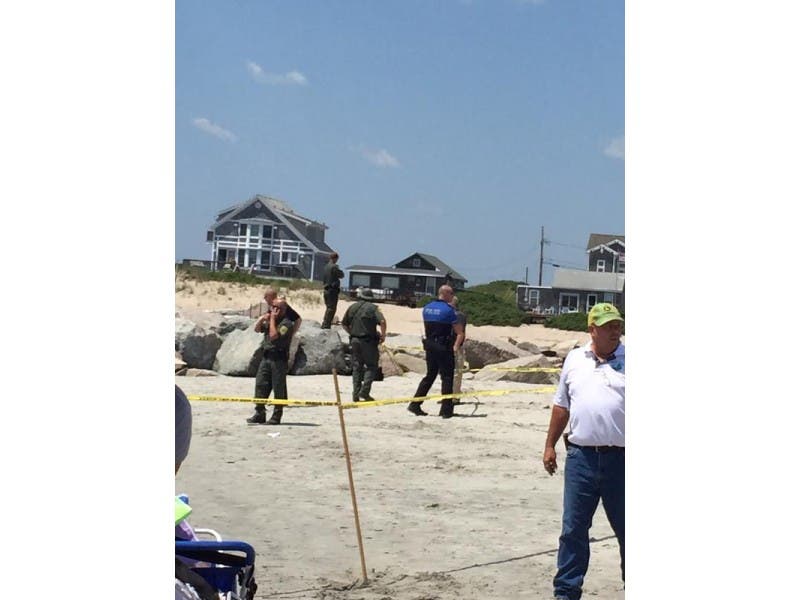
The cause of the mysterious blast on a Narragansett beach earlier this month that propelled a woman into the air and atop a rock jetty was likely caused by buildup and ignition of hydrogen gas in the sand due to an old, corroding copper cable, state officials announced.
In a Friday press conference, officials said that an oceanographer and expert in geochemistry, Dr. Arthur Spivack of the University of Rhode Island’s Graduate School of Oceanography, led a team that came to the conclusion that the incident was “due to the corrosion of an abandoned copper cable that was previously used by the U.S. Coast Guard.”
That cable, which once powered a navigation light at the end of the jetty at Salty Brine State Beach, is the same cable running along the jetty that was discovered and dug up during the early stages of the blast’s investigation.
Find out what's happening in Narragansett-South Kingstownfor free with the latest updates from Patch.
The victim, Kathleen Danise, 60, of Waterbury, Conn., landed on the rock jetty next to where she was sitting in her beach chair and suffered a cracked rib and some bumps and bruises. She was transported to the hospital and later released, telling reporters that she remembered watching a man put on scuba gear just before the blast. After that, she woke up in the hospital.
Soil samples led investigators to discover unusually high levels of hydrogen in the ground near the blast site, which led to the hypothesis that it was hydrogen combustion, Spivack said.
Find out what's happening in Narragansett-South Kingstownfor free with the latest updates from Patch.
Officials quickly ruled out any malicious act or incendiary device as the cause of the blast. Explosive sniffing dogs and equipment similar to devices used by the Transportation Safety Administration didn’t register a whisker of evidence along those lines, said Rhode Island State Fire Marshal John Chartier.
“It was really a team effort,” Spivack said, noting that the team included graduate students, other experts and professors and countless state, local and federal officials.
Spivack said that copper in a salty environment will cause it to corrode rapidly. That corrosive process produces hydrogen, which was apparently trapped in the ground and ignited by an ignition source. Hydrogen combustion is a very simple chemical process, he said, which “would take very little energy to ignite.”
Methane, for example, takes 10 times the energy to ignite as hydrogen. Hydrogen also does not produce a visible flame and it generates much less heat. That explains the mysterious, almost phantom-like descriptions in witness accounts as well as the lack of burns or residue at the blast site. Witnesses reported smelling what was believed to be chemicals and hearing a noise described as a boom or explosion.
Something like a cigarette could have caused the ignition, Spivack said.
The cause of the blast and subsequent mystery fascinated Rhode Islanders who know that the Ocean State can be a blast to visit, but not quite like this.
Authorities responded to the small family-friendly beach after a confusing 911 phone call from a woman who said a rock fell on the woman. Dispatchers began sending a response and the caller said “I heard a bang. People are saying that the rocks exploded.”
The investigation was led by the Rhode Island State Police and State Fire Marshal’s Office.
In a statement, Rhode Island Governor Gina Raimondo said she and others are grateful for the work of the “extraordinary scientists at URI.”
“Having the talent and research expertise of the teams at URI to turn to for quick results has proven invaluable.”
She also thanked the public for patience and cooperation as the investigation progressed. A small portion of the beach was taped off for days and officials observed a slight decline in attendance at Salty Brine State Beach after the incident.
“Our top priority is keeping people safe, and our state agency staff -- investigators and scientists -- never lost sight of this goal,” Raimondo said. “Rhode Island’s beaches are one of our most precious natural resources, and one of my family’s favorite ways to spend time together. I hope families across Rhode Island and visitors from around the country continue to take advantage of all our great state beaches and parks have to offer.”
To ensure that there’s no more hydrogen gas, DEM Director Janet Coit said that the ground was aerated, the cable has been removed and the area has been swept.
It is also unlikely to happen anywhere else as Salty Brine State Beach, which is within the Point Judith Harbor of Refuge and overlooks the joining of the Atlantic Ocean and Narragansett Bay’s west passage, is the only place that has an abandoned Coast Guard cable.
“This is an issue particular to Salty Brine State Beach,” Coit said. “No other combustion incident has ever occurred at any other state beach.
Get more local news delivered straight to your inbox. Sign up for free Patch newsletters and alerts.