Schools
How Navies Fight and Win at Sea: Naval War College Offers New Elective
The wargame was designed to teach students how to "think on a higher level of operations," the school said.


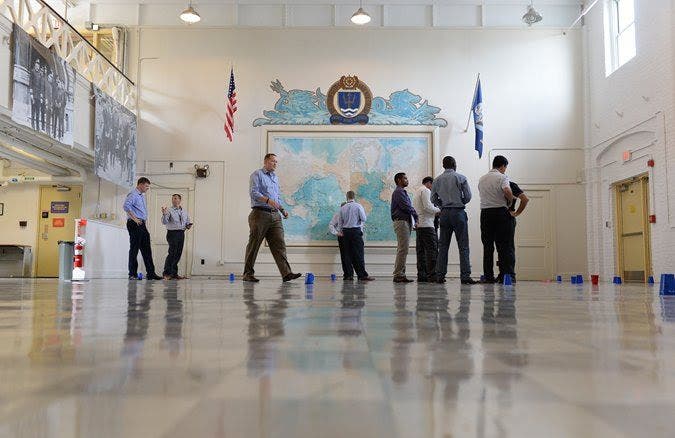
NEWPORT, R.I. – The Naval War College held a wargame to show students some of the basics of fighting and winning.
By Daniel L. Kuester, U.S. Naval War College Public Affairs
Oct. 25, 2016
NEWPORT, R.I. – An electives course held at U.S. Naval War College (NWC) conducted an unclassified wargame designed to allow students to bring to life a realistic scenario that included many of the course concepts.
Find out what's happening in Newportfor free with the latest updates from Patch.
The course, How Navies Fight and Win at Sea, teaches students the foundational tenets of naval operations during conflict.
Capt. Anthony Cowden, military professor of National Security Affairs and course director, conducted the war game in Sims Hall on campus.
Find out what's happening in Newportfor free with the latest updates from Patch.
“We are trying to stress their planning at the operational level of war,” said Cowden. “He or she needs to think about how to integrate the functions of a navy – that is, to strike, scout, screen and base – and worry less about the tactical engagements that will occur.”
The 13 students in the course formed the blue team and were asked to consider naval strategies in order to achieve an objective as one of two competing fictional forces in the South Philippine Sea against the red team operated by instructors.
“The commander of the students’ team needs to put a search out in front of him to see if there are any bad things out there so he can move his forces through,” said Cowden. “He’s got submarines out there to look for bad things. He has lots of assets he can use.”
One participant described cooperating with his colleagues as difficult, but satisfying.
“It was pretty intense,” said Lt. Cmdr. Matthew Brinkley, a U.S. Coast Guard student in the class. “There was so much cooperation from different people from different backgrounds working together, bringing unique experiences from their careers. There were lots of people who disagreed with the plan, just like there would be with any staff making a plan. But we overcame those disagreements to build a good plan.”
To make sure the game was realistic, it was played as though it took place in the Pacific using actual weather conditions. Unexpectedly, a storm actually developed in the region and swept through the game play area. Students were forced to carry on with the game under those conditions.
“There was a typhoon in the South Philippine Sea,” said Cowden. “The students weren’t able to use their air assets out of Clarke Air Force Base in the Philippines, so they are not going to be able to use those planes. It’s all part of the learning.”
Another student discussed how aspects of teamwork were a good lesson.
“Tactically speaking, as a submarine force commander, the game reinforced my ideas about the relevance of the knowledge, experience and diversity necessary to have a successful staff,” said Cmdr. Agustín Pájaro, Chilean navy.
Pajaro went on to say that he will take the lessons learned back to his country.
“The main benefit that I will bring back to my navy is about the experience and the interesting and original thesis about how navies succeed in the operational level during war time,” he added.
Caption: Students assigned to U.S. Naval War College in Newport, Rhode Island participate in a wargame at Sims Hall as part of the elective course, How Navies Fight and Win at Sea. During the course, students learn and apply naval quantitative analytical frameworks to explore: how naval warfare is different from combat in other domains; what leverage naval forces use to compete with each other; and what maritime roles naval forces play in joint operations.
U.S. Navy photo by Chief Petty Officer James E. Foehl/Released
Get more local news delivered straight to your inbox. Sign up for free Patch newsletters and alerts.