Health & Fitness
How Obese is Rhode Island?
The littlest state has some of the littlest waistlines, but that's not saying much in America, according to the Center for Disease Control.


Rhode Island, it seems you've lost some weight. Just a little, though.
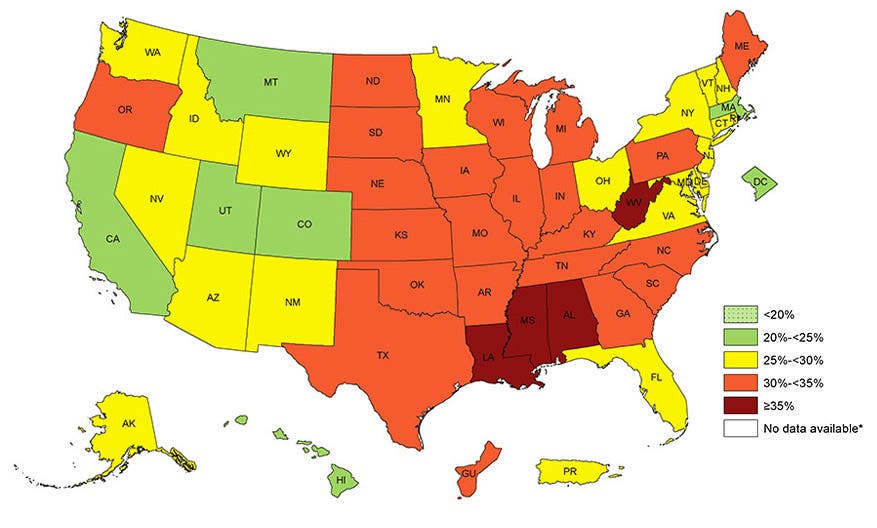
The Ocean State is one of the least obese states in America, according to the latest annual review of state obesity rates by the Centers for Disease Control. Unfortunately, that says more about everyone else than it does about us.
More than one in four adults — 26 percent — are obese in Rhode Island. Only 11 states, and Washington, D.C., have a lower rate of obesity.
Find out what's happening in Newportfor free with the latest updates from Patch.
The Rhode Island figures are lower than 2014's numbers by 1 percent.
Overweight people in Rhode Island make up 35.6 percent of the adult population. Additionally, 10.7 percent of Rhode Island adolescents is obese, and 16.2 percent are overweight.
Find out what's happening in Newportfor free with the latest updates from Patch.
The CDC releases annual obesity rates each September based on self-reported studies on behavioral risk factors.
Overall, the country seems to be getting larger, and the states with the highest obesity rates have only gotten worse.
According to 2015 numbers from the CDC, 35.3 percent of Rhode Island adults reported eating fruit less than once a day, and 21.4 percent said the same of vegetables.
Just less than half — 49.1 percent — of adults said they get the equivalent of at least 150 minutes of moderate-intensity physical activity per week.
Rhode Island received $358,148 in federal money in the last fiscal year through the CDC's State Public Health Actions program. Through that program, Rhode Island has worked with nutrition and health groups, worked with communities to provide safe areas to walk and bike, and more, according to the CDC.
The CDC also provides $1.7 million annually for college and university programs that reduce obesity and boost prevention in communities with the highest obesity rates.
People who are obese are at a higher risk of high blood pressure, Type 2 diabetes, heart disease, stroke, sleep apnea and some forms of cancer, as well as other health issues. Medical care costs related to obesity have reached more than $190 billion a year, according to a 2012 study in the Journal of Health Economics.
Photo provided by CDC/ Debora Cartagena
Greg Hambrick, Patch Staff, contributed to this report
Get more local news delivered straight to your inbox. Sign up for free Patch newsletters and alerts.