Community Corner
Lawsuit Filed over Casino Ballot Question
The suit alleges that the removal of a local ballot question in a "hurried deal" at the State House in July was unconstitutional.


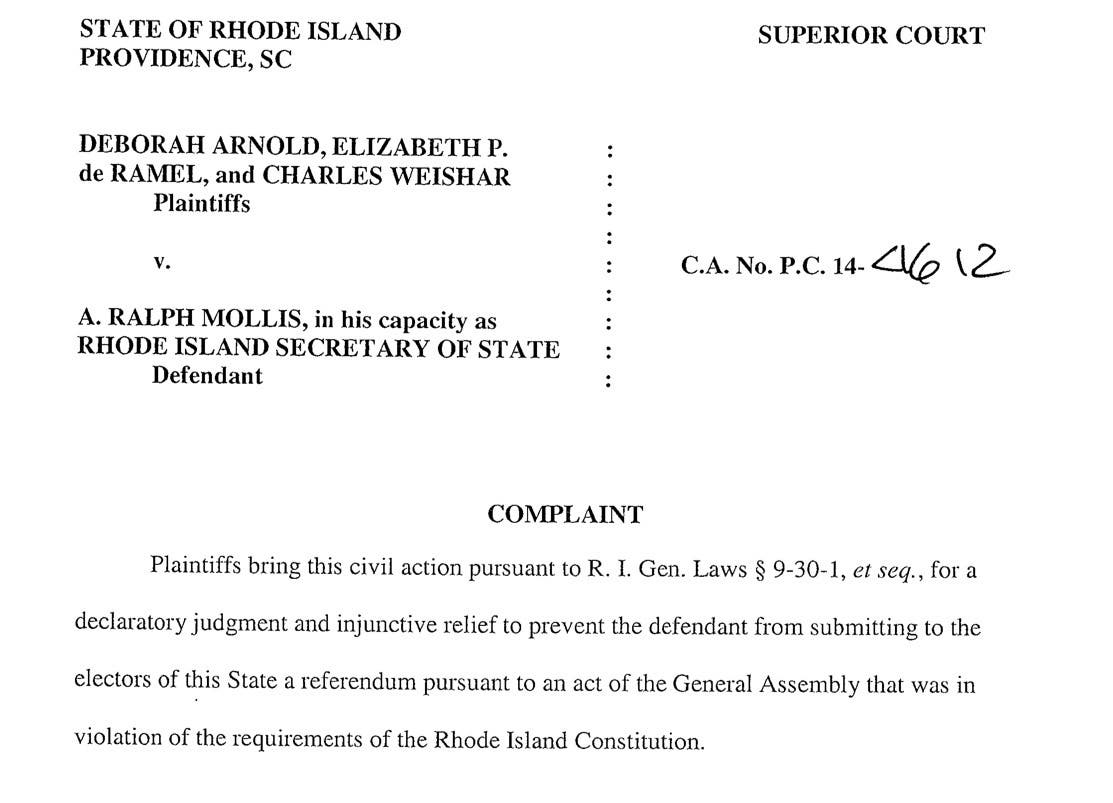
A group of Newport residents filed a lawsuit against the state in Providence Superior Court on Thursday alleging that the passage of the 2014 Gambling Act, which eliminated a local ballot question for Newport voters to decide if Newport Grand should have table games and become a full-blown casino.
Instead, the bill, passed in the waning hours of the last legislative session in July, calls for a single statewide ballot with the votes of Newport residents counted separately.
Though officials have stated confidently that the measure will fail if a majority of Newport voters vote against the casino — even if it gets more yes votes from the rest of the state — the lawsuit alleges that the state Constitution “clearly and unambiguously requires two referenda before any act expanding the types of gambling in a municipality.”
Find out what's happening in Newportfor free with the latest updates from Patch.
The suit was filed by Newport residents Deborah Arnold, Elizabeth P. de Ramel and Charles Weishar, who oppose the expansion of gambling at Newport Grand.
That expansion, which hinges on the outcome of the ballot question, would pave the way for the slot parlor to be sold to a team of investors including former Providence Mayor Joseph Paolino. They have proposed building a Monte Carlo style casino with table games along with resort and entertainment amenities.
Find out what's happening in Newportfor free with the latest updates from Patch.
According to the lawsuit, the elimination of the local referendum ”will result in a material risk that qualified Newport electors who oppose the expansion will not cast their votes on a statewide referendum.”
The result could be that the measure might pass without the local ballot question since “a majority of qualified Newport electors would disapprove of the expansion of the types of gambling that will be permitted in Newport if a local referendum were submitted to the qualified electors of Newport.”
The lawsuit seeks an injunction that would remove the statewide ballot question.
In the state Constitution, it states that no act expanding the types of gambling in any city or town shall take effect until “it has been approved by the majority of those electors voting in a statewide referendum and by the majority of those electors voting in a referendum in the municipality in which the proposed gambling would be allowed.”
In 2012, on the local ballot, Newport voters rejected table games at Newport Grand with 4,748 voters voting no and 4,150 voters voting in favor of table games.
But the same question on the statewide ballot, Question 2, was rejected by a more narrow margin and just 8,649 Newport voters chimed in on the statewide question.
With 249 more votes on the local question, “clearly, there is a material number of Newport electors who voted only on the local referendum,” the lawsuit states. “The most obvious explanation is that there are Newport voters who simply do not vote on statewide ballots, and restrict their attention to local candidates and issues.”
The original bill before the House of Representatives earlier this year did include both state and local ballot questions within its language. But in a “hurried deal” struck in the early morning hours on the last day of the session, the local ballot question was removed.
The lawsuit said the justification for the change was for “clarity and transparency” but opponents of gambling expansion say it clearly violated the Constitution and suggested the deal was struck after pressure from casino backers and lobbyists who realized it has a better shot of voter approval without a local ballot question in Newport.
Read the full lawsuit here: https://www.dropbox.com/s/gm9zqee3bsf49s3/DOC_20140918141131_000.pdf?dl=0
Get more local news delivered straight to your inbox. Sign up for free Patch newsletters and alerts.