Schools
Pell Petitioners Present Their Case at Hearing
The petitioners called upon several witnesses to testify against the school's design, policy and procedure.

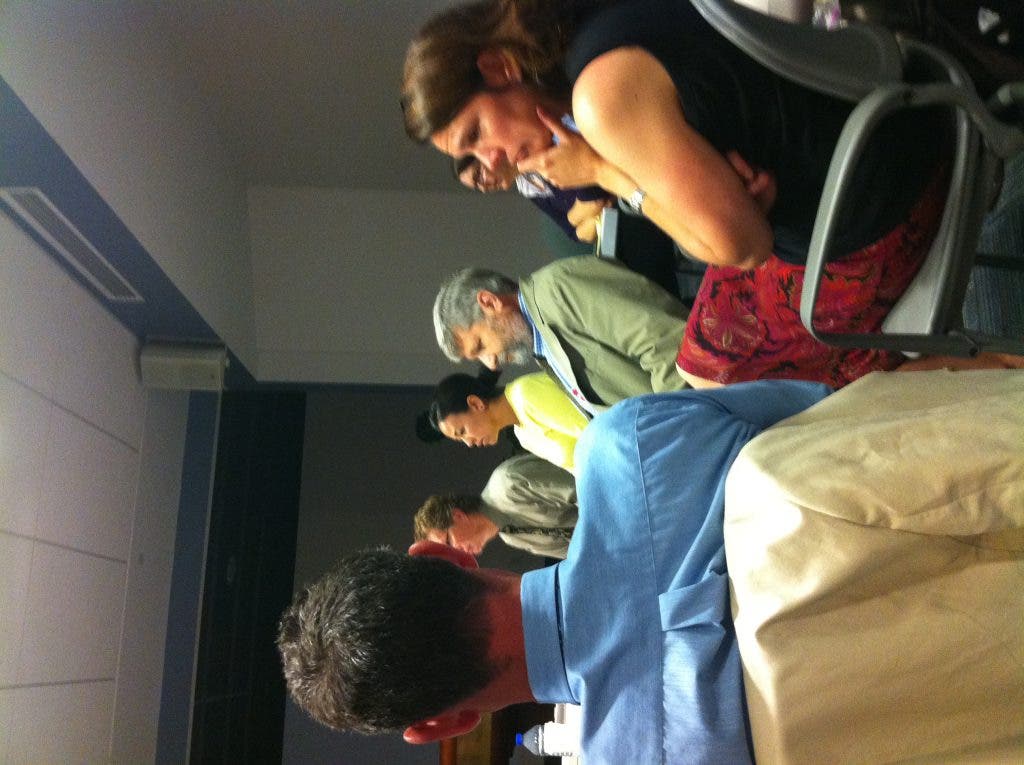


After months of back and forth with the Newport School Committee, the group of parents and community members fighting against the "T" design of the Claiborne D. Pell Elementary School, and the lack of engagement in the process, were able to officially make their case on Tuesday to the Rhode Island Department of Education.
The petitioners, led by parent Melissa Pattavina, faced an uphill battle from the moment hearing officer Kathleen Murray called the hearing at the Newport Public Library to order. As Murray stipulated upon the opening of the meeting, the group had to choose one member to represent the them as a group. The petitioners were unable to proceed with their original plan of several members presenting testimony, going through a timeline of the evolution of the design of the school and submitting several sheets of evidence. Instead, they were forced to choose one of their own to question the witnesses.
In a snap decision, the group chose fellow petitioner Drew Carey as their representative. The group decided that, for financial reasons, they would represent themselves at the hearing, Melissa Pattavina said afterwards.
Find out what's happening in Newportfor free with the latest updates from Patch.
Instead of flying through their meticulously arranged binder of information they anticipated would be accepted, Carey fought objection upon objection from Newport schools’ attorney Neil Galvin for lack of relevance and foundation, with the majority sustained by Murray.
Several site plans, schematics and diagrams credited to HMFH architect Laura Wernick were not accepted as evidence due to lack of School Committee action, much to the visible frustration of the petitioners.
Find out what's happening in Newportfor free with the latest updates from Patch.
Carey’s first witness, architect Holly Grosvenor, was also deemed not to be an expert witness. Despite Harvard credentials and decades of work on a variety of different types of buildings, it was her lack of experience with designing an elementary school that disqualified her as an expert. She was not allowed to give testimony on the designs.
“Our primary point is it’s essentially the same design all the way through,” Carey said, when met with opposition over what designs could be accepted as evidence. “There are no records of the other designs because they weren’t in an open process."
Carey moved on to examine architect James Asbel, who has at previous forums on the Pell school. Murray accepted Asbel as an expert witness.
Asbel admitted to never submitting alternate designs to the building committee, but rather shared them with School Committee members directly. During testimony, he said he regretted going around the architect with his designs.
Murray acknowledged Asbel had been called upon in an “important advisory role in the school construction project,” however was not in the role of providing professional advice.
Initial drawings from the Stage 2 application and the site plan developed in late January 2010 were eventually accepted to RIDE as evidence.
Throughout the hearing, despite requests for a reference design, Carey said he and his fellow petitioners did not oppose one specific design in the school's evolution, but rather the ubiquity of the “airplane” shape throughout the timeline of designs.
In her testimony, architect Wernick disagreed that the designs were similar, and said they had in fact gone through several changes and evolutions. During questioning, Wernick said she was not comfortable presenting her designs as evidence or as a reference.
Murray supported the declaration, saying only Wernick had been subpoenaed, and to require her documents would have required a second subpoena.
“I don’t know why she didn’t feel comfortable showing it, she’s presented them here there and everywhere,” Pattavina said later on. “. . .I think what I was thinking at the time . . 'What’s wrong with your design that you don’t want to show it in a hearing?'”
School Committee Chairman Patrick Kelley said the hearing overall “failed to show any violations of RIDE regulations or educational harm.”
“We complied with every one of [RIDE’s] steps,” Kelley said. “RIDE regulations are very specific. . .anything that happens [between stages], if the school committee does not take action on it, it’s irrelevant."
“They still have a very high bar to get over,” he added. “They did themselves a bit more harm than good.”
At the end of the seven hours of testimony, the group still has two witnesses, Newport School Committee member Rebecca Bolan and Michael McLarney, to examine. Testimony will be given at the continued hearing, which has yet to be set.
Galvin will also have the opportunity to question witnesses if deemed necessary and both sides will make their closing arguments. Due to conflicting schedules, the continued hearing will likely not be scheduled until mid-July or early August, Kelley said.
“We’re glad we’re doing this,” Pattavina said. “If not for anything else, to be able to help somebody else if they ever face a situation like this. It is a good feeling to try because we’ve gone every route, just about every single one of us.”
She said several points her group had planned on making were blocked, making it difficult to prove their point, but that she was pleased with Carey’s performance as the group’s representative.
“Drew really championed it,” she said.
The School Committee is scheduled to vote on the Pell school construction recommendations this Thursday night.
Get more local news delivered straight to your inbox. Sign up for free Patch newsletters and alerts.