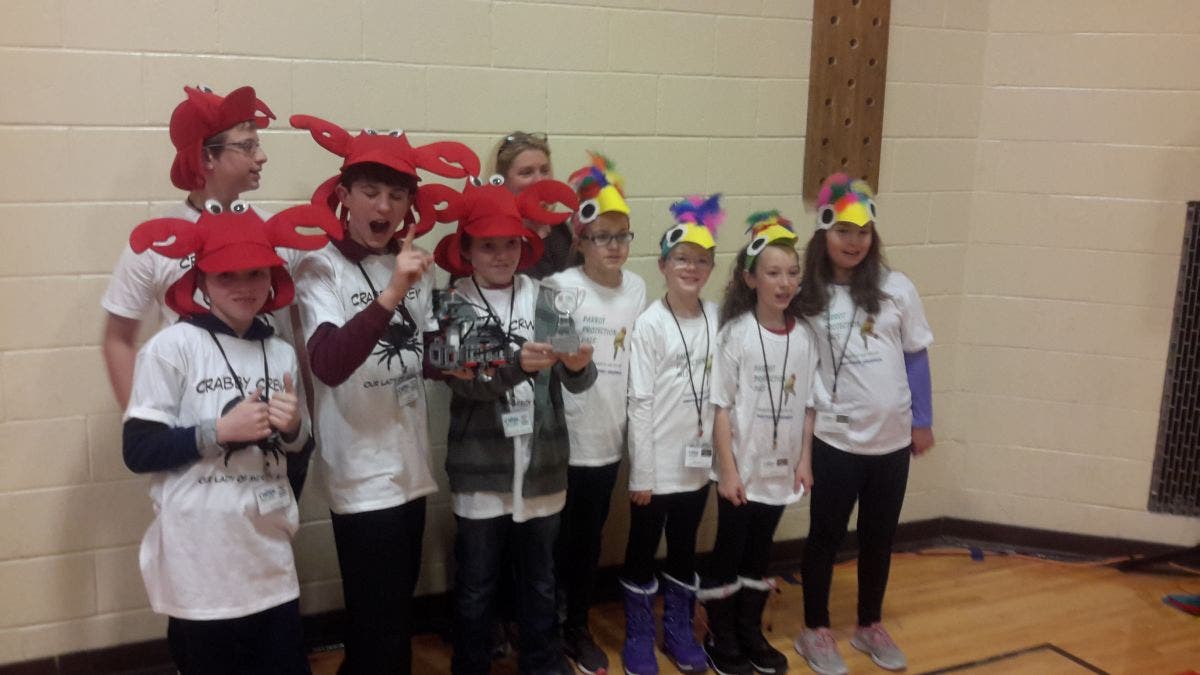
Our team, The Crabby Crew, was helped out by our coaches Ray Andraka, Mariola Butera, and Bea Lukens. The Crabby Crew consists of John and Mark Andraka, Jake Rademacher, and Colin Butera. We are part of the Our Lady of Mercy School robotics team in East Greenwich RI. We work together to complete as many missions as we can on a board made with LEGOs using a robotic programing LEGO brick called an EV3 to complete different tasks. These tasks have to be completed within two minutes and thirty seconds. On December 17, 2016, our team came in second place at the First LEGO League (FLL) qualifiers with a total of 62 points in the robot games. We are going to compete in the state championship on January 14th. In addition to the boar challenges, we also had to come up with a solution for a problem human-animal interaction. We identified a problem of the Asian Shore Crab that affects our local Narragansett waters after speaking to a representative from Biomes Marine Biology Center. We researched the problem by speaking to a marine biologist, Jason, who works at URI, two people from Biomes, and Save The Bay. Not many people know that the Asian Shore Crab is an invasive species that comes from Japan in the ballast water of a boat as an egg. All boats that deliver cargo have to use a vacuum like pump to pump water into a ballast tank so that the boat will not capsize. The eggs can pass through the filter system that gets rid of most of the bacteria and unwanted pests with UV lights. Since the eggs are so small, they can easily pass through these filters. After they get into the boat, they are carried from Japan to North America.The Asian Shore Crabs are a significant invasive species up and down the east coast, since each crab lays about 50,000 eggs twice a year. The Asian Shore Crabs feed on mussels, oysters, fish, and lobster larva which is a significant economic impact on local fisherman. To solve this problem, we searched for a solution that would not harm the environment. The solution that we came up with exploits the chitin inside each crab’s shell. We discovered that the chitin can be turned into a biodegradable plastic. Bioplastics are made from natural materials such as corn starch which are engineered to break down faster. Traditional plastics are made from petrochemicals, which do not break down quickly and harm the environment. Since chitin can be used as such a valuable and safe resource, we decided that by harvesting the Asian Shore Crabs and using their shells to produce biodegradable plastics would be the best action to safely reduce the population of these crabs and in turn, restore the ecological balance in the waters that they are affecting.