Health & Fitness
Glen Farm: Beginnings
There are many great stories about Glen Farm. Have you heard the one about the cow whose court case went all the way to the Supreme Court?


The Glen Farm era of Glen history lasted over seventy five years, and there are many stories to tell. This blog is the beginning of the story.
Glen Farm developed when Henry A.C. Taylor, a successful banker and merchant from New York, began to purchase farmland in Portsmouth. The first purchase was 111 acres from Halsey Coon which included two houses, a grist mill, two barns, and two cribs. An 1885 map shows that this piece of land stretched from the location of Elmhurst School and the Glen Manor House up to the barn complex. In 1885 Taylor bought 700 acres around Glen Road and he officially established Glen Farm. Just as the Glen land of the colonial Cooke family had been sold off piecemeal. Taylor began to buy and consolidate the smaller farms in the area into a farm that would at one time reach 1500 acres. For example, the 82 acres of the Leonard Brown farm were added in 1902 after Brown's death and six acres around the Durfee Tea House were added in 1909.
Taylor had vacationed in Newport and owned a house there, but he liked the idea of a working farm. In 1889 he began to breed Guernsey cows and would later breed Percheron horses and Horned Dorset sheep. He was very serious about scientific breeding and kept detailed records of milk and fat production. He had another farm in New York called Annandale Farm.
Find out what's happening in Portsmouthfor free with the latest updates from Patch.
An October 1911 to March 1912 edition of National Magazine has an article on Rhode Island farming that details Taylor's efforts with Glen Farm. Taylor's intention was "not merely to develop an ideal farm, but also to establish a herd of Guernsey cattle upon the place that should attain and hold pre-eminance in this country." Taylor spared nothing in raising the best. He hand picked the cattle and bull from the Isle of Guernsey.
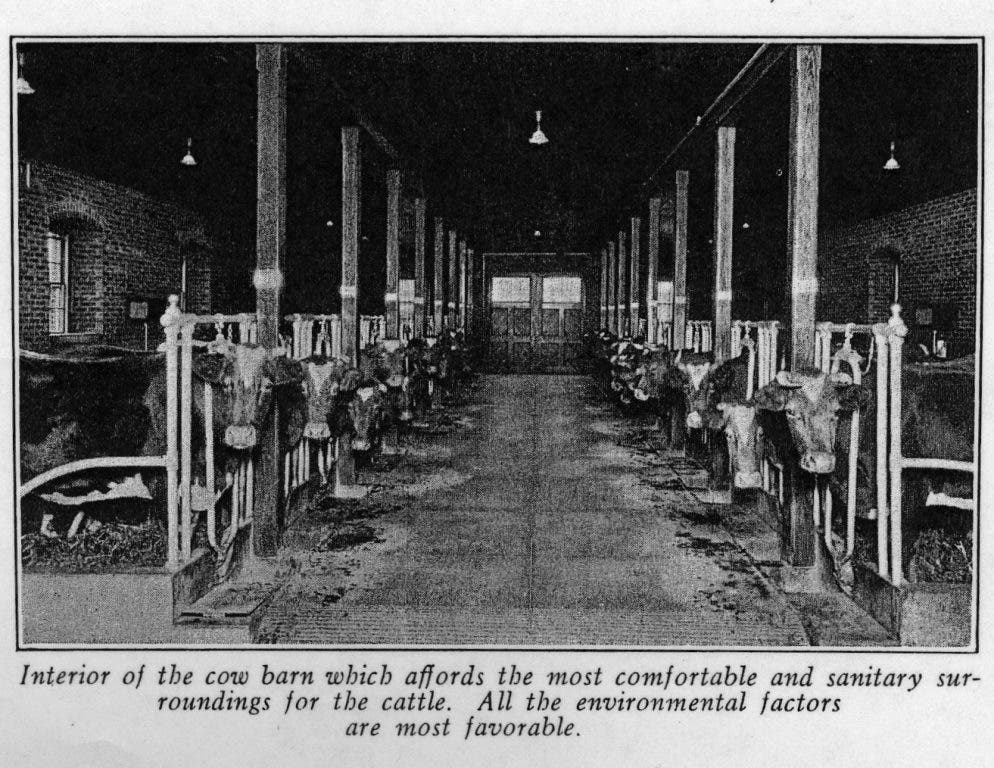
The National Magazine article goes on to explain that the arrangement of the barns and stables and their construction were all specifically designed. They were arranged to provide shelter in bad weather. You can still read the dates on the stone barns - a horse barn built in 1911, the cow barn and dairy built in 1907 and the bull barn built in 1910.
Find out what's happening in Portsmouthfor free with the latest updates from Patch.
The last of the barns built was especially modern. "There was an inner wall of brick with a six inch air space between it and the outer wall, which supplies proper ventilation and insures a uniform temperature within." Even the drinking basins for the animals have water "tempered by the furnaces in the basement which warm the buildings".
Mr. Barclay, the farm manager, explained that H.A.C. Taylor instructed him "not to study how to make money, but how to spend money in ways that will conduce to the highest development of his pets and pride, the Guernseys of Glen Farm." Even with that instruction, Glen Farm was exceedingly profitable. The stock raised at Glen Farm was very desirable.
H.A.C. Taylor was proud of his animals. The walls of the manager's office were lined with hundreds of prize ribbons. When a friend challenged his claim that "Missy of the Glen" had set a record for butterfat production, he brought a lawsuit that went all the way to the U.S. Supreme Court. Taylor won the suit but paid more for the lawyers than he won in the suit.
At least twenty-six families lived and worked on the farm. They raised all they needed for the families and the animals. A future blog will deal with what it was like to live and work on Glen Farm.