Business & Tech
Little Compton Homeowner Installs 'Perfect Hybrid' Wind and Solar System [VIDEO]
Jonathan Gewirz started sending some of his power back to the grid late last month.




Little Compton resident Jonathan Gewirz claims his home on Old Main Road, in a neighborhood dubbed “Windmill Hill,” is one of the more particularly blustery areas of the state. He’s not exaggerating that claim in the least.
Standing in the backyard of his 2.25-acre property facing the Sakonnet River on Oct. 20, Gewirz, 47, proudly announced his recently built 35-foot vertical wind turbine just went into full operation and his altered meter started sending some of its generated power back to the grid. The wind blew over 12 miles per hour that late afternoon, and Gewirz said he produced three months' worth of energy in one week.
“Today’s slightly faster than normal,” he said, adding he can’t wait to see how much his electricity and heating bill decreases over time.
Find out what's happening in Tiverton-Little Comptonfor free with the latest updates from Patch.
Over the spring and summer, Gewirz said, he paid roughly $50 a month on his propane heat alone. An artist and part-time real estate developer, he lives in Providence with his wife and 6-year-old son and owns a summer home in Common Fence Point in Portsmouth. Gewirz said he originally bought the Little Compton property in 2007 to serve as an art studio and began letting friends use it, but his family plans to eventually live there full time soon.
“Every time we drove down, we thought it was so special, and as we looked at other properties, this became more appealing,” he said.
Find out what's happening in Tiverton-Little Comptonfor free with the latest updates from Patch.
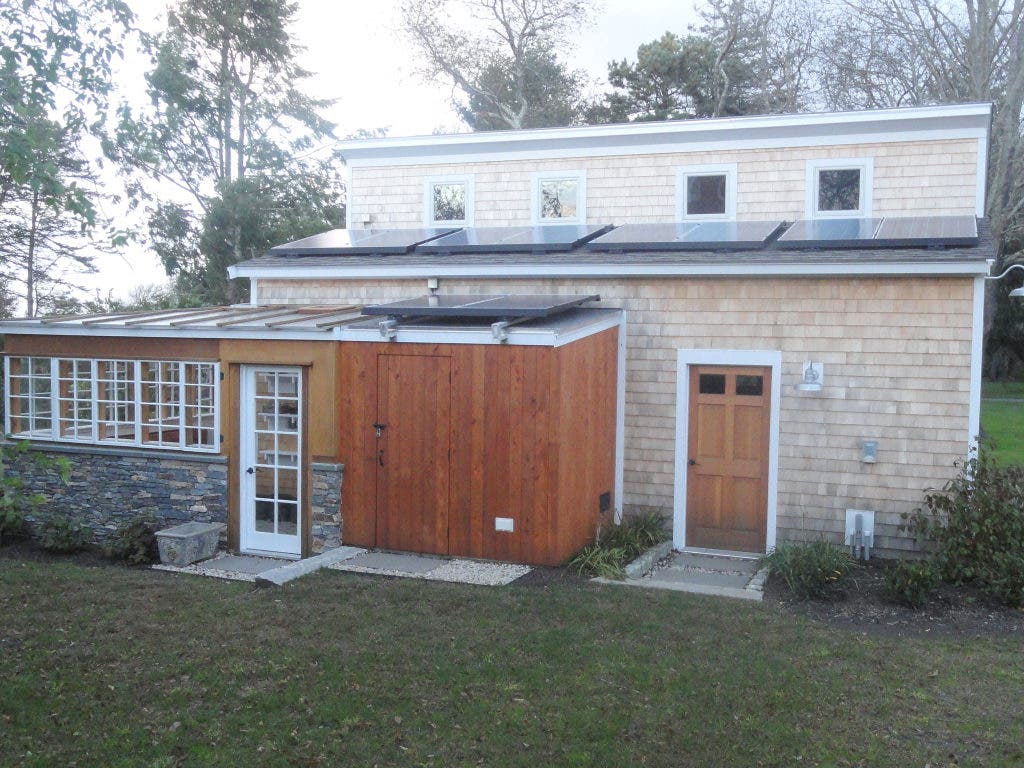
Looking for ways to lower his energy costs, Gewirz connected with Tim Hetland, vice president of Middletown-based Rhode Island Wind Power earlier this year about installing the turbine. Gewirz, whose wife is a gardener, converted an old garage on the property into a greenhouse. Hetland also installed five solar panels on its roof to serve as an alternative energy provider.
“He’s on a great wind site,” Hetland said in a recent phone interview. “It’s pretty much a no-brainer. Between his solar and turbine, he’s got the perfect hybrid system, with the chances of making power day and night.”
Hetland said the turbine, called an Urban Green Energy vertical access turbine, cost Gerwicz between $17,000 and $18,000 to install and would have received a 30 percent federal tax credit if the state tax credit remained in place.
“People are fighting to get that back into the picture,” Hetland said.
The turbine’s approval process was painless, Hetland added, saying it met the building height and zoning regulation of 35 feet, so it didn’t require a special use permit.
“All other towns want special use [permits] for everything, which adds costs to the job,” he said. “Little Compton is one of the towns I’ve run into where it’s very easy working with the building inspector, who’s very positive with people doing small projects.”
Hetland helped Gewirz apply for National Grid’s simplified user interconnection agreement, and said the average family with that turbine should be 700 kilowatts-per-hour. National Grid came out to Gewirz’s home and replaced his regular meter with a different one that registers what he’s sending back to grid, and when there’s no wind, it will register what he’s importing from them.
“When I was there, that turbine was pushing close to 520 volts down the pipe into his home,” Hetland said. “The solar system would have been another 2,250 watts at 50 volts. His meter does run backwards on sunny, windy days. There are chances of windless nights, where he’s going to draw power from the grid, but the balance from the property is in his favor.”
The greenhouse, which Gewirz said would also have a rainwater collection system, has panels where each of its modules registers 350 watts, according to Hetland. He said the panels cost approximately $12,000.
“He can monitor that entire system from his laptop,” Hetland said. “It shows five panels and they change color as they are making more power. If you put your hand in front of the panel, it will show up as a shading issue.”
Hetland noted he recently finished installing panels on a government building in Narragansett and is getting calls to install several on various buildings in Providence. Aside from the commercial projects, Hetland likes working with homeowners.
“It’s a smart investment in your family’s future, because you’ve got to look at electricity [costs] going up five percent every year,” he said. “The second you do a project like this, you freeze your energy costs for the next decade or two.”
Get more local news delivered straight to your inbox. Sign up for free Patch newsletters and alerts.