Sports
Tigers Players Return To Gridiron With Health Concerns In Mind
The Tiverton High School football team opened its 2011 preseason practice schedule last week with coaches cognizant of averting the twin perils of dehydration and concussions.
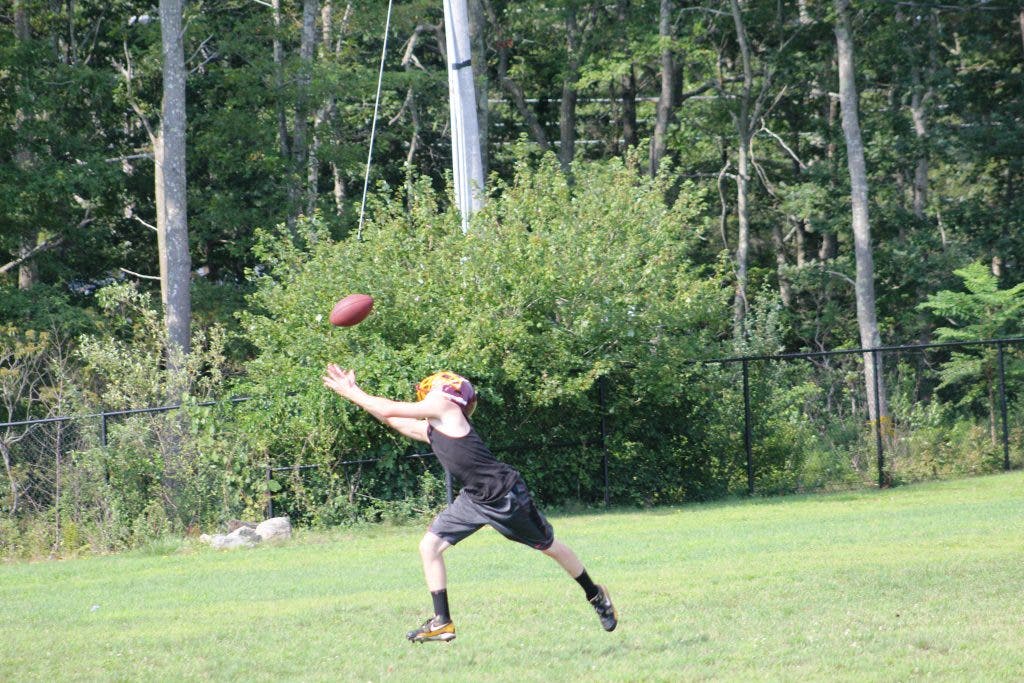


To school students, the middle of August traditionally means a new school year is just on the horizon. To athletes, it means the fall sports season is beginning.
At last week, the Tigers’ football team commenced preparations for its 2011 season with aspirations of improving on last year’s 2-6 finish against Division III rivals. Veteran Head Coach Bob Murray is working with approximately 40 players in grades 9 through 12 during week’s two-a-day sessions, which essentially consisted of conditioning and introductory techniques.
According to regulations of the Rhode Island Interscholastic League, the Tigers opened camp last Monday wearing helmets only; introduced shoulder pads Tuesday, but with no contact; and did not permit full pads and contact until Saturday. Murray and his staff ran sessions for up to 2 ½ hours and will conduct double sessions next week before beginning to scrimmage other high school teams.
Find out what's happening in Tiverton-Little Comptonfor free with the latest updates from Patch.
Although the weather has cooperated with high school football teams in Rhode Island recently with moderate temperatures, and similar forecasts for this week, the threats of dehydration and heat stroke are evident in summer heat. In other sections of the United States this month alone, six high school football players and one coach have died, although the causes of death have not yet been legally determined.
The RIIL has increased its emphasis on hydration-related issues this year, providing easy links on its Web site (www.riil.org) to six handbooks, guidelines and regulations produced by the National Federation of State High School Associations (NFHS), including health and wellness, heat-related illnesses, energy drinks, fluid replacement, hydration and sickle cell traits.
Find out what's happening in Tiverton-Little Comptonfor free with the latest updates from Patch.
The RIIL also requires all high school coaches to complete the NFHS course called “Fundamentals of Coaching” and to maintain updated certifications in First-Aid Training and Cardiopulmonary Resuscitation (CPR).
At Tiverton, Murray said dehydration has not been a problem in many years.
“We build at least four water breaks into our practice schedules and allow players to get water at any other time except when they are working on the blocking sleds,” he said. “When practice ends, we constantly remind our players to keep themselves hydrated.”
In the event of extreme hot weather, Murray said Tiverton takes special precautions.
“If it’s really hot during the daytime, we can always turn the lights at the football field on and practice next to the field,” he said. “We also cut back on practice time, if necessary. We want football to be a positive experience for our players and a fun time for them.”
Another national concern in football and other sports is the issue of concussions and head injuries, which has attracted considerable attention in recent years. In an effort to reduce risks, the National Football League has reduced contact activities for its teams and several collegiate conferences (including the Ivy League) have adopted similar precautions.
So has the RIIL. In accordance with state law (School & Youth Programs Concussion Act Title 16-90-1), all schools in Rhode Island (RIIL affiliates and those unaffiliated with the league) are now required to adhere to specific mandates introduced to minimize the risks of concussion and to properly treat student-athletes who have suffered concussions.
According to the RIIL Web site, all student-athletes and their parents or guardians must be apprised of the risks of concussions and traumatic brain injuries prior to the start of sports seasons; parents or guardians must sign a document indicating they are aware of these risks; schools must provide training materials produced by the United States Center for Disease Control for all teams; all sports coaches and athletic trainers (paid and volunteer) must successfully complete an online course entitled “Concussions in Sports” provided by the NFHS; and student-athletes who incur concussions must sign a concussion and head injury information sheet prior to their return to action (this document must also be signed by their parents or guardians).
Also, student-athletes suspected of suffering concussions or head injuries during practices or games must be removed from action immediately and will not be permitted to return to action until being evaluated and receiving written authorization from a licensed physician to return to competition.
At Tiverton, Murray said head injuries have never been prevalent.
“We teach our players how to hit and tackle properly,” he said. “We limit contact in our practices and we constantly monitor all our players for potential problems.”
Murray said the Tigers’ primary focus is to “protect the kids.”
“The parents of our players are entrusting us with their safety and we do everything in our power to protect them,” he said. “We never jeopardize safety for the sake of trying to win a football game.”