Arts & Entertainment
The Museum Of Work And Culture Honors Labor Fighters Of Yesteryear
In this old mill city, Labor Day is more than just a day off.


If you depend on Rhode Island's news media for your information, you might forget this state was the birthplace of America's Industrial Revolution. Today's headline stories mostly concern fatal car wrecks or the storm that passed by a week ago. There's scarcely a mention of Labor Day observations.
Don't think that means there were none.
At Woonsocket's , a standing-room-only crowd of history lovers and labor activists gathered Monday for a mock union meeting that examined the Rhode Island labor riots of September 1934, which left two dead and dozens injured.
Find out what's happening in Woonsocketfor free with the latest updates from Patch.
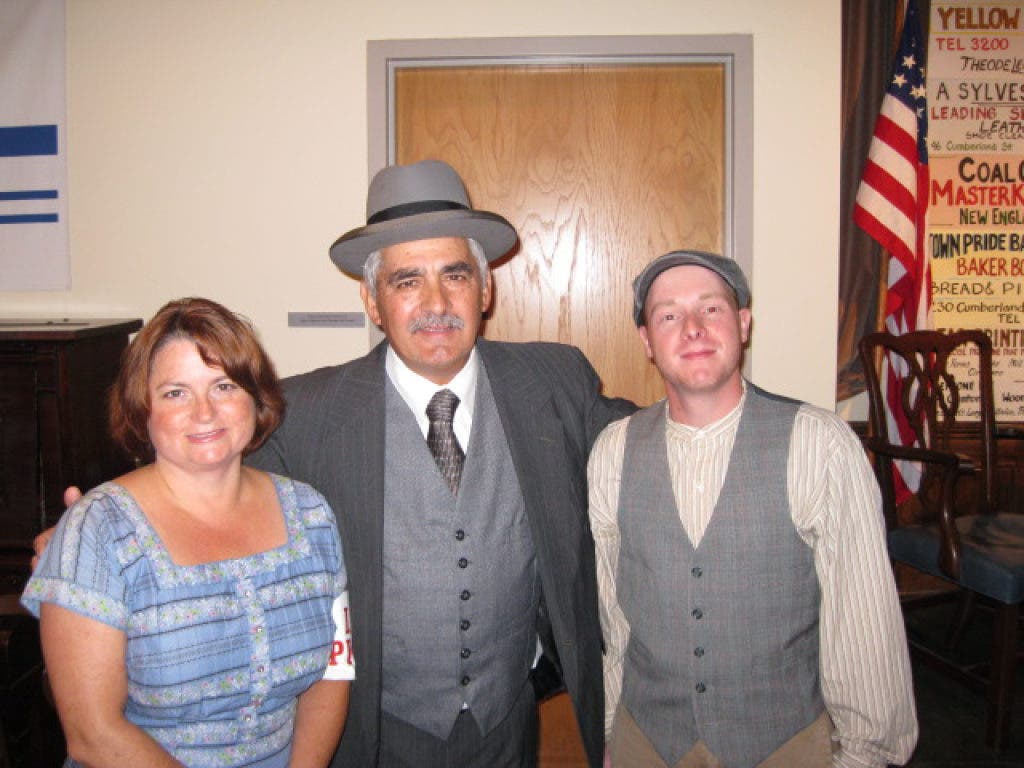
The discussion was actually a one-act play, and those who rose to speak were figures straight out of that era: Joseph Schmetz, president of the International Textile Union; Woonsocket Mayor Felix Toupin; Anne Burlak, a spitfire labor organizer who traveled the Northeast. They were portrayed by local actors Erik Eckilson, Romeo Berthiaume, and Danielle DeRotto. Others in the cast were: Shulla Sannella, Albert Brunelle, Darin Cooper, David Amaral, Jason Metivier, Irene Blais, Victoria Gendron, and Steve Van Orsouw.
"I like to think what we're doing is exactly what Labor Day should be about -- remembering those who came before us," said museum director Ray Bacon, who penned the drama. "We're saluting them, honoring them, and reflecting on what they did for us fifty years ago or a hundred years ago. We don't often appreciate what they went through to get us a better way of life."
Find out what's happening in Woonsocketfor free with the latest updates from Patch.
At least one person attending the play had close personal knowledge of the events portrayed. Kathryn Wright drove from Springfield, MA, to hear the representation of organizer Anne Burlak, her mother, who died in 2002.
She gave DeRotto and Bacon high marks. "It's an absolutely accurate portrayal," said Wright, who had seen the play once before. "This is the second time they've brought me to tears."
Coincidentally, nearly 80 decades after that famous strike, labor is astir once again, in Rhode Island and across the country. The reasons: The national unemployment crisis and efforts by some state legislatures to eliminate collective bargaining for public employee unions.
Many of those crowding the hall for Monday’s afternoon show were union members and organizers who had earlier gathered at Moshassuck Cemetery in Central Falls for a memorial rally commemorating the Rhode Island's Depression-era union strikers. The labor website we-r-1.org urged Ocean Staters to attend both events to "remember the martyred activists."
Bacon's play lit a fire in Scott Molloy, a University of Rhode Island professor who teaches a course on the labor movement. He took to the stage to give a short speech reminiscent of the soap box oratory of old-time union organizers. His words connected the labor struggles of the Depression-era with recent attacks on public-employee unions.
"When you look back at those people today, you can see they had virtually nothing," he said. "Yet they built this country up. They created the middle class . . . The economic crisis we have in this country today was given to you by Wall Street, but they want to play pin the tail on the donkey, and blame union labor."
In his play, Bacon's relates the events of September 1934 by staging a fictional meeting. While he invented all the lines, he based every word on things that actually happened.
At that time, the world was in the grip of the Great Depression. Textile manufacturers were already shutting down New England mills and moving their operations to the South, where workers were paid lower wages. More than a dozen Woonsocket mills were shuttered. Nevertheless, late in the summer of 1934 Rhode Islanders walked off their jobs to support workers in southern states, who were striking for better working conditions.
On Sept. 11 Gov. Theodore Green sent the National Guard to Saylesville to break up a crowd of several thousand people who had surrounded a mill. The guardsmen and police used tear gas. The crowd responded by tossing rocks and bricks.
The next day Green sent the Guard to Woonsocket, where union members were picketing outside the Woonsocket Rayon Plant, the only mill that remained open during the strike. Pushed away from the mill site, the crowd moved into the business district. Soon they were tipping parked cars, breaking windows, and looting stores.
The guardsmen and police fired. Passerby Jude Courtmanche, 19-years-old, was struck by a bullet and died. At least 11 more were wounded; Leon Rouette died of his injuries two weeks later.
"I heard the whole story from my great uncle when I was growing up," said audience member Brian Lanoue of Smithfield. "This is exactly how I always imaged it was like to be there."
In observation of Labor Day, the museum charged no admission Monday, and offered several special exhibits.
Visitors also got a look at the community French-Canadian immigrants created when they located in Rhode Island. The museum includes a classroom that looks exactly like those found in Catholic schools decades ago. Desks and chairs are bolted to the floor; the day's lesson was scribbled across the blackboard. The figure of a nun stood at the front of the room.
Those who visited the classroom Monday (or any time the museum is open) had the opportunity to explore their own past. A side hallway includes The Catholic School Archives, a repository for documents about Catholic education, not only in Rhode Island but around the world. Co-directors Gene Peloquin, Lois Peloquin (no relation) and Albert Brunelle were on hand to accept donated yearbooks, report cards, and anything else from a Catholic school.
On Monday Gene Peloquin was showing off a 1941 class photo from Cumberland's St. Patrick's School, donated by James Wooley. ""You can feel the buzz we have here today," he said.
"I've actually seen people crying as they go through the files and revisit memories," Lois Peloquin added.
In the classroom, Woonsocket resident Norman Gagnon pointed to a portrait of a nun, a member of the Sisters of the Presentation of Mary. "They were my teachers," he said. "At St. Anne's School. Half the day was in English, the other half in French. I still speak French today when I get together with relatives."
The museum also hosted a special exhibit involving both history and art, an installation that recalled life in Warren, RI, in the 1800s, when cotton mills were the town's economic engine. Historian Doug Hinman, a librarian in Providence, handled the research, while artist Deborah Baronas created the paintings.
Baronas painted figures showing mill workers at various tasks, using sheer cotton gauze as a canvas. Viewers could see through each painting to the next one, turning the gallery into a three-dimensional mill scene. "We focused on how the mill grew the community," Baronas said. "The project is a marriage of art of history."