Politics & Government
Pine Grove School Instilled Value of Education in Black Students
Looking back, former students of the school remember it as the starting point for their enthusiasm for education.


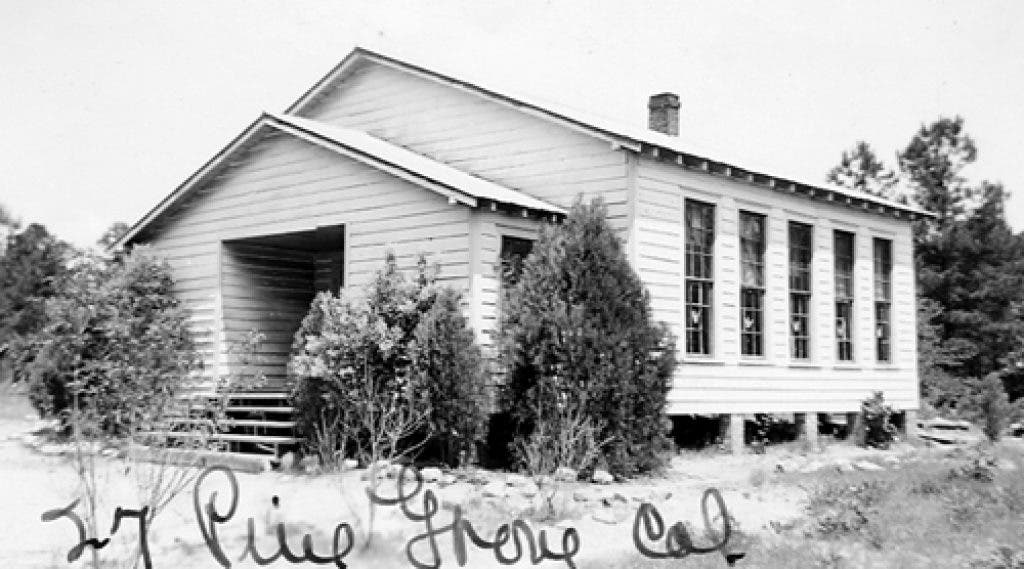
When the Pine Grove School opened in 1923, it was a step up from the wooden structure next to Pine Grove A.M.E. Church that had previously served as the school for black children in the neighborhood.
The new Pine Grove School was built with money from the Rosenwald Fund, a philanthropic foundation that provided grants for the construction of close to 5,000 rural schools for black children in the South in the 1920s and 1930s.
With the help of Julius Rosenwald, founder of the Rosenwald Fund and a part-owner of Sears, Roebuck and Company, children in the Pine Grove community had a new white wooden school with a pot-belly stove for heat and, later, a kitchen for hot lunches.
Find out what's happening in Columbiafor free with the latest updates from Patch.
But former students of the Pine Grove School, which will re-open to the public Thursday following renovations, remember it as much more than a wooden building with hot lunches. It was a place where they learned discipline, the importance of education and the value of hard work.
Cleonice Rhett, who started first grade at the school around 1934, remembers fetching water from a lady's house in the mornings. The boys cut wood for the stoves to keep the classroom warm. The girls were responsible for the housekeeping tasks: washing the windows, sweeping the floors.
Find out what's happening in Columbiafor free with the latest updates from Patch.
The students never complained about the work or the conditions of the school, Rhett said.
"It was a lot of fun and interesting because we didn't know nothing else," she said.
The building was divided into two classrooms by blackboards. The younger grades were with one teacher, and the older grades with another.
Iris Simpkins, who started first grade around 1948, remembers a particulary strict teacher: Mrs. Thelma T. Bellinger.
She didn't tolerate misbehaving students, Simpkins said, and she frequently reminded her students why they where in school: "The business of school is education," Mrs. Bellinger used to say.
With students on so many different levels, the teachers had to find a way to keep the attention of all the students. Bellinger did that by letting some of the students who were good at reading help the students who were struggling, Simpkins said.
Simpkins came from a family of women who knew how to read when many African-Americans didn't.
Her mother brought home newspapers, magazines and novels that guests left behind at the hotel where she worked. And Simpkins remembers having plenty of "quiet time" at home to read.
The family also got books through her grandmother's job as a maid at a white family's home.
Naturally, Simpkins was one of the students who helped others in her class with reading.
"For one thing, it taught us the value of an education," she said. "It taught us if you have a talent, it's your duty to help someone else who was struggling."
'Leveling the playing field'
The construction of Rosenwald schools started in the early 1900s, long before the Civil Rights movement gained steam.
In 1912, Booker T. Washington, an advocate of self-help for black Southerners, approached Julius Rosenwald and asked for money to help build better schools for blacks in rural areas.
In the spirit of encouraging communities and governments to take responsibility for needs in their areas, the Rosenwald Fund provided grants that matched the amount of money the communities raised.
The Pine Grove School was built with a grant from the Rosenwald fund, money raised by both the black and white communities and funds from Richland County, according to the book "Richland County's rural African-American schoolhouses."
Although the new schoolhouses were better than the old ones, textbooks were still passed down from white schools.
"That's the way it was, and that's all we knew," said Georgella Fouste, who started first grade at the Pine Grove School in 1943. "It was just the normal way of life."
Students who went to the school remember their parents stressing the value of an education.
"My parents thought it was very important for us to go to school," Fouste said. "But mostly I wanted to follow in the footsteps of my older brothers and sisters who were into school."
In the years before the civil rights movement and Brown vs. the Board of Education, it was hard for black families in the Pine Grove community to imagine desegretation ever happening, Simpkins said.
"We had no dream or thought that things would ever change," she said, "but we were taught that education would kind of level the playing field and help get out of the box we were in."
After getting her cosmetology license, Simpkins decided that the job wasn't for her. She went to Allen University, got a bachelor's of science in business education and taught school in South Carolina for 12 years.
Rhett, who came from a family with nine children, said her mother encouraged all of her children to at least have a trade.
After one year of college, Rhett went on to be a licensed cosmetologist. Three of her sisters went on to be teachers. One was a seamstress.
"[My mother] never had a regular job outside the home," Rhett said. "I guess she just wanted me to make a better life for myself."
Get more local news delivered straight to your inbox. Sign up for free Patch newsletters and alerts.