Neighbor News
North Mississippi Communities Confront a Week‑Long Crisis of Cold and Collapse
An unforgiving ice storm exposed failures in communication and preparedness

PANOLA COUNTY, MS — For seven consecutive days, North Mississippi did not thaw.
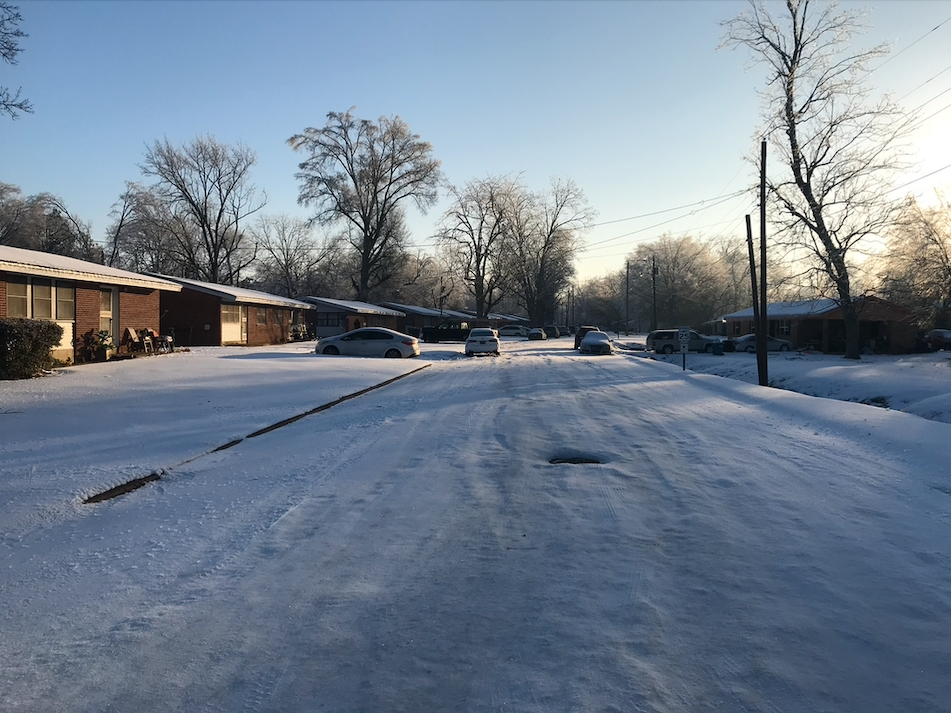
What began as a winter storm hardened into a prolonged emergency that reshaped daily life across Panola County and beyond. Ice clung to power lines, snapped trees into roadways, sealed neighborhoods behind impassable streets, and turned major travel corridors into frozen parking lots.
Temperatures hovered in the teens, with wind chills plunging even lower. The storm did not simply disrupt routines — it exposed the limits of infrastructure, communication, and preparedness across a rural region unaccustomed to managing ice at this scale for this long.
Find out what's happening in Memphisfor free with the latest updates from Patch.
By midweek, the signs of strain were everywhere: gas stations out of gas, grocery stores rationing entry and running low on supplies, schools shuttered, municipal buildings closed, and thousands of residents still without power.
And on Highway 51, the crisis came to a standstill.
Find out what's happening in Memphisfor free with the latest updates from Patch.
For more than four hours Thursday, a long line of 18-wheelers, passenger vehicles, and emergency trucks sat motionless on Hwy. 51 North. Ice turned the pavement into a slick corridor where even experienced truck drivers could not risk movement. Some had been rerouted from Interstate 55 only to find themselves trapped again.
Over the course of the gridlock, I spoke with at least nine truckers who had nothing to do but wait and wonder if anyone was coming to help.
Several law enforcement and Mississippi Department of Transportation vehicles passed through the corridor, but none stopped to offer guidance to the stranded drivers.
Several hours into the delay, Leon, a trucker bound for Texas, asked whether there was any way out besides I-55 or Hwy. 51. I explained that Hwy. 315 — its entrance just a few feet away — could connect him to Hwy. 61 and eventually lead toward Memphis. By then, though, he was boxed in between two trucks, stuck with no way out.
Mike, positioned near the front of the line and one of the few who could have attempted the turn, said he wasn’t willing to risk it.
“I’m not comfortable going on that highway without knowing the road conditions,” he said.
Retired Mississippi Highway Patrol officer John Lantern, now serving as Sardis’ Chief of Police, acknowledged the grim reality when asked if truckers could reroute onto Hwy. 315.
“Yeah, they can,” he said, but did not advise it. "It's going to get worse. They’re going to get stuck.”
Truckers shut off engines to conserve fuel. Others refused, afraid their rigs would not restart in the cold. Some walked to a nearby gas station that had no gas. One driver passed the time playing with his dog in the snow.
The silence of idling trucks became a symbol of something larger: a region stalled by more than weather.
Across Panola County, residents described days without electricity or heat.
“We still don’t have power at our house,” said Michael Stanford of Batesville.
Ice-laden limbs had taken down power lines across multiple counties. Utility crews worked in brutal conditions, restoring service pole by pole. But for many, the outages stretched from inconvenience into crisis. Residents spoke of spoiled food, cold homes, oxygen machines running low, and uncertainty about when relief would come.
Stores struggled to operate. Walmart in Batesville limited entry to a handful of customers at a time. Kroger had “run out of meat,” Stanford said.
Gas stations, without electricity, could not pump fuel — creating a secondary emergency for those trying to travel, assist others, or power generators.
Amid the dysfunction, something else moved: neighbors.
I first met Stanford after watching him help a stranded driver on an icy residential street. Using a cardboard box for traction, he helped the frightened motorist get moving. The driver turned out to be a neighbor of his sister — someone he had never met.
“People have been stuck in their houses; they’re frustrated,” Stanford said. “But when you can help someone, you do it.”
Those small acts became lifelines across the county. Residents checked on elderly neighbors, shared supplies, and offered directions around blocked roads when official guidance was scarce.
By Thursday evening, outside Sardis City Hall, a different kind of movement was underway.
Vehicles lined up for hot meals as Mayor Mancini Arnold and volunteers moved briskly between trunks and tables, lifting boxes and coordinating deliveries. Some of the meals were made possible through support from World Central Kitchen, which had provided food to the town for three consecutive days.
At one point, the mayor directed that a large box of meals be delivered to another nearby community still without power.
His right-hand man, Alvin Fondren, stood beside him, loading boxes and assisting residents one vehicle at a time.
The storm had paralyzed roads, but it had not stopped local leadership.
Throughout the week, a recurring theme surfaced from motorists and residents alike: confusion.
Truckers wondered why no one was stationed at key intersections to warn them that routes ahead were blocked. Drivers questioned reroutes that led to more gridlock. Residents struggled to get updates on court closures, city hall hours, and available resources.
One stranded passenger vented openly: “We don’t know which way to go.”
The storm revealed not just the dangers of ice, but the consequences of limited real-time communication during a prolonged emergency.
Convoys of Mississippi National Guard vehicles rolled down Hwy. 51 as part of broader relief efforts. State and federal agencies deployed resources including generators, food, water, and medical support. A State of Emergency was declared to accelerate aid.
First responders worked through blocked roads and dangerous conditions to reach those in need. In some areas, inmate work crews helped clear debris so emergency vehicles could pass.
But even as help mobilized, the geography of ice and fallen trees meant that response times were delayed and some neighborhoods remained difficult to access.
Winter Storm 2026 did more than freeze North Mississippi. It tested endurance, exposed vulnerabilities, and highlighted both the fragility and the strength of a rural region under pressure.
It showed what happens when power fails for days, when highways become parking lots, when fuel disappears, and when neighbors become first responders.
It also raised hard questions about preparedness, coordination, and communication that will likely linger long after the ice melts.
By late Thursday, plows escorted by MDOT and state troopers finally began clearing major routes. Traffic slowly resumed. But the memory of trucks frozen in place for hours, residents shivering in dark homes, and a mayor handing out hot meals in an icy parking lot will remain.
Because for seven days, North Mississippi did not thaw — and neither did the lessons left behind.
About the Author
Germany Kent is a journalist and media professional covering local and national stories. She has reported on community issues, public affairs, and breaking news across multiple platforms.