Politics & Government
Nashville Senator Vows To Fight James K. Polk's Proposed Move To Columbia
State Sen. Jeff Yarbro doesn't think the resolution moving through the legislature is enough to move President and Mrs. Polk.

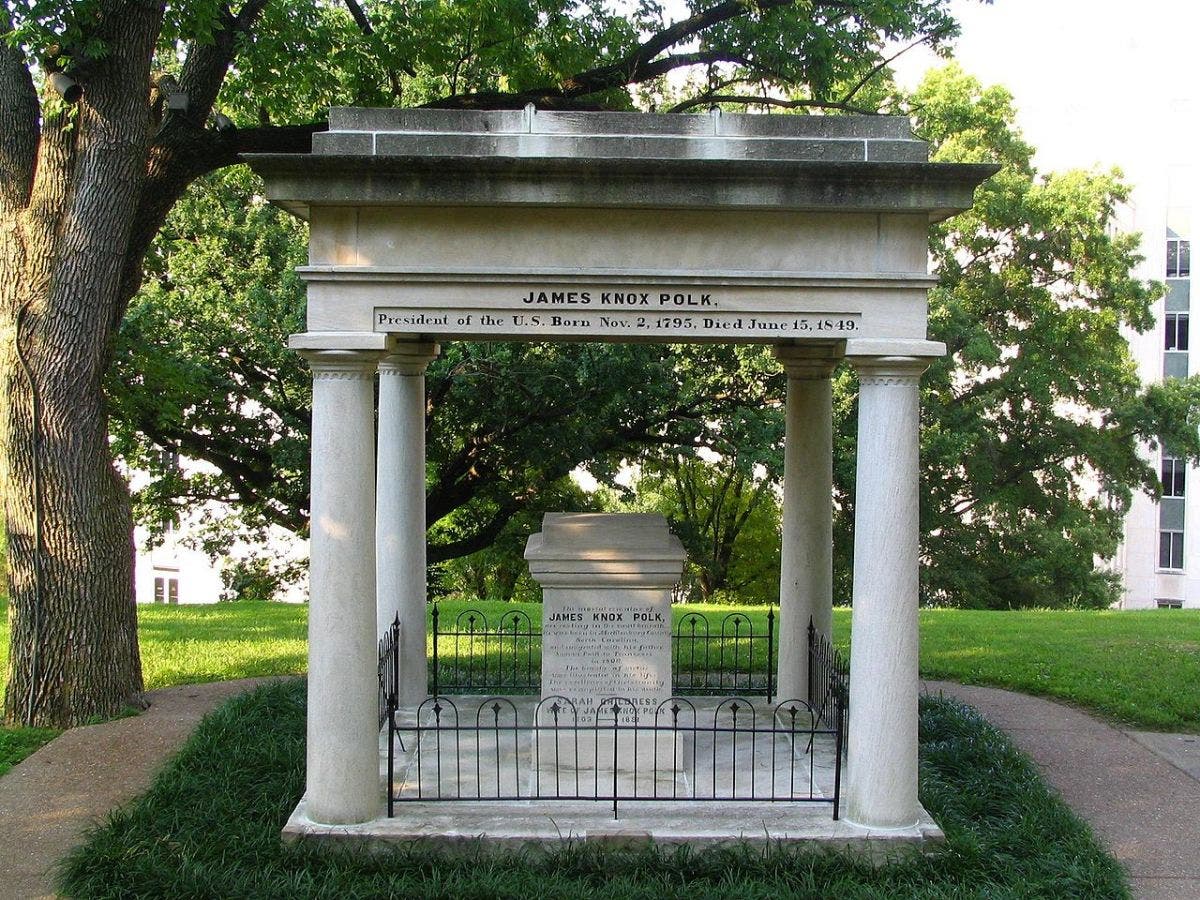
NASHVILLE, TN — As promised, State Sen. Joey Hensley filed a resolution announcing the General Assembly's support for the relocation of the tomb of President James K. Polk and his wife Sarah from the grounds of the State Capitol to the Polk Ancestral Home in Columbia.
But is that enough? Nashville State Sen. Jeff Yarbro, a Democrat, isn't so sure.
As filed, Senate Joint Resolution 141 says "we support the relocation of the Polk Tomb." The question, though, is whether that meets the standard set by a 1981 law, which reads "the grave site of James K. Polk shall not be relocated unless the proposed relocation is approved in advance by a duly adopted joint resolution of the general assembly."
Find out what's happening in Nashvillefor free with the latest updates from Patch.
Whether a resolution of support is tantamount to approval is an open question.
"The proposed resolution is likely insufficient under Tennessee law," Yarbro told Patch. Coincidentally, the 1981 law, which also allows for the equestrian statue of President Andrew Jackson to be relocated to The Hermitage without legislative approval, was sponsored by Yarbro's predecessor, longtime State Sen. Douglas Henry.
Find out what's happening in Nashvillefor free with the latest updates from Patch.
What's more, even a resolution, no matter its wording, may be insufficient. Under the Tennessee Heritage Preservation Act of 2016, passed as a result of an effort by the city of Memphis to relocate a statue of Confederate general Nathan Bedford Forrest, the first Grand Wizard of the Ku Klux Klan. That law requires that the relocation of any memorial or monument dedicated to an historic figure is prohibited unless a waiver is granted by a 2/3 vote of the Tennessee Historic Commission. Nothing in the text of that bill revokes the '81 Polk and Jackson law, so it may be construed as supplementary — that is any relocation of the Polks may require approval of the General Assembly and approval of 2/3 of the THC.
The office of the State Architect, who serves as the staff officer for the State Building Commission and the State Capitol Commission, as well as Secretary of State Tre Hargett indicated to Patch it was their belief that no THC approval would be required.
SJR141 passed its pro forma first consideration in the Senate Thursday and will next be assigned to a committee, likely the State & Local Government Committee of which Yarbro is a member.
If the Polks are indeed moved, it will be the Presidents fourth burial site and the First Lady's third. After his death, James K. Polk was buried in a mass grave for cholera victims in Nashville City Cemetery. Less than a year later, he was exhumed and buried in a tomb on the grounds of Polk Place at what is now Seventh Avenue and Union Street in Nashville. Mrs. Polk survived her husband 42 years and was buried beside him in the front yard. Then there was a fight about the will, Polk Place was sold to a developer, who tore it down to build some apartments and the Polks were carted up the street to Capitol Hill in 1893 where they've been ever since.
A group in Columbia is pushing to have the tomb moved to the site of the house built by the president's father in 1816, the same year James K. Polk matriculated at the University of North Carolina law school. That group says they are fulfilling the wishes of Polk's will, though his will explicitly states that he and his wife wanted to be buried at Polk Place. SJR141 acknowledges this, but argues "the relocation of the Polk Tomb to the President James K. Polk Home in Columbia shall more properly honor the wishes and memory of a great national leader."
Yarbro, though, disagrees.
"President Polk has been exhumed and reburied twice already. We should allow President and Mrs. Polk to rest in peace in the county they intended," he told Patch.
Other than that will, which was written in 1849, just months before his death, there's precious little in Polk's writings to indicate his eternal preference.
"I’ve read a lot of his correspondence, including every known letter he wrote or received during the last two and a half years of his life. In none of those did he discuss where he wished to be buried. He didn’t expect to die anytime soon, so that’s not too surprising," Michael Cohen, a University of Tennessee professor and editor of Polk's correspondence.
He had two wills prior to the 1849 will, Cohen said. One is lost and the other does not indicate a burial preference.
A few weeks before his death, he wrote to John Y. Mason, a friend who'd been his Attorney General and Secretary of the Navy, and spoke of how much he liked Nashville
"My heath, which suffered severely, on my return journey homeward, is entirely restored, and I am enjoying at my quiet home, in this delightful city, the rest which I so much needed. . . . I think you would find a visit to Nashville agreeable. You would be warmly received by our whole democracy, and indeed I think by our whole people, without distinction of party. Our Legislature will be in Session on the 1st Monday of October. The Supreme Court will meet at the same time. The College commencement, the annual Meeting of the Masonic fraternity, and a horse-race, will all take place on the same week, so that as I once jestingly remarked to you, you could have a selection of the entertainment which might be most agreeable to you," he wrote, according to Cohen.
As for Columbia? Polk "didn’t write either nostalgically or disgustedly about his old hometown," Cohen said. In an diary entry dated April 5, 1849, written shortly after Polk took a brief trip to Columbia, there may be a passing reference.
“I had here the inexpressible gratification to meet my old neighbours of both political parties, whom I had not seen for more than four years, when I left to proceed to Washington to enter on my duties as President of the U.S. ... My Jou[r]ney on my return from the seat of Government is now over and I am again at my home, in the midst of the friends of my youth & of my riper years,” he wrote, but Cohen said, it's impossible to know if Polk was referring to Tennessee generally or Columbia specifically as "my home."
The second reading of SJR141 has not been set on the Senate calendar and as yet it has no sponsor in the House.
For more local news that affects you, find and subscribe to your local Middle Tennessee Patch.
Image via Flickr user Brent Moore, used under Creative Commons
Get more local news delivered straight to your inbox. Sign up for free Patch newsletters and alerts.