Politics & Government
Austin City Council Passes Police Reform Measures
Five separate resolutions aimed at changing police practices and tactics were unanimously passed Thursday amid ongoing protests.


AUSTIN, TX — In unanimous votes on five separate resolutions, Austin City Council members on Thursday passed what was touted as the beginning of sweeping reform of the local police department amid ongoing civil unrest over law enforcement abuse.
During an hours-long meeting that ended just before 9:45 p.m., council members passed measures ranging from controlling the types of weapons and tactics used by police to achieving zero disparity as it relates to vehicle stops and confrontations utilizing use of force.
Yet as bold as the actions might be, they likely fell way short of measures for which many of those calling for change among the citizenry were clamoring — mainly defunding police and firing the police chief. After the meeting, Mayor Steve Adler made it clear that defunding — a clarion call sweeping across communities throughout the U.S. — was off the table as a solution.
Find out what's happening in Austinfor free with the latest updates from Patch.
"We will neither abolish nor defund the police," he wrote on Twitter. " We will not compromise the safety of the community. Period. But re-imaging policing & investing in people & the community hold the promise of making us even more safe.
We will neither abolish nor defund the police. We will not compromise the safety of the community. Period. But re-imaging policing & investing in people & the community hold the promise of making us even more safe. 8/8
— Mayor Adler (@MayorAdler) June 12, 2020
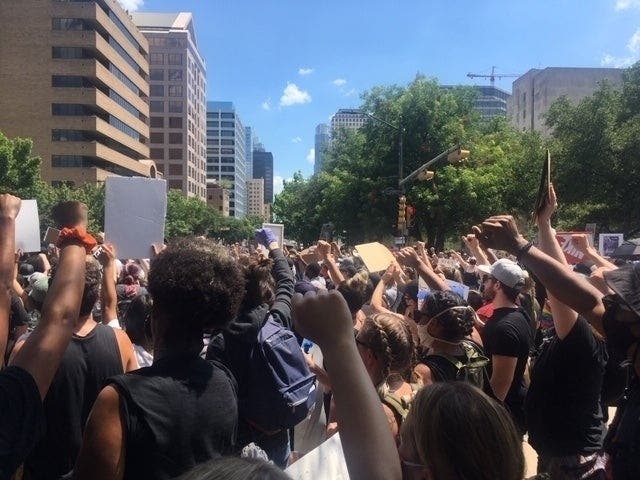
For two weeks straight, demonstrators decrying police abuse have descended to the downtown sector to express their outrage with law enforcement in the wake of recent killings — George Floyd in Minneapolis on May 25 and Michael Ramos in South Austin on April 24. The former died after an officer kneeled on his neck for nearly nine minutes while the latter died outside an apartment complex after police were incorrectly told he was brandishing a gun.
Find out what's happening in Austinfor free with the latest updates from Patch.
As demonstrators gathered in front of police headquarters for a peaceful protest two weekends ago, they were met with the very type of police tactics they were condemning. A 16-year-old Hispanic teenager and a 20-year-old African American man were both hospitalized in serious condition after being hit with a beanbag projectile in the head. A third protester, a pregnant African American woman, was struck in the belly from one of the same so-called non-lethal projectiles.
The incidents sparked outrage among city council members that led up to Thursday night's votes — all aimed at reform and control of the police department over which they have ultimate supervision. Despite the measures, a growing chorus of residents — including many of the scores who dialed into the Zoom meeting to air their views — have called for the resignation of Police Chief Brian Manley.
As disappointed as many among their ranks undoubtedly were over the removal of the defunding option, so too were they likely disheartened to hear Manley insist on the value of beanbag projectiles as effective police tools — notwithstanding the pair of injuries resulting from their use against protesters.
Last week, Manley vowed the projectiles would no longer be used to control large crowds that have materialized in downtown Austin for two weeks straight. But on Thursday, he insisted on their effectiveness as a police tool for one-on-one confrontations with suspects.
"The use of those impact munitions still absolutely have a place in policing," Manley said. "I understand — and obviously we learned a lot a few weeks ago that we have not seen before — but I do believe there is still an appropriate use for that tool because it allows us to engage with a suspect from a distance that we really don't have any other tool that would allow for."
Manley also expressed the need for chemical agents such as the CS gas — commonly known as tear gas — that also was used on protesters in the first weekend of the protests two weeks ago.
"When we have an individual — say a suspect from an armed robbery or aggravated assault — that has taken a hold up in a home — and we end up in a SWAT callout, and we're trying to bring that very violent person into custody, the most dangerous thing you can ever do in that circumstance is send a SWAT team into that home to apprehend that individual because that person will know the layout of that house better, most likely. They will have had opportunities to potentially booby trap or perhaps make a stronghold, and you're forcing a confrontation potentially that right now we're actually successfully addressing regulary through the use of these chemical munitions that create an environment that the suspect no longer wants to stay in and therefore we're able to get them to come out and surrender to us."
In short: "I am greatly concerned if there is an all-out prohibition, that will make our officers' jobs that much more difficult in that circumstance."
But the chief did make concessions on Thursday ahead of the council meeting. During a news briefing with members of a group called Just America, he said he codified a ban on choke holds. Manley said the tactic is not part of cadet training and is, in effect, banned, but he took the extra step of inserting the prohibition in the police manual to formalize its ban, he suggested.
Manley also said any officer found to have deliberately turned off their bodycam equipment while on the job will be suspended. If criminal intent is determined, cases against officers would be referred to prosecutors, he added.
During the council meeting, Manley also agreed to only use long-range acoustic devices (LRADs) as communications devices rather than their intended use as high-decibel and pain-inducing sonic weapons the chief acknowledged had been utilized during the protests. Some residents who addressed council members related stories of having been exposed to the devices that literature suggests could have negative health impacts.
For now, at least, council unanimously passed five measures representing their first steps at police reform:
- Item 50: Approve a resolution setting a goal of zero racial disparity in certain metrics under the safety strategic outcome in Strategic Direction 2023 other racial equity metrics and baseline analyses. Sponsors: Mayor Pro Tem Delia Garza, Council Member Gregorio Casar, Council Member Natasha Harper-Madison, Council Member Jimmy Flannigan, and Mayor Steve Adler.
- Item 93: Approve an ordinance amending City Code Chapter 2 relating to City Council committees and the Municipal Court; creating a Public Safety Committee; and declaring an emergency.
- Item 94: Approve a resolution relating to tenant selection policies and procedures for individuals with prior convictions or evictions.
- Item 95. Approve a resolution relating to City of Austin policies on police use of force; on police munitions, equipment, and technology; on policing tactics; and on the upcoming cadet class.
- Item 96. Approve a resolution relating to Council direction for the FY 2020-21 budget and creating reporting requirements for Austin Police Department General Orders.
Council members took stock of the historic moment — not just in Austin but across the country — as seemingly inexorable protests form daily among demonstrators demanding change. "This is a big moment, the world is watching," Flannigan said. "I'm really proud to be on this council, proud of my colleagues, proud of my community."
The councilman pointed to the chosen background of his Zoom meeting backdrop showing a photo of one of the recent locally organized protests: "I want to remember for myself the number of people who are standing over my shoulder who are doing this work."
His counterpart on the dais, Sabino "Pio" Renteria, spoke briefly of a grandson — a big baby when born now grown into a strapping young man — he's had to advise on dealing with law enforcement amid fears for his death at the hands of officers. "I'm so proud were finally taking this step and live the dream of Martin Luther King," Renteria said. "That's what I wish for, and I hope Austin just grows up and cuts that cord of racism."
Added council member Leslie Pool: "I'm honored to be on this council on this moment as we hear a call from our society to make big strides and leaps for the future we all long to see. I'm listening and I'm humbled by the passionate voice of our community who are asking us to rise and lead."
Also on the dais, introspection also came from Harper Madison — the sole black member of city council. "The nationwide sparked eruption of outrage nationwide sparked by the killing of George Floyd put a whole new dimension to this year nationwide," she began. "Seeing our own police fire bean bags and tear gas added more to that fire. Younger people are telling us they don't want to inherit thee broken systems."
Mayor Adler reserved his rhetorical flourishes for his Twitter page, where he offered an eight-part summation of council action. "Tonight, #ATXCouncil unanimously moved toward re-imagining a new model for policing," he began. "We set goals for 0 racial disparities in APD, new rules for use of force & tactics & launched a path to reinvest APD dollars in community services & support. This is more than just a moment."
He continued: "Why? Because no one should be afraid when a police car pulls up behind them. Because when white people succeed, it should be because of their merit, & not the lead they were born into at the beginning of the race. It’s not that we’re all 'racists,' " he wrote. "It’s that we are all part of systems that don’t give everyone an equal shot. All of us — each of us — can change our part of the world."
Get more local news delivered straight to your inbox. Sign up for free Patch newsletters and alerts.