Business & Tech
Austin High Tech Industry Makes Gains: Austin Chamber Report
Detailed report breaks down burgeoning industry in a city where 6,500 employers in the Austin metro area are in high tech.



AUSTIN, TX — Austin boasts of a burgeoning high tech industry, some observers going so far as to labeling the city as a mini-Silicon Valley. New data from the Austin Chamber of Commerce suggests the assessment is no hyperbole.
But it's complicated.
Over the last five years, employment in high tech industries has grown by 23.7 percent, compared to 21.1 percent for all industries in Austin, according to a chamber study released Tuesday. However, over the last ten years, the gain for high tech (30.0 percent) falls short of the gain for all industries (31.1 percent), according to the chamber data.
Find out what's happening in Austinfor free with the latest updates from Patch.
The reason for the decade slump: The recession. The economic downturn's impact on Austin jobs was a loss of nearly 21,000 jobs and nearly half of those jobs were in high tech, the chamber found. Consequently, while high tech jobs have grown faster than all jobs in seven of the last eight years, as of 2017, tech’s current 14.1 percent share of all jobs is slightly below levels maintained before the recession.
Among the study's highlights:
Find out what's happening in Austinfor free with the latest updates from Patch.
- Nearly 6,500 employers in the Austin metro area are in high tech industries.
- Jobs in Austin's tech industries total over 138,500, or 14.1% of all jobs, compared to 7.0% nationally.
- In 2017, jobs in Austin's high-tech industries grew by 4.3%, surpassing the metro's 3.2% total job growth.
Annual average employment in high tech industries in the Austin MSA in 2017 was 138,544, up 4.3 percent from 2016, the data reveal. That’s a stronger gain than the 3.2 percent increase for employment across all industries, the study's author noted. High tech jobs represent 14.1 percent of all Austin area jobs in 2017 and 18.5 percent of the year’s net new jobs, the study reveals. For added perspective: Nationally, high tech accounts for 7.0 percent of all jobs.
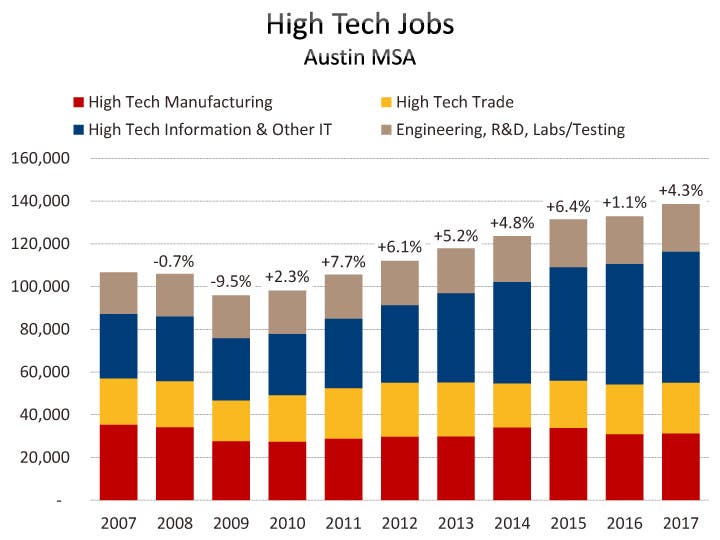
New industry data through the final quarter of 2017 was released last month by the Texas Workforce Commission (TWC). The Quarterly Census of Employment and Wages (QCEW) produces much detailed data than the monthly Current Employment Statistics program, the study noted, and allows users to examine trends in distinct and narrow sectors such as computer systems design or scientific R&D at the metro or even the county level. Since Austin is one of the most technology intensive metro economies in the U.S., we regularly examine new releases of QCEW to quantify the character and trends of Austin’s tech sector.
The chamber study found there are 6,474 high tech employer firms in Austin (13.4 percent of total). While there was a small decline in total firms in Austin in 2008, the recession did not cause the number of high tech firms to fall, according to the study.
By 2017, the number of tech firms grew by 309 or 5.0 percent, according to the data. Total firms in Austin number 48,297 in 2017, up 2,081 or 4.5 percent over 2016. High tech firms are a larger percentage of total firms now than before the recession (the share was 11.7 percent in 2007). Over the last five years, the number of firms has grown 35.7 percent in high tech industries compared to 26.0 percent overall, according to researchers. Among Austin's high tech firms, 5.0 percent (327) are manufacturers and 95.0 percent (6,147) are in non-manufacturing industries, according to analysts.
Payroll figures
In terms of total payrolls in the industry: High tech payrolls in 2017 totaled $15.6 billion, or 26.6 percent of the Austin metro’s total payroll of $58.8 billion. Total payroll growth in 2017 was 7.7 percent, while the gain for high tech industries was 10.7 percent, the data show. High tech payrolls also have a slight edge over the last five years, gaining 39.4 percent compared to all payrolls gain of 39.2 percent. Over the last decade total payrolls are up 67.7 percent compared to 63.1 percent for tech payrolls, the study found.
Annual salaries
For all industries, the average annual salary in Austin is $59,742, up 4.3 percent from 2016, while the average salary for high tech jobs is $112,771, up 6.2 percent, according to the newly released data. Since 2012, the all-industries average annual salary is up 14.9 percent, while the average tech salary is up 12.7 percent. High tech salary growth in Austin primarily faltered relative to all industries in 2007 and 2013, researchers noted. In 2006, the average high tech salary was 201 percent of the average salary. The average high tech salary registered a low of 184 percent of the all-industries salary in 2014 and 2015, but is at 189 percent last year, according to the study.
High tech employment levels
The study found that Austin’s high tech employment is 22.5 pecent manufacturing industries (31,221 jobs) and 77.5 percent non-manufacturing industries (107,323 jobs). Researchers detected that manufacturing’s share has declined significantly over the long term. After climbing nearly back to pre-recession-level jobs in 2014 (34,099), growth was negative in 2015 and 2016 (-0.7 percent and -8.8 percent respectively) in high tech manufacturing; however, these jobs gained 1.1 percent in 2017. High tech’s share of all manufacturing jobs in Austin is 54.8 percent in 2017, down from 55.8 percent in 2016, the study found.
Location quotient findings
According to the study, Austin has a location quotient (LQ) of 1.9 for the collection of industries making up high tech manufacturing, meaning that Austin employs workers in the sector at nearly two times the national rate. Austin’s computer and electronics manufacturing industry employs workers at nearly four times (3.7) the national rate.
Salaries
Salaries are higher in high tech manufacturing, $130,893, compared to the average of $107,500 in non-manufacturing high tech industries. In Austin’s tech sector, manufacturing salaries have gained 10.9 percent over the last five years, while the non-manufacturing average has risen 14.9 percent, researchers learned. Over the same period, the average salary for all industries also rose 14.9 percent, according to the research. Over the last year, salaries in high tech manufacturing rose 5.1 percent, high tech non-manufacturing gained 6.8%, while the average salary for all industries increased 4.3 percent.
Nonmanufacturing high tech industries include subsectors of trade, information, professional and business services, and education and healthcare.
Information industry breakdown
The study found that the high tech portions of the information industry include software publishers (185 Austin firms); motion picture and sound recording (229); telecommunications (117); data processing, hosting and related services (158); and internet publishing, broadcast and web portals (164). Other IT-related industries include computer systems design and related services (2,888 firms) in the professional and business services sector and computer training (29) in the education sector. Combined, high tech information and other IT accounts for 61,347 jobs and 3,769 firms in Austin in 2017. Jobs in this group of industries are up 8.5 percent (4,807) in just one year, dominating the net jobs added (5,321) by non-manufacturing tech industries in 2017. Computer systems design and related services employs 35,534 and grew by 9.2 percent, or 3,007 jobs, in 2017, researchers found.
The upshot: Austin has a LQ of 2.1 for the group of industries we’re calling high tech information and other IT, meaning that Austin employs workers in the sector at two times the national rate, researchers determined.
Average annual salaries
The average annual salary in high tech information and other IT was $110,211 in 2017, with software publishing and computer systems design and related services being the best compensated industries ($129,738 and $121,329 respectively), according to the chamber study. Salary gains (4.3 percent) were average (all industries also grew 4.3 percent) in 2017. The industry group gained 20.3 percent over the last 5 years, compared to 14.9 percent for all industries, researchers found.
Industry comparisons
After computer systems design and related services, the next largest non-manufacturing tech industry is computer and software merchant wholesalers (143 firms) which employed 19,014 in Austin in 2017, up 254 jobs or 1.4% from 2016, the chamber found.
This trade industry, together medical equipment merchant wholesalers, business-to-business electronic markets, and electronic shopping and auctions represents 583 firms and 23,832 jobs in Austin’s high tech trade industries. Employment in high tech trade is 5.9 percent (1,494 jobs) below a peak the industry reached in 2013. Average annual salary is 108,323 in 2017, up 13.6 percent over 2016, according to the research.
Austin has 9.7 percent more high tech trade jobs in 2017 than it had in 2007 while jobs in the sector nationally are up by 24.3 percent, according to the report. The driver of job growth nationally is electronic shopping and auctions. This industry has grown 220.4 percent over the decade while computer and software merchant wholesaler jobs have declined by 13.2 percent nationally. As of 2017, electronic shopping and auctions accounts for more jobs nationally than computer and software merchant wholesalers. In Austin, electronic shopping and auctions represents only 2,709 jobs, but growth over the decade was 379 percent.
High tech trade picture
Austin is highly concentrated in high tech trade, researchers said. Austin has almost five times the national concentration of jobs in this group and has 13 times the national concentration for jobs in computer and software merchant wholesaling, researchers added.
Architectural and engineering services (1,185 firms), environmental consulting services (95), other scientific and technical services (241), scientific R&D services (204), and medical and diagnostic laboratories (72) round out the remainder of the high tech sector and employed 22,144 in 2017, down 0.3% from 2016 but up 7.0% since 2012. Architectural and engineering services employs 14,843 of the total while scientific R&D employs 2,882. Austin’s LQ for engineering, R&D, and labs/testing is 1.2.
An Excel file of TWC data for Austin MSA establishments, firms, employment, payrolls, and average salary data for 2005-2017 for all of the high tech industry classifications referenced above, plus data for all other industry classifications is here. The file opens on an extract of the data for high tech industries as employed in this article. The other tab in the file contains data for all industries from major sectors to 6-digit NAICS. The data in the file is “total,” i.e., private and public.
The study was prepared by Beverly Kerr, vice president of research. Kerr joined the Chamber’s Economic Development Department in 2004, following 10 years in a similar role with the Kansas City Area Development Council. She earned an M.A. in economics at the University of Missouri-Kansas City.
>>> Image courtesy Austin Chamber of Commerce
Get more local news delivered straight to your inbox. Sign up for free Patch newsletters and alerts.