Crime & Safety
FBI Unable To Crack Encryption On Texas Mass Shooter's Phone
Killer's phone is being sent to lab for analysis, officials said in a Tuesday press conference updating with other investigation details.


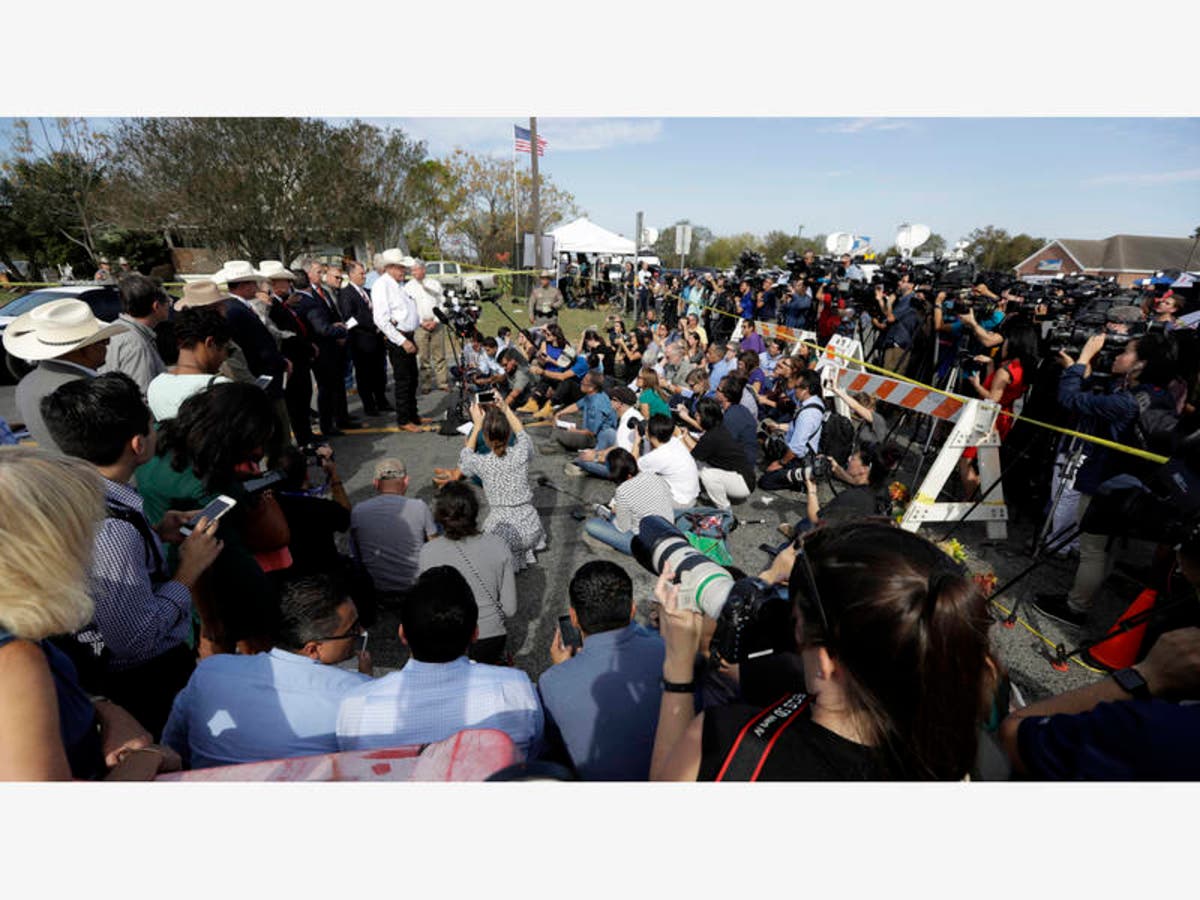
AUSTIN, TX — The FBI official in charge of the investigation into last weekend's Texas mass shooting that left 26 dead acknowledged the agency has been unable to unlock the killer's phone due to encryption technology, officials said Tuesday.
Christopher Combs, the FBI special agent in charge of the investigation, said the shooter's phone was being flown to the FBI Training Academy in Quantico, Va., to try to crack the encryption code the shooter used on his phone. His comments came during a noon press conference to update reporters on the investigation.
"The phone of the subject was turned over to us," Combs said. "We flew that on a DPS plane last night to Quantico. They're in the process of looking at the phone. Unfortunately, at this point in time, we are unable to get into that phone. That actually highlights an issue you've all heard of before: With the advance of the technology of phones and the encryptions, law enforcement whether it's at the state, local or the federal level is increasingly not able to get into these phones."
Find out what's happening in Austinfor free with the latest updates from Patch.
Cracking the phone is critical in learning more about the killer's motivations, particularly given anecdotal reports he had sent threatening texts to his mother-in-law prior to embarking on his rampage.
This past Sunday, Devin Kelley opened fire on parishioners at the First Baptist Church of Sutherland Springs, Texas, during a late morning service. In the aftermath of his rampage, 26 were left dead in the worst mass shooting in state history and the nation's most prolific church shooting.
Find out what's happening in Austinfor free with the latest updates from Patch.
Combs did acknowledge the mother-in-law was the likely target of the shooter's rage, but declined to speak further on his motivation. Earlier reports confirmed that the grandmother of the shooter's estranged wife, 71-year-old Lula White, was among those attending the service and was also killed.
Martin Freeman of the Texas Department of Public Safety echoed the assessment: "He was upset with the mother-in-law but I can't comment beyond that."
At the outset of the press conference, officials laid out the subjects they would not discuss with reporters. Among those topics deemed off limits given the preliminary nature of the investigation were the killer's motive and details related to his year-long stint in the U.S. Air Force.
Although not mentioned at the press conference, the quest to crack the encryption code could set the scene for a battle with the service provider in gaining access to the cell phone's contents. In similar past cases involving killers' phones, law enforcement officials have often faced challenges in convincing service providers to agree in providing access to contents. In response to reporters' questions, Combs declined to reveal details on the type of phone the shooter used, citing avoidance of aiding copycats from securing similar technology to obscure their communications from law enforcement.
On another note, Combs said there was no evidence the shooter utilized a so-called "bump stock" to optimize his carnage similar to the one in the Las Vegas massacre that left 58 people dead. Some reporters seemed incredulous the device wasn't used given the level of carnage — the reaction perhaps exacerbated given investigators' decision to not yet confirm the number of shots fired — but Combs said no such device was found.
The shooter is said to have utilized an Ruger AR rifle for his killing spree, with 15 loaded magazines.
A bump stock is an attachment that modifies a long, semi-automatic rifle to fire even faster toward mimicking a fully automatic weapon. The device replaces a rifle's standard stock, which is the part of the weapon that is held against the shoulder in firing.
Its non-use notwithstanding, the church-turned-crime scene is still a hotbed for investigators, with 136 law enforcement officials alternately at the site as they continue to scour for evidence, Combs said. The FBI agent also confirmed that Kelley was not in the FBI database that could've yielded red flags upon his purchase of firearms, but wouldn't elaborate.
Officials at the U.S. Air Force previously acknowledged they erred in not sending information about Kelley to the FBI following the shooter's conviction related to domestic abuse for which he was dishonorably discharged following his military stint. Kelley was found to have physically abused his wife and young son, reportedly fracturing the latter's skull, leading to a year in incarceration.
The information would have prevented Kelley from buying any of the four firearms he owned that have since been inventoried as evidence, officials have said.
As for the victims, one official noted the state's Crime Victims Compensation Fund would be tapped to assist them with financial assistance related to burial and medical treatment costs. Each victim would be eligible for up to $6,500 from the fund, an official noted. Additionally, a benefactor has offered to buy the caskets for each of the dead, but officials at the press conference didn't release his name.
The benefactor was later identified by media outlets as Robert Dixon Tips, who owns funeral parlors in San Antonio. In an interview with CNN, Tips said he would be offering the full range of funeral needs — funeral services caskets, grief counseling — to victims in need.
Officials said 10 other victims who survived the slaughter remain in critical condition. Immediately following the press conference, a spokeswoman at University Hospital in San Antonio where four victims of the massacre are being treated said two adults were upgraded to serious condition while a pair of children injured in the shooting remain in critical condition.
The nature of the massacre in a tiny, rural Texas town has left many in shock in knowing that no place is now immune to such violence. Combs mused on this reality during the press conference, saying that everyone should be cognizant of potential violence and should have a plan of action in mind — not unlike fire drills, particularly in the times before smoke-detection technology when there were exponentially more fatalities from fires than today.
"I think we should all be thinking about what we need to do if a crisis breaks out," Combs said. "We all have to think about this. if you're in a school, at college, at the movies, we should all be thinking 'what are we going to do if a crisis breaks out right here?' "
Watch: FBI Has Texas Suspect's Phone, Working On Getting In
>>> Photo credit: Eric Gay/Associated Press
Get more local news delivered straight to your inbox. Sign up for free Patch newsletters and alerts.