Politics & Government
Impasse Deepens Between Texas Governor, Travis County Sheriff Over Immigration Enforcement Policy
County Judge gets terse reply to written plea urging governor rethink threat to block funds over sheriff's stance on immigration enforcement


AUSTIN, TX — Travis County Judge Sarah Eckhardt thought she might convince the governor from withholding $1.8 million in grants over his feud with the sheriff on local immigration enforcement policy. Programs benefiting women, children and veterans would be in jeopardy should he block the grants, she wrote on Wednesday, thinking she would persuade him by appealing to his sense of compassion.
She was wrong. On Friday, she got her official response — not from the governor personally, but delegated to the Camille Cain, the executive director of the criminal justice division of the governor's office.
"I too am hopeful that we can reach a reasonable resolution of this matter," Cain wrote to Eckhardt in a letter provided to Patch. "But our office’s criminal justice grants must be used to uphold the justice system and cannot be wasted on local governments intent on undermining it."
Find out what's happening in Austinfor free with the latest updates from Patch.
Abbott's threat to ban the funds comes as he clashes with Travis County Sheriff Sally Hernandez, who has said her office would limit its cooperation with federal Immigration, Customs & Enforcement (ICE) agents in helping deport residents who are arrested and suspected of being undocumented.
The issue isn't about compassion, Cain wrote Eckhardt: "The Governor disagrees with your assertion that the 'compassionate' thing to do is to ignore ICE’s request, to superimpose one sheriff’s capricious conception of public safety over the considered wisdom of federal immigration authorities, and to allow these criminals to walk free—in her own streets no less."
Find out what's happening in Austinfor free with the latest updates from Patch.

Hernandez has cited the corrosive effect the practice has on community policing and building trust in vulnerable populations, saying her priority in honoring detainer requests would be limited to those proven to have felonies or sexual assaults as part of their criminal background.
Not good enough, Cain wrote in her letter, and the vow to block the grants stands as a result of the sheriff's stance: "This dispute centers on the rule of law, which ultimately guarantees both public safety and security," Cain explains. "As a local sheriff, Hernandez is the chief law enforcement officer of her county. Her dictate is to enforce the law and keep the community safe. Her policy does precisely the opposite."
In her original letter urging the governor to reconsider, Eckhardt lists the various county agencies that would languish should the grants be blocked:
- Travis County Veterans Court focusing on defendants suffering from Post Traumatic Stress Disorders, Traumatic Brain Injury and other mental health disorders that resulted from combat-related experience. The court links veterans with misdemeanors and felonies who are defendants to services, monitoring their progress and diverting them from further criminal sanctions.
- Parenting in Recoverty (PIR) Travis County Family Drug Treatment Court (FDTC), a civil courts program providing a continuum of court and community-based supports for parents and their children involved in the Child Protective Services docket. "PIR/ FDTC helps children stay with their loving families rather than entering the foster care system by helping their parents become sober, responsible caregivers, ensuring the safety and well-being of the children they love," Eckhardt wrote.
- Family Violence Accelerated Prosecution Program and victims outreach. "The County Attorney's program enhances victim services and speeds op the prosecution of criminal family violence cases," Eckhardt wrote. "With the additional staff funded in part by your office, victims receive rapid outreach and intervention increasing the likelihood of their meaningful participation in the prosecution." Over the past three years, Eckhard noted, the time to file a case has dropped 37 percent and the time from filing to disposition has dropped 62 percent, Eckhardt wrote.
- The Phoenix Court (prostitute prevention), a grant program created pursuant to Senate Bill 484 that requires counties with populations of more than 200,000 to implement a prostitute prevention program. The county created the Phoenix Court in response as a pilot program during Fiscal Year 2015, with full implementation in FY 2016. "The program provides case management and other services to assist these women who are both defendants and victims in untangling themselves from the commercial sex trade," Eckhardt wrote.
- Trauma Specific Treatment for Juveniles. The Travis County Juvenile Probation Department provides an evidence-based education advanced therapy program, TARGET, for children who have experienced trauma. The program increases the child's opportunities for success, recovery and an adulthood free of criminal involvement.
- Travis County Adult Probation DWI Court, a proven effective program reducing repeat DWI offenses through treatment, supervision and judicial involvement.
- Drug Diversion Court, a proven effective program reducing repeat drug offenders through case management and treatment services.
"Moreover, all of Travis County’s grant contracts with our office incorporate those federal provisions and disqualify the County from receiving money when it breaches..." she wrote. "Sheriff Hernandez’s new sanctuary-city policy plainly violates these provisions. Her obstructionist policy prohibits, for example, all Travis County Sheriff’s Office employees from “conduct[ing] or initiat[ing] any immigration status investigation[s] into individuals in TCSO custody.”
Cain claimed in her letter that the Travis County Sheriff's Office has arrested 56 people for whom ICE issued a detainer request, effectively categorizing them as threats to the public safety.
"But only two of those detainers would be honored under the Sheriff’s new policy," Cain said. "The Sheriff would ignore the other 54 and allow those individuals to go free — notwithstanding their arrests for heinous crimes like these," she wrote. She lists the infractions: Aggravated assault with a deadly weapon; assault with bodily injury; assault with bodily injury of a family member; sexual assault; felony assault family violence strangulation; and intentional injury to a child, elder, or disabled individual.
Cain then cites three cases that where requests for ICE detainer requests would not be honored under Sheriff Hernandez's preferred protocol:
- "Willison Peter Mogga, from Sudan, who was arrested for injury to a child, elder, or a disabled individual with intent. His known previous convictions include felony obstruction or retaliation, deadly conduct, drug possession (marijuana and penalty group 1 drugs), assault causing bodily injury to a family member, and driving while intoxicated."
- "Santos Cruz-Garcia, from Mexico, arrested for burglary of a building. His prior convictions include aggravated assault with a deadly weapon and multiple convictions for assault on his own family members causing bodily injury. He was previously deported and returned to the U.S. illegally."
- "Salvador Simon, from Mexico, was arrested for possession of drugs but has prior convictions including assault on a family member with bodily injury, criminal trespass, and multiple convictions for driving while intoxicated."
Cain then cites Eckhardt's own concerns of the erosion in assistance efforts to crime victims by suggesting Hernandez's stance runs counter to such worries.
"Currently, CJD is spending over $200 million to help victims of crime to recover from such traumatic crimes as the ones above. Of that amount we focus over $180 million specifically for victims of sexual assault, domestic violence, and child abuse. The Sheriff's policy embodies a willingness to not use every tool at her disposal to help these victims get away from their abusers."
Cain acknowledged the likelihood that other county programs would suffer as a result of the grants cutoff, as
Eckhardt acknowledged, which is why Abbott is now exploring methods that might enable him to remove "wayward local officials" like Hernandez — duly elected as sheriff this past November with 60 percent of the vote against a Republican challenger — from office.
"That is one reason why Governor Abbott will work with the Legislature during this session to impose new penalties that fall directly on the shoulders of wayward local officials," Cain wrote in her letter to Eckhardt. Abbott went on the nationally broadcast "Fox & Friends" this week saying he would seek ways to find a way to remove Hernandez over her disagreement with him on how best to enforce immigration policy at the local level.
"In the meantime, however, our office will not continue to funnel state taxpayers’ dollars to a local government whose illegal policies breach the very grant agreement that is the source of those funds," Cain wrote.
In conclusion, Cain extrapolates Eckhardt's own verbiage from her original letter to Abbott to further emphasize the governor's stance. "I am heartened by your history of holding public service above politics," Eckhardt originally wrote to Abbott in appealing to his sense of compassion to abandon the threat to cut funds.
But the flattery didn't have the desired effect: "If Travis County is interested in 'holding public service above politics,' as your letter suggests, the easiest way to do so is by honoring duly issued detainer requests," Cain wrote.
"It takes two to write a letter as much as it takes two to make a quarrel," Elizabeth Drew once said. In Travis County, the quarreling on this issue comes in both printed and spoken form with no signs of capitulation, acquiescence or reconciliation. Instead, the impasse is ICE cold.
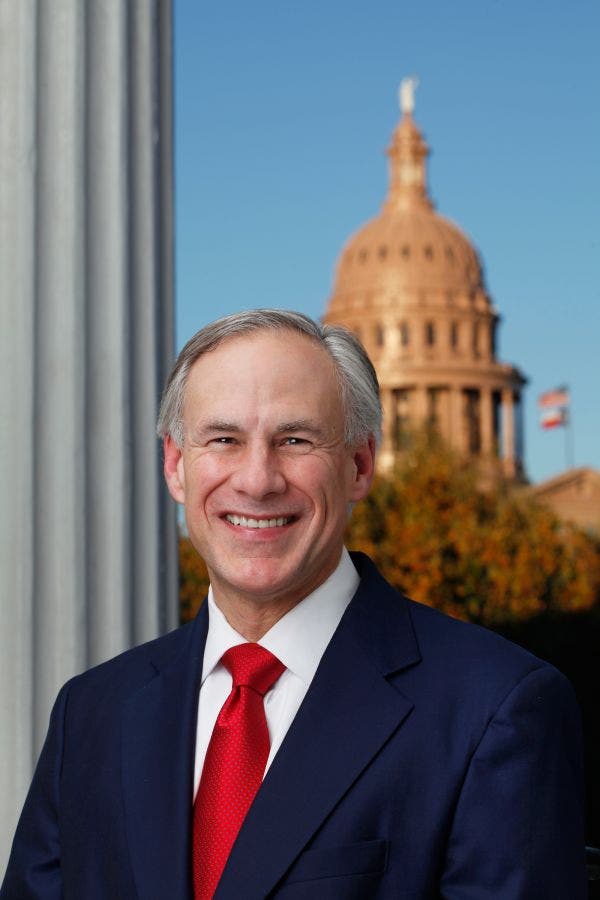
>>> Above, Gov. Greg Abbott (official photo)
Get more local news delivered straight to your inbox. Sign up for free Patch newsletters and alerts.