Politics & Government
Prolonged Slump In Oil Prices Will Contribute To Tight State Budget For Texas
$104.9 billion in revenue available for general-purpose spending for next biennium is a drop of nearly 3 percent from last cycle.


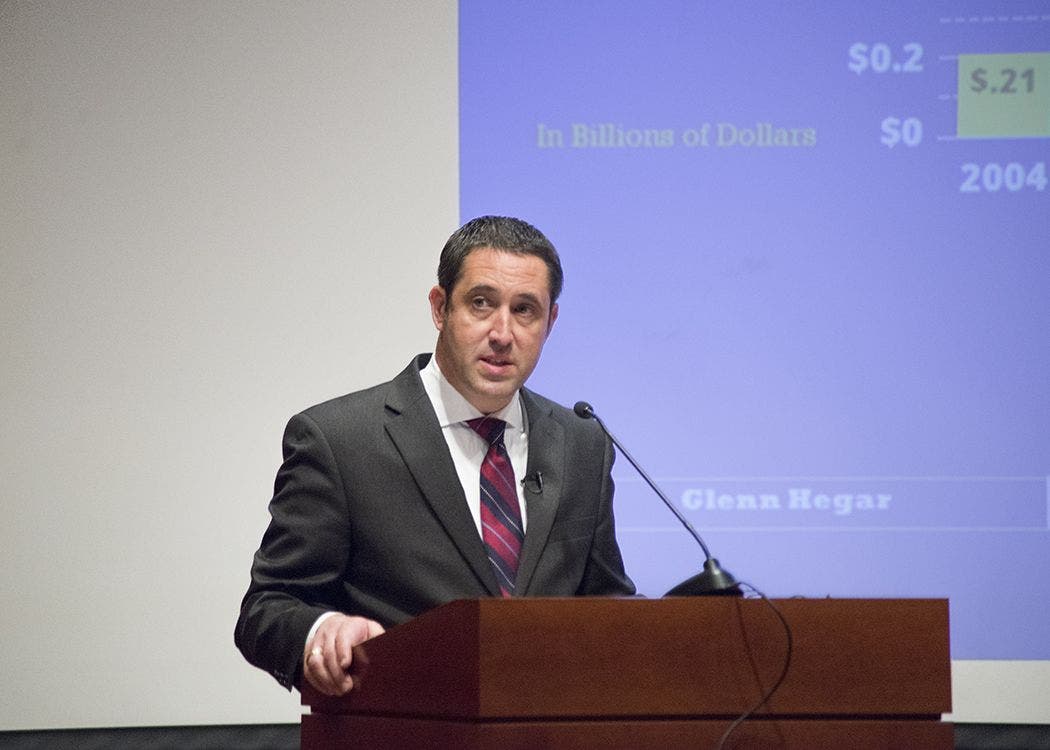
AUSTIN, TX — The continuing slump in oil prices will yield a tight state budget that will be nearly 3 percent less than what was available in the last spending cycle, according to a report by the Texas Comptroller on Monday.
Texas Comptroller Glenn Hegar released the state's Biennial Revenue Estimate on Monday, showing the state is projected to have about $104.9 billion in revenue available for general-purpose spending during the 2018-19 biennium. The total represents a 2.7 percent decrease from the amounts available for the 2016-17 biennium.
"Ongoing weakness in activity related to oil and natural gas has been a drag on state economic growth and led to lagging revenue collections in 2016," Hegar said. "Still, the diversity of the Texas economy has allowed for slow but continued economic expansion and steady growth in employment, which we expect to continue over the coming biennium. Texas stands in contrast to other states with large energy industries, many of which have suffered declines in employment and economic output."
Find out what's happening in Austinfor free with the latest updates from Patch.
But the comptroller noted the decline isn't due to a projected drop in total revenue collections from the 2016-17 biennium to the 2018-19 biennium. Instead, the comptroller is projecting overall revenue growth from teh current biennium to the next.
"Such growth, however, is offset by a significantly lower beginning balance of $1.5 billion," the report reads. "In addition, a 2015 voter-approved constitutional provision (Proposition 7) dedicates up to $5 billion in biennial sales tax revenue to the State Highway Fund (SHF) starting in the 2018-19 biennium to address important transportation infrastructure needs."
Find out what's happening in Austinfor free with the latest updates from Patch.
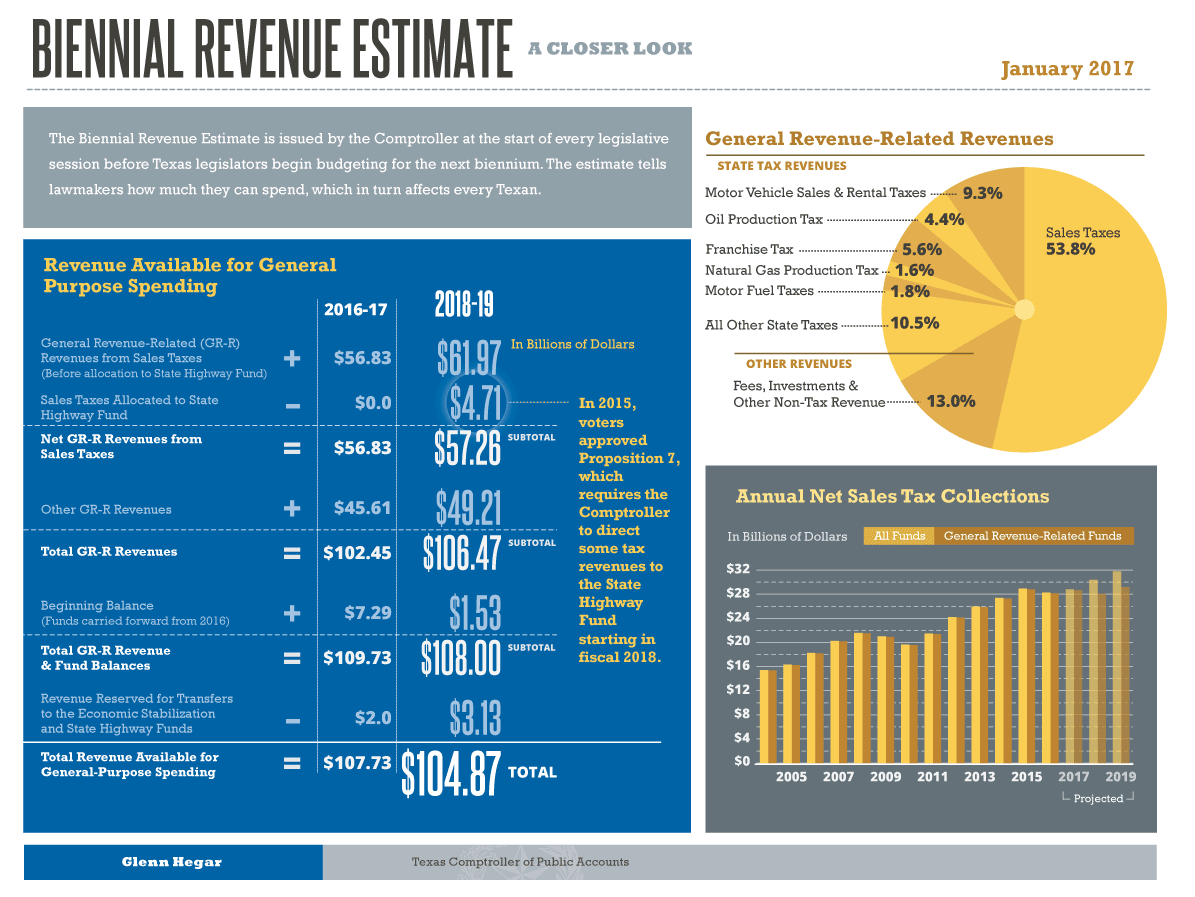
Hegar crunched the numbers. Sales tax collections make up the state's largest source of General Revenue-Related (GR-R) revenues, estimated to be nearly $62 billion in the next biennium, he said. But when subtracting $4.7 billion dedicated to the State Highway Fund (SHF) as a result of Proposition 7, leaves nearly $57.3 billion.
(Last November, voters overwhelmingly approved Prop 7, a constitutional amendment to dedicate portions of revenue from the state's general sales and use tax, as well as from the motor vehicle sales and rental tax, to the SHF for non-tolled projects.)
Added to the sales tax collections are other GR-R revenues of $49.2 billion and a beginning balance of about $1.5 billion, bringing the subtotal to $108 billion, Hegar said. From that subtotal, $3.1 billion will be set aside for transfers to the Economic Stabilization Fund and the SHF, leaving $104.9 billion available ot the Texas Legislature for general-purpose spending in the next biennium, Hegar said.
Reacting to the report, Gov. Greg Abbott framed the upcoming budget as one that will focus on priority spending that doesn't outpace population growth or the rate of inflation.
“Texans expect their government to live within its means, and I fully expect to sign a budget that does just that," Abbott said in a prepared statement. "As fiscal conservatives, we must treat our state budget the way families do – by funding our priorities, while constraining the size and growth of government. I will work with the Legislature this session to craft a budget that funds our most vital services without growing faster than the growth of population and inflation.”
The comptroller's report foreshadowing a pared-down budget is the latest less-than-robust outlook for the state since Abbott's first year as governor after being inaugurated in January 2015. Following a strong 5.9 percent increase in real gross state product in fiscal 2015, the Texas economy is estimated to have grown by only 0.2 percent in fiscal 2016, Hegar said in his report.
In fiscal 2017, the Texas economy is projected to grow by just 2.5 percent, the comptroller added. That growth rate should increase slightly to 3.0 percent in fiscal 2018 and 3.1 percent in fiscal 2019, Hegar projected. Moreover, Hegar said employment growth is expected to be 1.9 percent in fiscal 2018 and 1.7 percent in fiscal 2019, while the state's unemployment rate is expected to remain relatively unchanged at 4.5 percent in both fiscal 2018 and 2019.
Among other large tax revenue sources, as outlined in the report:
- motor vehicle-related taxes, including sales, rental and manufactured housing taxes, are expected to reach $9.87 billion, up 6.7 percent from 2016-17.
- oil production tax collections are projected to generate $4.7 billion in the 2018-19 biennium, a 32.3 percent increase from $3.6 billion generated in the current biennium; natural gas tax collections in the 2018-19 biennium are expected to be $1.7 billion, 27 percent more than the $1.3 billion collected in 2016-17.
- the state's franchise tax revenue for all funds is estimated to be $7.8 billion for 2018-19, a 2.4 percent increase.
As far as the state's Rainy Day Fund balance, it currently stands at approximately $10.2 billion, Hegar noted. Absent any additional appropriations that might be made by the Legislature, the balance is expected to be $11.9 billion at the end of the 2018-19 biennium, he added.
"While our state revenues were down in 2016 and we face some difficult decisions in the coming months, Texas remains fiscally healthy," Hegar said. "Despite energy-related headwinds, Texas has gained 210,000 jobs in the last year, and while our gains have not been at the same rapid rate as a few years ago, it is important to note that we have added jobs in 19 of the last 20 months. We have also seen signs of possible improvement in recent months, with some modest acceleration in job growth and oil prices and rig counts rising. And December brought the best monthly sales tax revenue collections since May 2015."
State revenue from all sources and for all purposes is expected to reach $224.8 billion for the 2018-19 biennium, including approximately $74.9 billion in federal receipts, along with other income and revenues dedicated for specific purposes and therefore unavailable for general-purpose spending, the state comptroller said.
The full Biennial Revenue Estimate is available on the Comptroller's website.
>>> Photo of Glenn Hegar delivering his Biennial Revenue Estimate report courtesy of Comptroller of Texas
Get more local news delivered straight to your inbox. Sign up for free Patch newsletters and alerts.