Business & Tech
Real-Life Angry Birds: Audubon Society Decries Austin Energy Nests Destruction
Feathers ruffled over utility workers' practice of destroying parakeet nests, chicks and all, from utility poles throughout the city.


AUSTIN, TX — Austin Energy officials on Friday responded to accusations by Audubon Society preservationists that utility workers routinely destroy parakeet nests from energy poles with birds in the throes of raising their young amid their nesting season.
The charge came Thursday via a Facebook book by officials of the Travis Audubon Society.
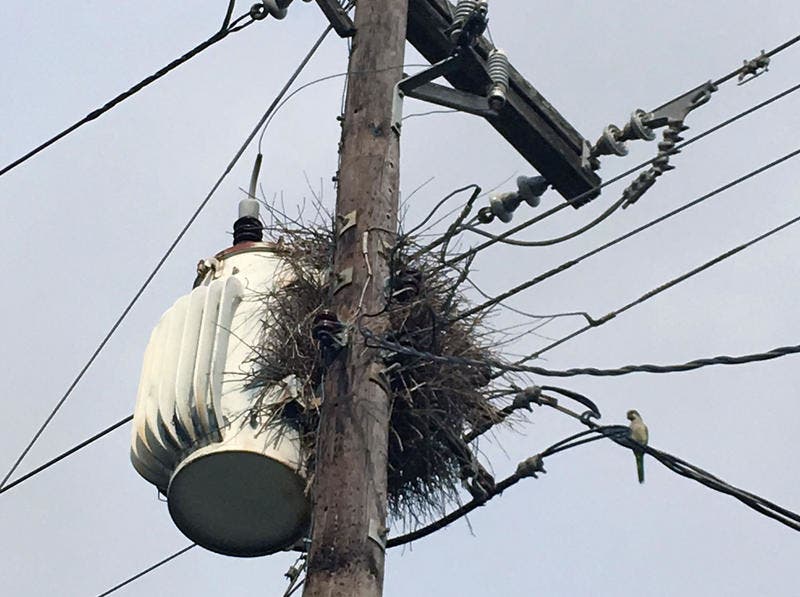
"This month, Austin Energy is using long poles to knock Monk Parakeet nests from power poles," Audubon Society officials wrote. "During this heartless process, adult birds repeatedly dive-bomb the crews, desperately trying to protect their eggs and young from this cruel attack. The parakeet eggs and flightless young plummet to the ground, before Austin Energy crews toss them into a truck for disposal."
Find out what's happening in Austinfor free with the latest updates from Patch.
At a press conference to address the accusation, Operating Officer Elaina Ball acknowledged the nest removal, but said it is done for safety purposes when the sometimes-large nests are too close to the power source. The nests pose a fire hazard she said in defending the process of using the long implements to shear the nests into sections in destroying the habitats.
“When we do remove a nest, our crews will only be working on nests that are up in the energized space," Ball said at a media briefing at the intersection of Pleasant Valley and Riverside Drive, where a nest cluster offered a ready-made visual aid. "It’s not safe for our crews to reach in and grab those nests," she added, saying the insulated, electrocution-proof tools used are used to carefully clip each nest until it's destroyed.
Find out what's happening in Austinfor free with the latest updates from Patch.
"Please call and email Austin Energy immediately and demand that they stop this cruel practice," officials wrote. "If you would like to help document this tragedy by following Austin Energy crews at night, please contact Travis Audubon Society at membership@travisaudubon.org to volunteer."
Although not native to Central Texas, colonies of Monk parakeets abound in Austin. Presumably, the former pets were released from cages or escaped to try to make a go of it in the wild. Their un-caged freedom can be seen in a number of larges nests seen atop utility poles. Last year, more than 300 of the avian critters were displaced when the UT-Austin Whitaker fields were remodeled last year, as reported by local media outlets.
But Ball insisted utility crew members are not bad people, but simply doing their job in the interest of safety. Our crews are good people," she insisted. "We're all part of the community; we're working with each other to take care of each other and take care of the environment," she said, noting that one crew worker has taken empathy on the fallen young, nursing them back to health while raising them in what was described as sounding like a baby bird foster program.
Native to Argentina, the birds nesting season occurs during warmer climate from March to July, according to the Cornell Lab of Ornithology. According to officials there, Austin is hardly unique in having an abundance of parakeets out in the wild.
"It may come as a surprise to see noisy, green-and-gray parrots racing through cities in the U.S.," Cornell Lab of Ornithology officials write. "But Monk parakeets, native to South America but long popular in the pet trade, established wild populations here in the 1960s. They are the only parrots to nest communally; dozens live together year-round in large, multifamily stick nests built in trees and on power poles. These large group nests may be one aid to surviving the cold winters in adopted cities as far north as Chicago and New York."
The utility spokeswoman insisted work crews are "thoughtful" in removing the nests, a task only done with the twig-and-grass homes get out of hand: "They don’t go out and remove all the nests everywhere, we really only look at nests that have an extreme public safety or reliability issue,” she said.
Were they able to be quoted, affected birds would like have a decidedly different perspective. Angry birds, indeed.
>>> Uppermost photo: Monk parakeet ponders life at the Costanera Sur Nature Reserve, Buenos Aires, Argentina, by dfaulder via Wikimedia Commons
Get more local news delivered straight to your inbox. Sign up for free Patch newsletters and alerts.