Business & Tech
Revised Data Show Austin Is Nation's 4th Best-Performing Metro Area
By contrast, Houston contracted by 3.0 percent in 2016, while Dallas, San Antonio ranked 15th and 13th in terms of growth respectively.


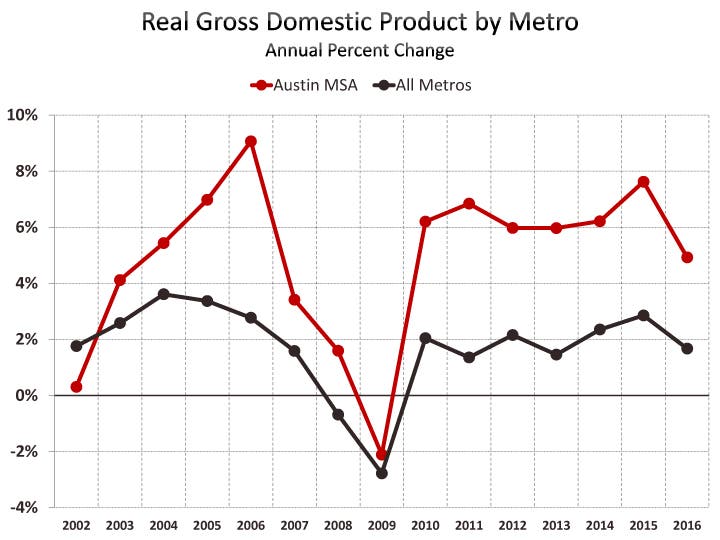
AUSTIN, TX — Austin's economy grew 4.9 percent in 2016 according to new data on gross domestic product (GDP) by metro released late last month by the U.S. Bureau of Economic Analysis (BEA).
The numbers were released Tuesday by the Greater Austin Chamber. Growth for 2015 — which was previously stated as 5.0% — has been revised to 7.6 percent, according to the new findings. These growth rates are real, inflation-adjusted, rates, chamber officials noted.
"While 4.9 percent growth is slower than what Austin has seen each year since 2010, relative to almost all major metros in 2016, Austin’s performance is outstanding," chamber officials noted. The mixed-bag sentiment was expressed during a previous interview Patch conducted with Drew Scheberle, the chamber's senior vice president, Federal/State Advocacy & Education/Talent Development.
Find out what's happening in Austinfor free with the latest updates from Patch.
Before delving into the numbers, an overview:
- Austin’s economy grew an outstanding 4.9% in 2016, making it the fourth fastest growing major metro economy in 2016.
- Professional and business services was the most significant driver of Austin’s GDP growth in 2016, but financial activities and trade were also important.
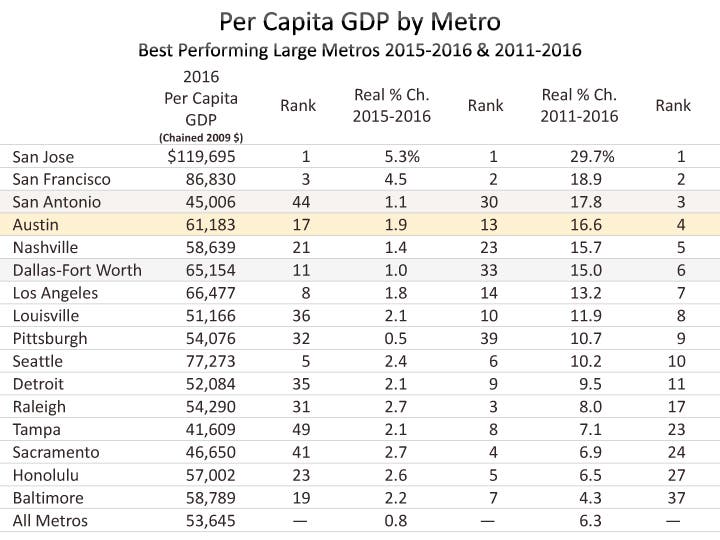
- Over the last 5 years, real per capita GDP is up 16.6%, making Austin the fourth best performing major metro.
- While Austin ranks as the 31st largest metro based on population, its economy ranks as the 27th largest.
Related story: Austin Economy Grows, But Not As Robustly As Some Had Hoped
Find out what's happening in Austinfor free with the latest updates from Patch.
Economic growth in 2016 across U.S. metropolitan areas was widespread. However, only 70 percent of 382 metros saw real gains, compared to 75% in 2015, according to the latest data. Aggregate growth for all U.S. metros fell to 1.7% in 2016 after increasing by 2.9% in 2015, the findings indicate.
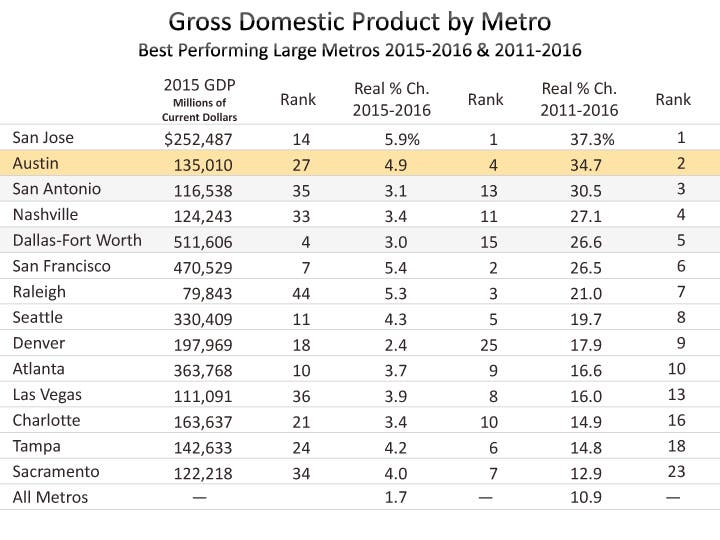
Despite some measure of disappointment over last year's modest gains, the nearly 5 percent growth in real GDP represents the fourth-highest rate of growth among the 50 largest metro economies, chamber officials noted. Austin follows San Jose, Calif., which grew by 5.9 percent, San Francisco (5.4 percent), and Raleigh (5.3 percent). In Texas, San Antonio grew 3.1 percent and ranked 13th while Dallas-Fort Worth’s 3.0 percent growth ranks 15th. Houston’s economy, which had growth of 4.9% in 2015, contracted by 3.0 percent in 2016, ranking 50th among the nation's metro areas.
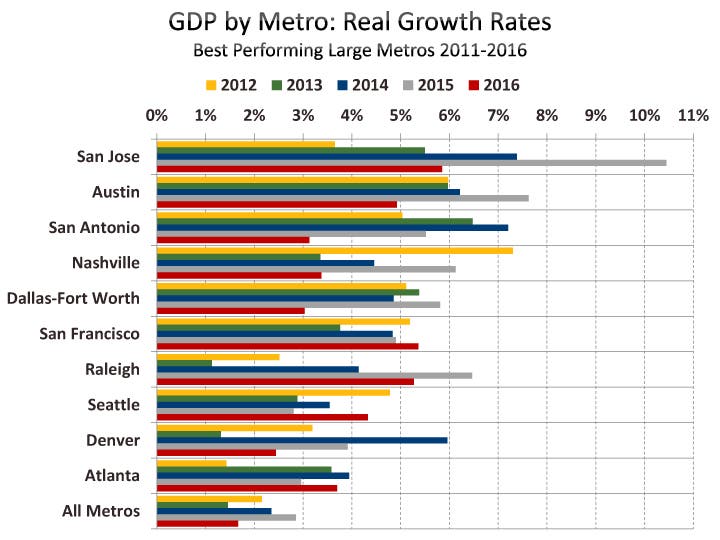
"For the metropolitan portion of the U.S. as a whole, and for Austin, 2009 is the recession low-point for real GDP and positive growth resumes in 2010," chamber officials said. "Over the last 5 years, real GDP is up 10.9 percent in the metropolitan portion of the U.S. In Austin, real GDP has grown 34.7 percent since 2011, making it the second fastest growing major economy—behind only San Jose. San Antonio (up 30.5%), Dallas-Fort Worth (up 26.6%), and Houston (up 14.9%) rank as the third, fifth and 17th-fastest growing large metros for 2011-2016."
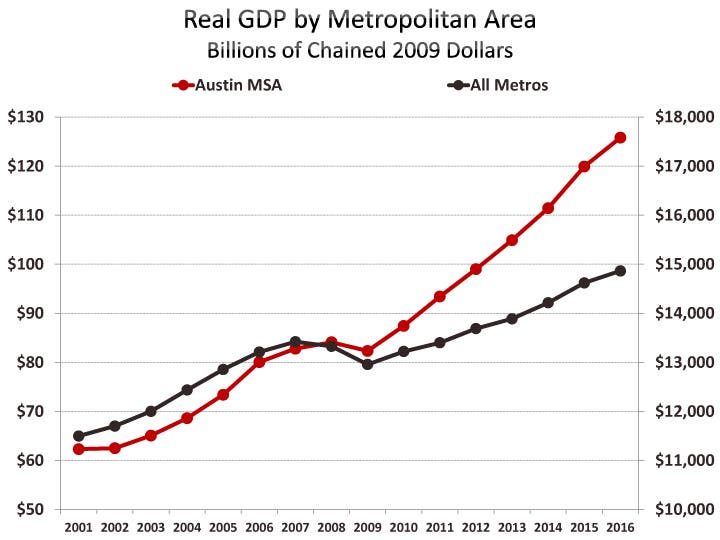
Moreover, Austin’s current dollar GDP totals $135.0 billion in 2016, making it the 27th largest U.S. metropolitan economy, the new data indicate. At the time of last year’s release of this data, Austin ranked 32nd. However, this release revises upward Austin’s 2015 GDP, making it 27th largest in 2015 as well. On the basis of population, the Austin metro ranks 31st in 2016.
While 70% of all metropolitan economies grew in real terms in 2016, 94 percent of the 50 largest metros grew (in addition to Houston, Oklahoma City and Virginia Beach had negative growth in 2016). In aggregate, their growth was 1.9 percent, slightly greater than the 1.7 percent real gain for the entire metropolitan portion of the U.S., according to the data. The 50 largest metros account for 73% percent of U.S. metropolitan area GDP.
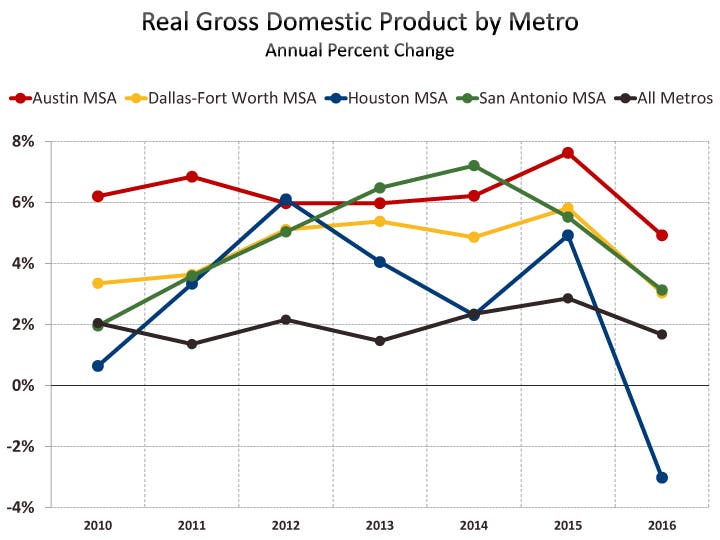
Austin real GDP performed well versus other metro areas
Austin’s real GDP on a per capita basis performed well relative to other large metros over both 2015-2016 and 2011-2016, according to the revised figures. The upshot: Austin ranks 13th with 1.9 percent real growth in per capita GDP in 2016, while the growth for all metros was 0.8 percent. Since 2011, real per capita GDP is up 16.6 percent in Austin, making it the fourth-best performing large metro. Across all metros, 2011-2016 growth was 6.3 percent. Gains in real GDP on a per capita basis reflect improvement in an area’s standard of living, chamber officials noted.
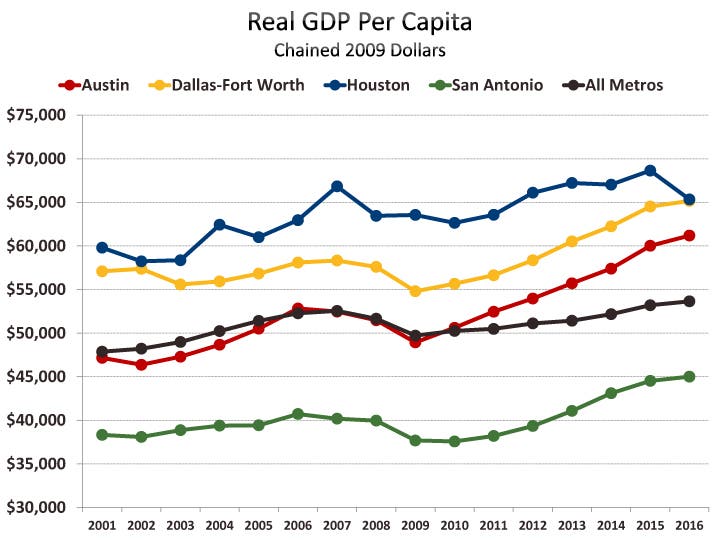
The pre-recession peak for real per capita GDP across all metros was 2007, officials said. For the metropolitan portion of the U.S., 2016 per capita GDP just surpasses 2007 by 2.1 percent. Of the 50 largest metros, 21 still have real per capita GDP that is lower than what it was in 2007. San Jose (up 34.3 percent) and Pittsburgh (up 18.2 percent) lead all major metros for real per capita gains since 2007. Austin’s per capita GDP is $61,183 in constant (2009 chained) dollars, which is 16.6 percent ahead of 2007, chamber officials said. This is the third-best gain among the large metros. Five large metros have real per capita GDP in 2016 that is more than 10% below the level of 2007: Las Vegas, Phoenix, New Orleans, Orlando, and Jacksonville, according to the data.
Most industry sectors contributed to metro area gains
All private industry sectors, save a pair — natural resources and mining and non-durable goods manufacturing — contributed positively to U.S. metropolitan area real GDP growth of 1.7 percent last year, according to the data. Professional and business services, information, and financial activities made the greatest contributions to growth of U.S. metros in aggregate. Information only accounts for 5.1 percent of GDP for the metropolitan portion of the U.S., but was the fastest-growing industry sector in 2016, with 6.5 percent real growth, figures indicate.
With Austin's 4.9 GDP gains, professional and business services contributed the most to growth (1.33 percentage points), followed by financial activities (1.28), and wholesale and retail trade (1.19). Natural resources and mining and durable goods manufacturing contributed negatively to Austin’s growth in 2016 (by 0.55 and 0.09 percentages points respectively).
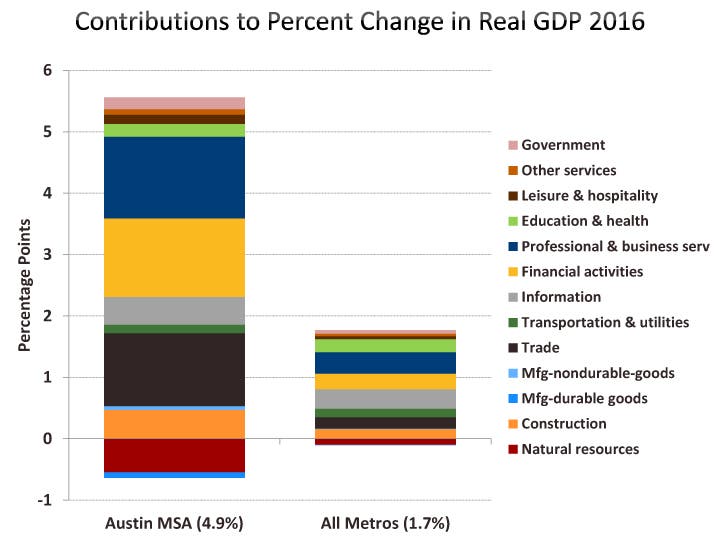
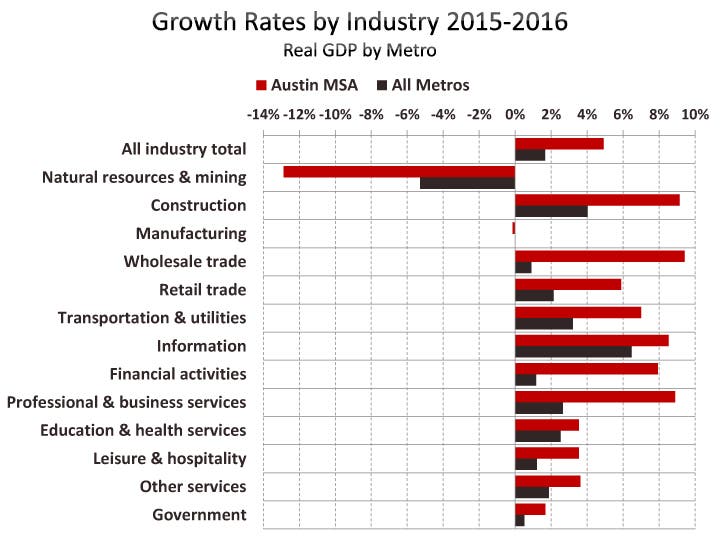
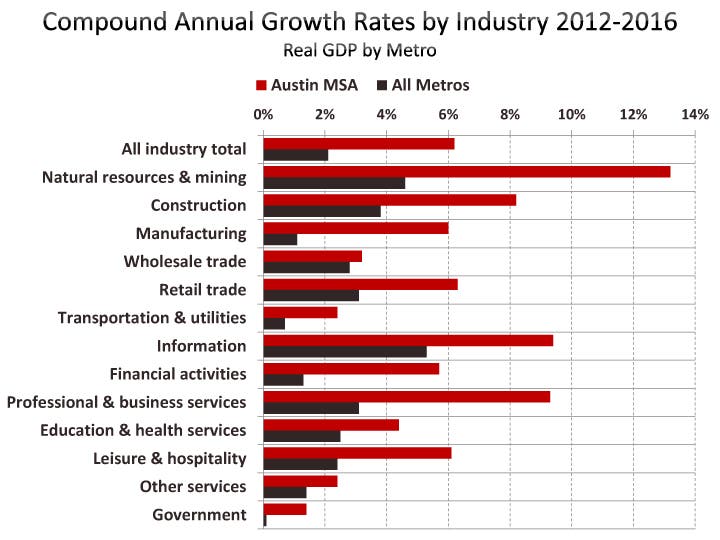
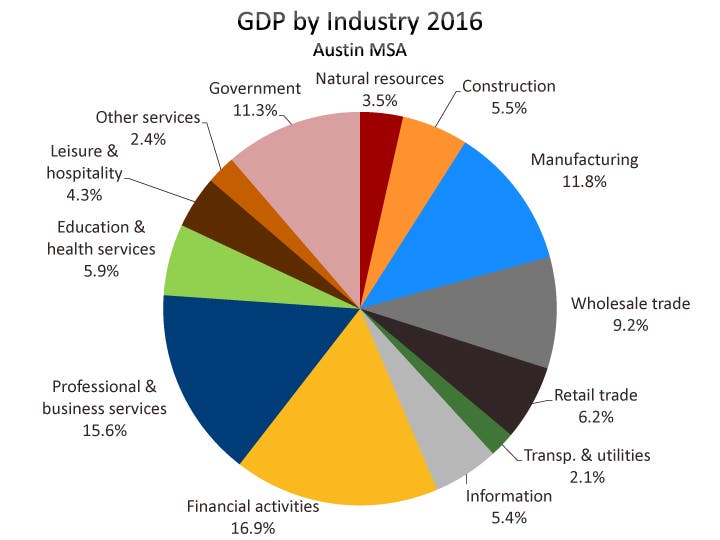
The three industries contributing the most to Austin’s growth are also the regions’ three largest, chamber officials said. Financial activities, accounts for 16.9 percent of GDP and saw 7.9 percent real growth.Professional and business services, accounting for 15.6 percent of 2016 GDP, and real growth was 8.9 percent. Wholesale and retail trade makes up 15.3 percent of Austin’s GDP and was up 8.0% in 2016. After professional and business services, information was Austin’s second fastest growing sector, with real growth of 8.5 percent in 2016.
Natural resources and mining accounts for 3.5 percent of Austin’s GDP but the industry’s real growth for 2016 was -12.9%, chamber officials noted. Durable goods manufacturing, which accounts for 9.2 percent of Austin’s 2016 GDP, contracted by 1.0% in real terms, officials added.
Other metro areas see overall mixed results
Houston, the nation's sixth-largest metro economy, contracted by 3.0 percent in 2016. This shrinkage was driven by natural resources and mining (-1.44 percentage points), durable goods manufacturing (-0.71), and financial activities (-0.42).
Dallas-Fort Worth, the fourth-largest metro economy, ranked 15th for growth last year. The metro’s 3.0 percent gain was driven by financial activities (0.76), professional and business services (0.64) and wholesale and retail trade (0.49), while natural resources and mining contributed negatively (-0.46).
San Antonio (ranking 35th largest metro area) posted real growth of 3.1 percent (13th fastest-growing) and the largest contributors to growth in 2016 were financial activities (0.79), durable goods manufacturing (0.75), and professional and business services (0.49). As with the rest of Texas’ major metros, natural resources contributed negatively (-0.49).
>>> Image via Shutterstock
Get more local news delivered straight to your inbox. Sign up for free Patch newsletters and alerts.