Community Corner
Snakes Emerging Across Central Texas Amid Warming Weather
Recent snake bite death of a family's miniature pinscher at the Onion Creek Greenbelt in South Austin points to the reptiles' dangers.


SOUTH AUSTIN, TX — The recent death of a South Austin family's dog after being bitten by a poisonous snake serves as a warning about the reptiles growing emergence amid warmer, summer-like weather.
The Austin American-Statesman reported on the recent death of "Kishi," a three-year-old miniature pinscher, who died Sunday after being bitten by a venomous snake during a family outing at the Onion Creek Greenbelt.
The dog's owner, Grace Teves, told the newspaper she had gone to the greenbelt with her husband at around 5 p.m. before hearing the animal let out a yelp about two minutes in.
Find out what's happening in Austinfor free with the latest updates from Patch.
Initially thinking the dog might have stepped on something pointy, she noticed a large, bleeding lump on its neck. A trip to a nearby fire station proved futile, as crew members directed her instead to the nearest emergency animal clinic, according to the report. Sadly, Kishi died a few minutes later.
While most snakes don't pose a threat, the Texas Parks and Wildlife Department reports the Central Texas region is home to four venomous species: Copperheads, coral snakes,cottonmouths (commonly known as water moccasins) and western diamondback rattlesnakes.
Find out what's happening in Austinfor free with the latest updates from Patch.
As reptiles, snakes are cold-blooded creatures needing to warm up on rocks or in the sun's heat. Temperatures in the Austin region already reaching the low 90s in recent days — with a likely scorching summer just around the corner — make this time of year ideal for snakes' warming tactics.
The term "pit viper" is often used to describe snakes as well. The term is not a specific snake, but a type. Copperheads, cottonmouths and rattlesnakes are called pit-vipers because they have a pit near each nostril which is highly sensitive to heat, and that helps them in locating warm-blooded prey.
On its website, the wildlife agency offers a primer on identifying these poisonous snakes:
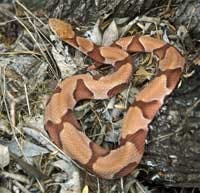
- Copperheads have gray and brown bands with copper-colored heads enabling them to easily blend into forest surroundings.
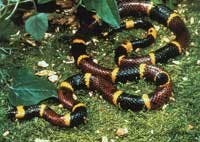
- Coral snakes are bright red, yellow and black. Red and yellow colors touch on coral snakes, unlike the markings of the nonvenomous Texas milk snake, which has red and black bands that touch. The various coral snakes' coloration gave rise to a rhyming guide to distinguish the poisonous from the non-venomous: "Red Touch Yellow - Kills a Fellow. Red Touch Black - Venom Lack. Yellow Touches Red - Soon You'll Be Dead. Red Touches Black - Friend of Jack."
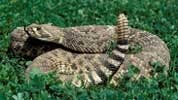
- As their name suggests, rattlesnakes are easily identified by the rattle at the end of their tails, and they are most active at night while hunting, according to the Texas Parks and Wildlife website. There are several types of rattlesnakes across the country, but it's the Western Diamondback that is prevalent in Central Texas (along with North, South and West Texas), according to Texas Parks & Wildlife. By contrast, the Timber Rattlesnake lives in East Texas while the Western Massasauga lives in prairies from the Gulf Coast up to the Panhandle. The snake pictured below is a Western Diamondback.
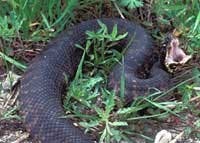
- Cottonmouths are usually found in and around water. They derive their name given the white coloration inside their mouth. These are aggressive and defensive snakes able to bite underwater, according to parks and wildlife officials.
Immediate veterinary care is highly urged if a pet is bitten. Officials at the Austin Veterinary Diagnostic Hospital, reportedly has a rattlesnake vaccine for dogs on hand in case of such bites. Officials at the Emergency Animal Hospital of Northwest Austin note that dogs and puppies are curious animals, often giving in to the temptation to check out any movement in the grass — a curiosity making canines especially vulnerable.
What to do
Emergency Animal Hospital of Northwest Austin outlines steps to take if your pet gets bitten by a snake:
- Keep your pet as calm, quiet, and inactive as possible.
- Identify the snake if possible, but do not put yourself or others at risk, do not try to approach it.
- Take your pet to a veterinarian as quickly as possible.
- The sooner your pet is treated the better the chance of survival.
- Even if your pet appears normal shortly following the bite your pet could still develop severe symptoms associated with a snakebite.
Symptoms
Symptoms of a bite by a pit viper such as the rattlesnake, copperhead, or cottonmouth may show some or all of the following, veterinarians noted:
- Two puncture wounds, often on the face or neck, but sometimes on the legs. Snake bites on the torso are rarer, but usually have bad outcomes.
- Extremely painful swelling, bleeding and/or bruising at the bite site.
- Nausea, vomiting
- Sudden weakness followed by collapse
- Shock and difficulty breathing
- Shaking or tremors of the muscles
- Coral snake bite wounds are hard to notice due to their small size and the fact that their venom is a neurotoxin and does not cause significant local tissue reaction.
"Venomous pit viper snake bites can cause significant tissue damage at and around the bite site, affect the hematologic system (the blood’s ability to coagulate), the cardiovascular, renal, and gastrointestinal systems," the website reads. "Some rattlesnake bites may cause neurologic signs with minimal reaction at the bite site but the rattlesnakes (Mojave) that cause these symptoms are not located in the Central Texas area."
Treatment
Treatment for venomous snakebites depends upon the type of snake, the severity of the bite and laboratory results, vets noted. Treatment aims to curtain the circulating venom load and treat symptoms with a combination that includes:
- Antivenin administration which binds to the venom to reduce its effects (shock, hematologic abnormalities, pain, swelling, local tissue damage). Some pets will require multiple vials of antivenin.
- Intravenous fluid administration to treat circulatory shock.
- Pain medication to control pain.
- Antibiotics to help prevent infection.
What not do do
- Do not cut the bite open and try to suck out the venom.
- Do not try to apply a tourniquet.
- Do not apply ice.
- Do not wait to have your pet examined by a veterinarian.
>>> Photos of snakes via Texas Parks & Wildlife Department
Get more local news delivered straight to your inbox. Sign up for free Patch newsletters and alerts.