Politics & Government
Cruz Wins Texas Primary, Seeks Man-to-Man Showdown with Trump [UPDATES]
In victory speech, he says his is only candidacy who "...has beaten, that can beat and that will beat Donald Trump."


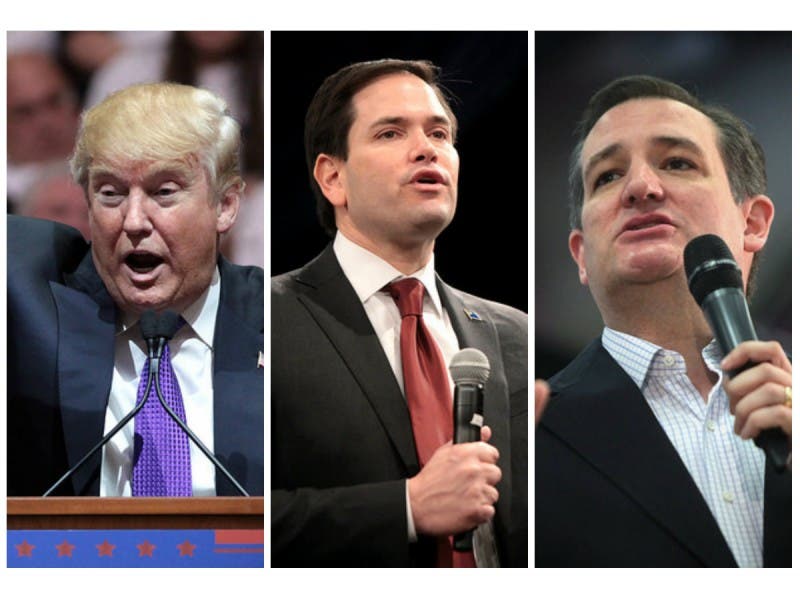
AUSTIN, TX -- Sen. Ted Cruz has defeated Donald Trump to win the Texas GOP primary Tuesday and hoped to take that win paired with victory in Oklahoma to mount a challenge to the real estate developer who captured a large number of delegates elsewhere despite the loss.
With the home state advantage, Cruz won handily with 40.8 percent of the vote compared to Donald Trump’s 28.1 percent. Florida Sen. Marco Rubio was a distant third with 18.4 percent of the votes cast, with John Kasich and Ben Carson trailing far behind, at 4.4 percent and 3.7 percent, respectively.
Speaking to supporters in the town of Stafford just outside of Houston, Cruz was anything but conciliatory toward his main rival. While the victor on the Democratic side, Hillary Clinton, congratulated her rival, Bernie Sanders, Cruz was in no mood for niceties -- even after securing the must-win in his home state to stay alive in the race.
Find out what's happening in Austinfor free with the latest updates from Patch.
“So long as the field remains divided, Donald Trump’s path toward the nomination remains more likely,” Cruz said. “And that would be a disaster for Republicans, for conservatives, and for the nation.”
He added that from among the field of GOP contenders remaining, his was the only candidacy able to beat Trump.
Find out what's happening in Austinfor free with the latest updates from Patch.
“And after tonight, we have seen that our campaign is the only campaign that has beaten, that can beat and that will beat Donald Trump,” he said to loud cheers from the crowd.
In a turn reflecting the odd nature of this year’s presidential campaign, it was the typically brash Trump who was gracious toward Cruz in a speech to supporters following his own Super Tuesday primary wins in Arkansas, Georgia, Massachusetts, Tennessee and Virginia.
“I want to congratulate Ted on the winning of Texas,” he told supporters. ”I know how hard he worked, and so I congratulate Ted Cruz on that win; it was an excellent win.”
He then addressed themes of unifying an increasingly splintered Republican Party: “I am a unifier. I would like to see the Republican Party and everybody get together and unify. And when we unify there’s nobody, nobody who’s going to beat us.”
In another odd twist, Ben Carson -- who mustered just under 4 percent of the vote in Texas -- chose the occasion to assert he’d stay in the race. Winning no primary wins and in single digits, he told fans he has not intention of dropping out based on the guidance of his Facebook following.
“We still have millions of Americans who are saying on Facebook ‘you cannot leave us; we need to have a representative for honesty, integrity,’ ” Carson said.
But by new light on Wednesday, Carson clearly saw the writing on the wall and all but indicating he’d suspend his presidential run by announcing he won’t be attending the next GOP candidate debate.
Given its sheer size, Texas is rich in delegates. There are 155 of them up for grabs toward the party’s nomination.
- Patch will have live totals as they come in
- Click here to get real-time news alerts for your Austin, Texas, neighborhood, including election results.
Cruz was widely expected to win his home state, which would at least disrupt the improbable rise of reality-star-turned-politician Trump who had already won smaller, yet key, primaries.
“Why Texas is the Republican primary to watch on Super Tuesday,” screams a headline in the Washington Post.
Why? Because a likely Cruz victory would undoubtedly upend the current pace of the Republican race -- Trump’s steamroll included. A look at required FEC filings yields a barometer of the wide support for Cruz in his home state, where he’s raised more than $15 million statewide -- half the amount of all candidates combined.
That monetary support could be an accurate bellwether for Cruz securing his party’s nomination. But the senator hasn’t rested on his poll laurels, barnstorming Monday ahead of Super Tuesday with Texas Gov. Greg Abbott who previously endorsed the junior senator.
The lion’s share of donor funding has enabled Cruz to launch a full-court press toward the nomination, while Trump has relied on free publicity via news coverage to spur his campaign along.
- Texas Democratic Primary Results
- Super Tuesday National Results: Hillary Clinton, Donald Trump Seek To Dominate
In this Texas showdown, media-driven publicity did not help Trump this time. Across the board, polls showed Cruz ahead of Trump -- most showing double-digit leads over the billionaire -- with other candidates trailing behind.
But then again, Texas is but one of 12 states participating in Super Tuesday, and Trump led in virtually each state but Cruz’s stomping grounds prior to Super Tuesday. By Wednesday, those poll numbers proved accurate: Trump won Alabama, Arkansas, Georgia, Massachusetts, Tennessee, Vermont and Virginia.
Those wins secured 316 delegates for Trump thus far, compared to Cruz’s 226. In addition to Texas and Oklahoma, Cruz won Alaska and its 28 delegates on Super Tuesday.
Back in Texas, national polls projected well before Super Tuesday that Cruz would emerge the victor in his home state.
On the high end, an NBC/Wall Street Journal found Cruz with a commanding 39 percent of support from among the electorate to Trump’s 26 percent. Rubio trails at 16 percent; John Kasich, 6 percent; and Ben Carson with 8 percent.
An ARG poll predicted a much closer primary race, with a 33 percent support for Cruz and 32 percent for Trump. The other major candidates -- Rubio, Kasich and Carson -- have 17 percent, 7 percent and 6 percent support, respectively, according to the poll.
Taken in aggregate, Cruz came out ahead when the poll results are added up for an average: 37.2 percent support for Cruz, 28.2 percent for Trump.
Largely because of the Republican race and its diverse cast of characters, the early voting period leading up to today’s Super Tuesday primary exceeded election officials’ expectations in terms of voter turnout.
That brisk pace continued unabated with the arrival of Super Tuesday. Travis County officials expected up to 130,000 voters at 190 polling locations -- a vote that would outperform the 2008 primary turnout of some 111,000 voters, notes the Austin American-Statesman.
As of noon, the county clerk said as many as 32,000 people had already voted. Shortly after 5 p.m., the total had grown to 37,073 and counting, said Williamson County elections administrator Christopher Davis during a telephone interview.
At that pace, voter activity is certain to dwarf the entire turnout for the 2012 Texas presidential primary, which drew 48,000 voters.
As if the drama inherent in the political horse race weren’t enough to keep political watchers engrossed, reports started to emerge of odd happenings in Williamson County. Some voters called in to a talk radio station to say their votes for Trump were being automatically switched to Rubio.
What gives? Elections officials aren’t sure, but they vowed to investigate the matter further.
Polls opened at 7 a.m. and close at 7 p.m.
The New Texas Patch
Sign up for free news alerts and follow us on Facebook.
- Downtown Austin-UT: email | Facebook| news
- East Austin: email | Facebook | news
- North Austin: email | Facebook | news
- South Austin: email | Facebook | news
- Cedar Park-Leander: email | Facebook | news
- Round Rock: email | Facebook | news
- Coming in 2016: Dallas and Houston
- Want Patch in Your Town? Make a suggestion
Get more local news delivered straight to your inbox. Sign up for free Patch newsletters and alerts.