Home & Garden
Texas Agriculture Commissioner's Approval Of Poison To End 'Hog Apocalypse' Gains Detractors
Wild pigs are a scourge across Texas given their marauding numbers, but the use of poison to curb the population getting push-back.


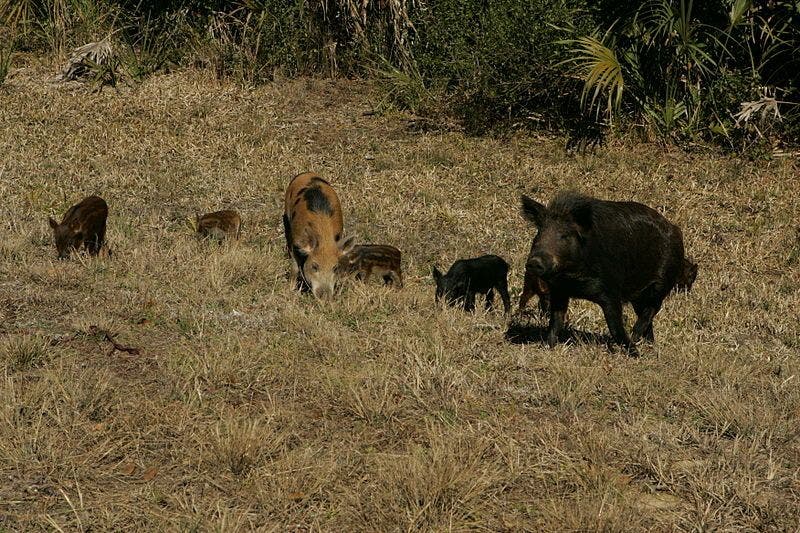
AUSTIN, TX — They're calling it the "hog apocalypse."
Texas State Agriculture Commissioner Sid Miller is touting what he says will be the magic bullet to curb the out-of-control feral hog population in the state as he continues his longstanding war against the porcine enemy. He recently approved the use of the "Kaput Feral Hog Lure" to thin the wild herd that has become a nuisance for farmers given the maruading hogs' destruction of crops and property in the rural parts of the state.
It's the latest assault on a determined and prolifically breeding enemy, following efforts over the years to thin its ranks by allowing hunters to shoot them from helicopters, with packs of dogs and, naturally, shotguns, with no limit on the amount that can be bagged. Miller touts his newly approved use of poison as a "major new weapon" in the state arsenal against the hog enemy.
Find out what's happening in Austinfor free with the latest updates from Patch.
Oh, and then there's the cost savings! Miller said in a recent press conference the Texas Department of Agriculture won't need to dole out $900,000 in state funding earmarked for feral hog control research. You know, because the poison is probably going to kill most of the animals, rendering the research moot.
“Wild hogs have caused extensive damage to Texas lands and loss of income for many, many years,” Miller said. “I am pleased to announce that the ‘feral hog apocalypse’ may be within Texans’ reach.”
Find out what's happening in Austinfor free with the latest updates from Patch.

Here's how it would work, according to Miller: The poison would be placed in special feeders with 16-pound lids that deer and other wildlife are hard-pressed to open. “The hogs come in and they eat the bait; and usually in one to three days, they will be eradicated,” Miller said during a recent interview in San Antonio.
Miller said Scimetrics, the Colorado-based maker of Kaput, has asked him to help find companies to make the specialized feeders in which to deposit the poison. He said the product is safe and not likely to be accidentally ingested by humans.
What could possibly go wrong?
The reason for Miller's ire and arsenal-building is that the feral hog in Texas has become something of a scourge given its exploding numbers, blamed for millions of dollars in destruction to crops as they travel in packs across the rural landscape. Some wildlife folks here call them "four-legged fire ants," in a trans-species comparison to another decidedly smaller-sized yet equally stubborn invasive creature also blamed for much damage.
Smithsonian magazine categorizes wild pigs as being among the most destructive invasive species in the U.S. today, wreaking havoc in at least 39 states and four Canadian provinces. Half of their numbers are in Texas, where they cause about $400 million in damages each year, tearing up recreational areas, terrorizing tourists in state and national parks and chasing out other wildlife from their habitats.
But despite that, even hunters eager to help thin the numbers aren't too crazy about the idea. For one thing, the poison turns the fat of the animal ingesting it blue, which could make it impossible to sell the meat. Others worry about the implications of introducing a poison into the environment, particularly along surface areas, reservoirs and lakes across the pastoral landscape of rural Texas.
Mere hours after Miller announced his new offensive in the war on feral hogs on Tuesday, the Texas Hog Hunters Association had circulated a 2,500-signature petition opposing the measure. A Change.org petition by the statewide group has garnered 8,758 supporters at last check.
Yes, there is a Texas Hog Hunters Association here in the Lone Star State. Its formation should alert you as to the large numbers of its referenced prey.
"For Texas to introduce a poison into the equation is a bad decision in our opinion and could likely contaminate humans who unknowingly process and eat feral hogs," the petition reads. "We also believe this can open a whole new level of liability from the state and private landowners who utilize this product."
Organizers explained they have built an "enormous" network of hunters, conservationists and trappers opposed to Miller's new initiative to curb the feral hog numbers. The population has exploded in recent years to an estimated 2.6 million swine throughout the state and shows no signs of ebbing, even while hunters bag some 750,000 wild swine each year.
Among hunters, feral hog hunting is a longtime rewarding activity. Not only is the meat quite tasty (it's prized in China, where it fetches top dollar), but the thrill of the hunt is the stuff of lore. Feral hogs are an ornery bunch, and are known to charge at hunters with the full force of their massive girth.
Bagging a ginormous feral hog is something of a rite of passage in some parts, the ultimate father-son (or father-daughter too, there are many women hunter in Texas) bonding experience. In 2015, an 800-pound monster was captured on a ranch in De Leon, a town located some 35 minutes west of Stephenville, roughly 95 miles southwest of Fort Worth as the crow flies.
The hunt became a cause célèbre throughout the state. Adding to the legend is that this King Kong of feral hogs was taken alive with the aid of two bulldogs, a popular technique used to help take down a hog while hunters tie the animal’s legs.
There's even a Facebook page devoted to the creatures, titled simply Feral Hogs. "Welcome to the only place where it's OK to 'like feral hogs' " the page reads. People like to post pictures of their trophies here, or videos of feral hogs embarking on their feral hog routines, such as swimming in a lake.
Feral hogs have a face that only a mother would love, but their meat is delicious. Often, the surplus meat is donated to food shelters and soup kitchens for the poor. But all this could change once Miller's poison remedy takes effect.
"We certainly don't want to be out hunting hogs and kill and consume a poisoned animal," Texas Hog Hunters Association members wrote. "Texas Hog Hunters Association and its partnering companies have ideas, techniques and experience in bringing the numbers down, help us be heard!"
A similar eradication method was used in Australia on a wild pig population but was later stopped after being declared inhumane, ABC 13 noted. Similar to rat bait, the poison causes painful internal bleeding. Some of the targeted hogs down under took up to a month to die, according to published reports.
The Hog Apocalypse is still a thing in Texas. But with Miller's controversial eradication method, the aggressive creatures' oink may soon be forever muted.
>>> Photo credit: U.S. Fish and Wildlife Service Headquarters
Get more local news delivered straight to your inbox. Sign up for free Patch newsletters and alerts.