Politics & Government
Trump Transition Team Surveying U.S. Southern Border For Wall Construction
Congressman Henry Cuellar favors aerial surveillance resources, but says Trump team is insistent on bricks-and-mortar wall construction.


McALLEN TX — Still a month away from the president-elect taking office, his transition team has begun surveying the southern border toward fulfilling the campaign promise Donald Trump made to build a wall, according to a congressman. Well, they've started taking measurements, anyway.
U.S. Rep. Henry Cuellar, D-Laredo, recently told the McAllen Monitor newspaper that spots along the border are being eyed for construction of physical barriers rather than a "virtual wall" created with aerostats, balloons or blimps outfitted with infrared, high-resolution cameras used for surveillance along the border.
“My understanding is that the sectors have been asked by headquarters at the request of the transition team, ‘Tell us where you think we ought to have a wall,’” Cuellar told the newspaper. “I can tell you about the one in Laredo; they basically said no wall,” Cuellar said, referring to the Laredo sector’s response. “But, nevertheless, they said ‘No, that’s not good enough, come back and tell us where we ought to put fence, wall, structure, whatever you want to call it.’ "
Find out what's happening in Austinfor free with the latest updates from Patch.
The congressman's comments came during a recent tour of an aerostat, the newspaper reported. Seeing construction of a great wall as implausible, some have turned to the aerostat option toward construction of a virtual wall. Such aerostats were used previously by the military in Iraq and Afghanistan, and a handful are deployed in the Rio Grande Valley sector and another one in Laredo, according to the newspaper.
Two of the aerostats, the Rapid Aerostat Initial Deployment, are owned by Customs and Border Protection. The so-called Persistent Ground Surveillance System aerostats and the Persistent Threat Detection System aerostats are leased from the Department of Defense. They're able to fly up to 1,000 feet, 3,000 feet and 5,000 feet above ground, respectively.
Find out what's happening in Austinfor free with the latest updates from Patch.
Information captured by the devices is also used by Mexican officials, Cuellar noted. The cost of operating and maintaining each aerostat ranges from $308,000 to $466,000 per month, Cuellar said during the tour which was attended by officials from the Border Patrol and CBP.
“What we’re trying to do in Congress in the appropriations, myself, is to have money in the budget to make it permanent where they can use the operations for the aerostats and for the tower cameras,” Cuellar said, estimating roughly 100 aerostats would be needed to cover the entire 1,954-mile stretch of the southern border with Mexico.
Cuellar is among those believing that a virtual wall, rather than a bricks-and-mortar variety, would effectively secure the border and would be less costly. One mile of the aerostat technology would cost roughly $1 million compared to the same length of fencing (including contracting the work out and maintenance costs) of $6.5 million, he told the newspaper, citing testimony from the U.S. Department of Homeland Security.
The use of aerostats could be augmented with camera-outfitted towers with a five-mile visibility range in either direction and ground sensors aiding Border Patrol agents at eye level, Cuellar told the newspaper. He also suggested using drones which are ow being used in the San Angelo region.
During the interview, Cuellar also complained a $750 million he and Republican Texas congresswoman Kay Granger (who sits on the House Appropriations Committee) earmarked for border security hasn't been used.
“Kay Granger and I added $750 million to help the northern triangle,” Cuellar said. "That was about a year ago, and as of maybe at least two weeks, they had only used $23 million out of the $750 million while we’re still having a large number of unaccompanied kids that are still coming in at this particular time.”
Texas Gov. Greg Abbott also previously complained that border resources weren't being used to their fullest extent. Last month, he questioned DHS officials about the frequency of aerial inspections for activity along the border, basing his perception of low surveillance on the logged hours requested by the federal agency.
Obama is wrong to abandon post on our southern border. Texas will continue efforts to secure the border. https://t.co/YhNRtI7Mqt
— Greg Abbott (@GregAbbott_TX) November 22, 2016
The next day, in an answer to a follower's suggestion, Abbott tweeted that he had dispatched members of the Texas National Guard to help secure the border ahead of Thanksgiving Day.
The Texas National Guard is activated & on the border. RT to thank them for their service this Thanksgiving. #txlege #tcot https://t.co/jFP2r2g8fr
— Greg Abbott (@GregAbbott_TX) November 24, 2016
Historically, Abbott has been forceful in calling for border security and controlling the flow of undocumented immigrants from entering the U.S. As for Trump's pledge to build a wall — a key plank of his political platform that resonated with his base and helped fuel his rise — Abbott has expressed full-throated endorsement of the plan.
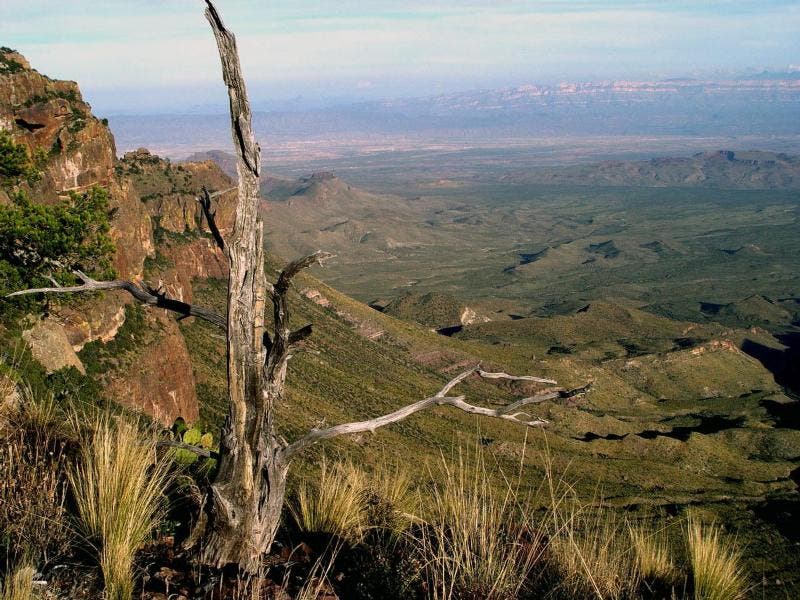
Except along the more picturesque parts of the landscape, that is. Abbott recently made headlines when he expressed an aversion to having Trump's envisioned wall linking across the bucolic Big Bend National Park. What's more, in addition to marring its beauty, the unforgiving landscape there would make wall construction implausible.
“There are serpentine regions of the Rio Grande where it would be extremely challenging to build a wall," Abbott said. "There are parts like the Big Bend region — we don’t want see a wall in the beautiful Big Bend National Park.”
Ironically, U.S. National Parks Service officials tout the multicultural dynamic of Big Bend as part of its enduring appeal.
"Big Bend National Park is a geological marvel evidenced in sea fossils and dinosaur bones to volcanic dikes that mar the desert landscape," officials write. "It's a world of species diversity from the meandering river corridor that sidles across the desert floor to the sky island ridge tops that reach for the stars. It's a place where you can still hear the whispers of pioneers, ranchers, miners, and Native Americans. And it's a land of borders—a place where countries and cultures meet."
>>> Image above of border patrol agents via WikiMedia Commons
Get more local news delivered straight to your inbox. Sign up for free Patch newsletters and alerts.