Community Corner
U.S. Army Futures Command Celebrates 1st Year In Austin (Video)
Military function embarked on modernizing Army performs serious work, but it was party time on Monday to celebrate its anniversary.


AUSTIN, TX — Aimed at modernizing the U.S. Army, the Futures Command also knows how to party. Military officials staged a celebration on Monday to celebrate the first full year in Austin since selecting the city for its base of operations.
Several hundred people braved temperatures just shy of 100 degrees to attend the free party dubbed "Thank You, Austin!" as the command's way of thanking the city for its support and hospitality since it selected Austin as its home base from an original list of 150 cities that had sought to land the 500-worker, four-star command.
As the crowd shuffled onto the grounds of the Long Center for the festivities' 4 p.m. start time, the 312th Army Rock Band played covers, including "Hey Jude," by The Beatles while urging the crowd to join in the chorus ("na na na na, Hey Jude....").
Find out what's happening in Austinfor free with the latest updates from Patch.
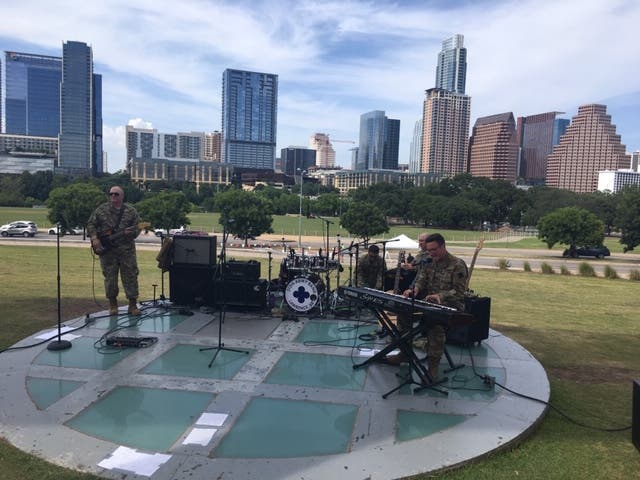
The 312th Army Rock Band rocked the house at the Long Center during the "Thank You, Austin!" celebration. Photo by Tony Cantú/Patch staff.
About a half-hour later, an Army Drill Team unit displayed impressive, machine-like precision of military movements in unison — eliciting oohs and aahs punctuated with applause with every toss of rifles and spinning of bayonets.
Find out what's happening in Austinfor free with the latest updates from Patch.
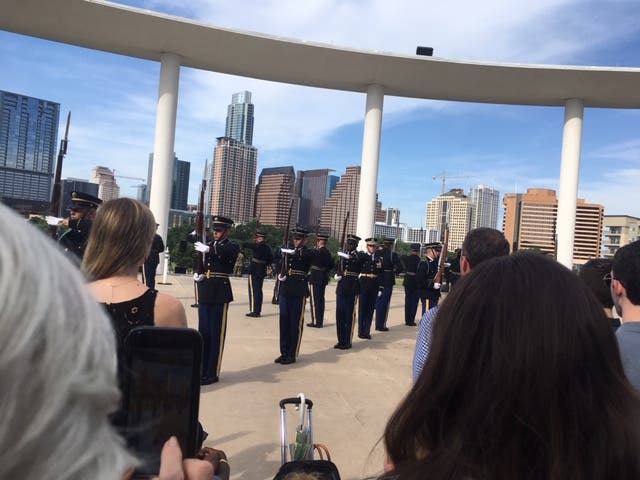
Army drill team displayed an impressive precision of movement for the crowd during the "Thank You, Austin!" celebration at the Long Center. Photo by Tony Cantú/Patch staff.
Related story: It's Official: Austin Lands New U.S. Army Futures Command
By 5:15 p.m., Gen. John M. "Mike" Murray, the first commanding general of the Futures Command, led a new class of Army enlistees in an oath of enlistment ceremony.
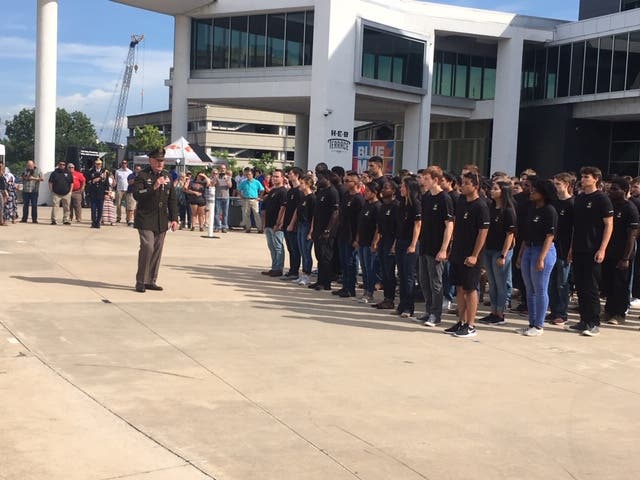
Gen. John M. Murray leads an oath of enlistment ceremony at the Long Center. Photo by Tony Cantú/Patch staff.
After the young enlistees professed their service to country, Murray directed their attention to a special tribute meant just for them as he pointed to the sky — seemingly guiding the trajectory of a pair of Black Hawk helicopters streaking across the sky in flyover formation.
Video taken by Tony Cantú/Patch staff.
But if there were a pièce de résistance to the affair — an element that truly captivated young and old alike — it was the breathtaking display by the Golden Knights as they parachuted to the Long Center grounds from dizzying heights high up in the sky.
Video by Tony Cantú/Patch staff.
Those in attendance started to gather around the lawn area of the Long Center as word spread of where the landing ground would be. Those gathered spoke among themselves, when suddenly a man attending the celebration with his wife and young children pointed to a plane so high up in the sky it could barely be seen as it circled overhead.
"That's it!" he told his eager kids, as those within earshot fixed their collective gave at the near-cloudless skies above to watch the nearly imperceptible aircraft they now knew carried the parachutists. Soon enough, people started to fall gently from the sky — to a man, each parachutist sticking the landing with remarkable precision. After a sole parachutist floated onto terra firma, many thought that was the demonstration before a dozen more appeared in sky minutes later.
Video by Tony Cantú/Patch staff.
Albeit with a palpable aura of patriotism, the event was good fun for all those attending. Heck, there were even a couple of cash bars for those in true party mode, their presence reminiscent of myriad music festivals to which Austin — the "live music capital of the world," after all — is host throughout the year.

Photo by Tony Cantú/Patch staff.
Food truck operators selling their culinary wares added to the festival vibe.

Photo by Tony Cantú/Patch staff.
Yet for all the reveling, the underlying impetus of the gathering served to remind of the highly important — and decidedly serious — work of the Futures Command. Its ambitious modernization aim is guided by six priorities: Long-range precision fire; next-generation combat vehicles; future vertical-lift platforms; a mobile/expeditionary Army network; air and missile capabilities; and soldier lethality.
That's pretty heady stuff, and by the Army's own admission born of past shortcomings and inefficiencies. In an impromptu interview with Patch, U.S. Army Maj. Gen. Patrick W. Burden invoked as example the infamous Comanche helicopter boondoggle involving stealth, armed reconnaissance and attack aircraft designed by the U.S. Army. In 2004, the Boeing=Sikorsky RAH-66 Comanche helicopter program was canceled but not before billions of dollars (yes, with a "b") had been spent on its development.

U.S. Army photo of U.S. Army Maj. Gen. Patrick W. Burden by Monica King.
"We essentially sank tens of billions of dollars down the drain," Gen. Burden said. "A lot of the issues associated with that was because many of the elements of modernization are in separate commands," he added, ticking off such functions as requirements generation, U.S. Army training doctrine command, resource management — not to mention acquisition and program management of systems upon finalization that's in under another entity under the assistant Secretary of the Army, he added.
The general is no newcomer to this whole modernization thing, having worked in the area for some 25 years now. He now serves as deputy commander, Acquisition and Systems Management for Futures Command. "The stand-up of Futures Command is to have unity of effort and unity of command for all those things that make up the modernization process," he said. "That's why we set the command up."
Monday's choice of Austin as the Futures Command base was fueled largely by the city's robust business sector of which military personnel will avail themselves toward the modernization aim. Partnerships with those in the private sector were once anathema to the U.S. Army, Burden suggested, but not anymore.
"The other thing that we didn't do a good job with was seeking help from industry partners that don't traditionally do work with the Department of Defense," he said. "So establishing the command here in Austin Texas is allowing us to have interaction with innovators that have been solving problems for businesses across the country that are now in a position to help us solve problems."
It's a tall order — nothing short of revolutionary some might say. But Monday was a time to celebrate, and the U.S. Army did not disappoint.
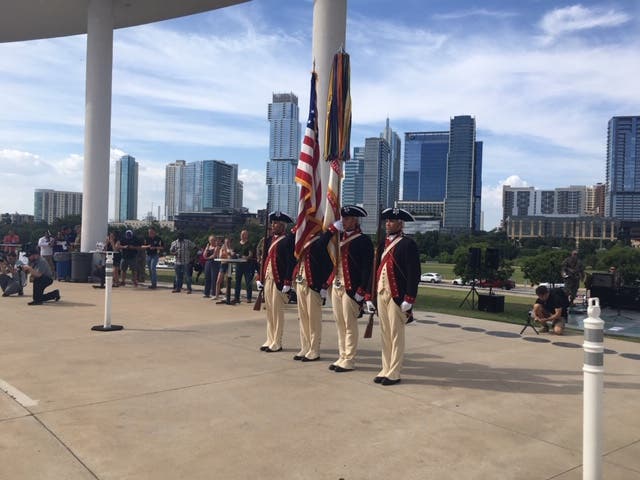
Army color guard at Long Center. Photo by Tony Cantú/Patch staff.
Get more local news delivered straight to your inbox. Sign up for free Patch newsletters and alerts.