Community Corner
Video Shows Skyline Changes As Austin Celebrates 180th Birthday
COMMERCIAL Café zeroes in on the changing face of the Austin skyline since completion of the Capitol in 1888 to the present day.


AUSTIN, TX — Austin is poised to turn 180 this year, and its transformation to one of the nation's most vibrant metros from a settlement of fewer than 1,000 residents is truly a stunning metamorphosis. And yet it's hard to track that expansion, especially given the breakneck speed of municipal growth spurts in recent years.
Enter COMMERCIAL Café, which has made the Texas capital city the focus of its latest installment of its cityscape series. In charting municipal growth visually, the real estate company's new Downtown Austin Skyline video maps the chronological completion of buildings that rose 200 feet or taller, starting with the State Capitol Building.
Here’s some interesting trivia about three of the buildings highlighted in the video:
Find out what's happening in Austinfor free with the latest updates from Patch.
- Chase Bank Tower – Year built: 1974: The tower, nicknamed “The Golden Mirror,” was originally covered in inch-thick insulated reflective glass panes, which contained a small amount of gold alloy.
- Moody Bank Tower – Year Built: 1981: The conference room is entered through the bank’s original vault door, built in 1875 in Pennsylvania and weighing more than 40,000 pounds.
- The Austonian – Year built: 2010: Austin’s tallest building for eight years, surpassed by the still-under-construction “Jenga Tower” in May 2018.
The video summary starts with the "queen of the skyline," the state Capitol, completed in 1888. With skylines now reaching dizzying heights, it's hard to believe the Capitol — as formidable an edifice as it is — was once among the world's tallest buildings. Upon its completion, researchers found, the building registered as the 7th largest building in the world. Despite being dwarfed by more imposing structures now surrounding it, the state Capitol still rises 14 feet higher than the nation's Capitol in Washington, D.C., COMMERCIAL Café noted.
As the video progresses, it yields a visual timeline as to the downtown Austin skyline came together. Tracked is the chronological completion of buildings rising 200 feet or taller, along with inclusion of developments currently in the works.
Find out what's happening in Austinfor free with the latest updates from Patch.
The state Capitol would be supplanted in height with completion of the 26-story Westgate Tower in the 1960s. The rise of the 261-foot building came with some controversy, as residents groused the high-rise obstructed views of the beloved Capitol from the west. In time, the building was embraced for its imposing nature, becoming Austin’s youngest landmark in 2010, when it was added to the National Register of Historic Places and designated a Recorded Texas Historic Landmark two years after that.
By 1974, construction of the tower at 221 West 6th Street wrapped up in 1974, yielding the first downtown Austin building to rise taller than the Capitol. "In order to showcase this seminal project, developers set up the AmericanScene Observation Room — specially built, carpeted, and air conditioned — from which locals and tourists alike could watch as it unfolded from foundation to its tip," COMMERCIAL Café officials wrote.
The tower was covered in 3,600 panels of gilded glass, encompassing roughly 170,000 square feet. "Although this 'Golden Mirror,' which actually contained a small amount of gold alloy, made a big splash in the Austin skyline upon completion, the property got a whole new look just two decades later," officials wrote. "The 21-story tower’s glaring coat was stripped and replaced with new colors, and a 40-foot addition decorates the roof of what is now called Chase Bank Tower."
In 1975, downtown Austin’s newest tallest building was completed. Austin National Bank Tower rose 354 feet above Congress Avenue and retained its tallest building title for nearly a decade. Now known as Bank of America Center, the building sported a dark, monolithic appearance, a striking contrast to the golden tower located just two blocks away. Designed by local architect S.I. Morris, the tower was commissioned by Houston developer Gerald D. Hines, who had a lot of curtain wall glass panes left over from building Pennzoil Place and saw this as the perfect opportunity to make good use of that surplus, officials said.
The Eighties Marked Austin’s First Skyscraper Building Boom
Congress Avenue drew the developers of some of Austin’s tallest and most recognizable skyscrapers, which filled empty lots or replaced older structures. In 1984, One American Center reached just over 400 feet up and put the Bank of America Center in second place. Now marketed as 600 Congress, the 503,000-square foot One American Center office tower replaced a two-story Art Deco-style Woolworth’s department store.
The 1980s saw America’s most prolific skyscraper building boom, which also made its mark on the downtown Austin skyline: Capitol Center, the Crown Plaza Austin, 301 Congress, Capitol Tower, the Austin Center, the William P. Clements State Office Building, and One Eleven Congress —Austin’s newest tallest upon completion — were all built in the 80s.
Although no new high-rises popped up in downtown Austin during the 1990s, COMMERCIAL Café noted, a new wave swept in with the new millennium. The 328-foot tall office tower at 300 West 6th Street completed in 2002 became the location of Facebook’s first sales and online operations office outside of California eight years later. At 516 feet, the iconic Frost Bank Tower became Austin’s tallest upon completion in 2004. Arguably one of the city’s few signature towers, the “Owl Building” rivals the State Capitol as Austinites’ favorite, according to a recent local survey.
"As more and more people were drawn to life in downtown Austin, a flurry of hotels and residential towers filled in more of the skyline: the Hilton Austin, the 360, Spring, the Monarch, the Ashton, Four Seasons Residences, Gables Park Tower, the Bowie, and of course the Austonian — the city’s tallest building for 18 years, and among the tallest residential towers in the entire state," researchers wrote. In 2004, the city rezoned downtown’s Rainey Street and officially made it part of the central business district, which ushered in more high-rise development and resulted in the completion of properties such as Windsor on the Lake and SkyHouse.
In 2015, downtown Austin welcomed its first Class A high-rise office building in 11 years—the Colorado Tower was built by Cousins Properties, an Atlanta-based real estate company that has a long history in Austin. The company’s reputation for high-quality construction made for great leasing success. According to statements made by property representatives at the time, the 30-story tower filled up in no time and 60 percent of the property was leased by companies that were new in town.
Since then, nine other towers taller than 200 feet opened in downtown Austin, some of which were made possible by city efforts to revitalize under-served areas along Lady Bird Lake, such as redeveloping the Seaholm district.
Skyline continues to metamorphose amid robust residential influx
By the time next year's Zilker Kite Festival rolls around, the view across the river will already be different than right now, researchers said. With estimates of some 150 people per day moving to Austin, brisk development of luxury towers to house them has dotted the city with skyscrapers.
The Independent (688 feet, 307 residential units), Fifth & West (459 feet, 154 residential units), and 70 Rainey (419 feet, 164 residential units) have topped out and are poised for delivery this year.
The cantilevered Independent, nicknamed the “Jenga building” for its unusual shape, was reportedly already 60 percent under contract at the close of 2018 (see photo above). Rising 688 feet above West Avenue, it already overtook the Austonian as the tallest building in town. Although interior work is still underway, the Jenga penthouse is already taken, and, despite local petitions to “fix” the top section, the tower is largely completed.
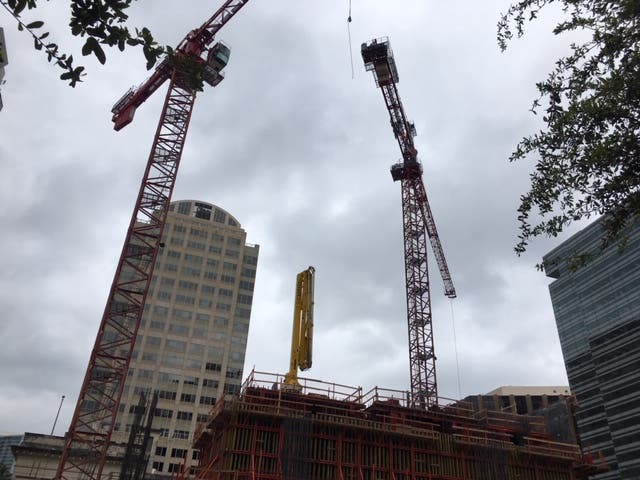
Cranes seen in downtown Austin attest to the changing landscape as new high-rises are built. Photo by Tony Cantú/Patch staff
The Hotel ZaZa and Gables Residences complex on Guadalupe Street is also expected to open this year, bringing 159 hotel rooms and 221 apartment units to the city’s vibrant and ever-growing downtown. The Austin Proper luxury project will also contribute 244 hotel rooms and 99 residences.
Third+Shoal is Downtown Austin’s newest and swankiest office building. Turned over to tenants for interior finishes late last year, the 29-story tower is not yet open but is up for sale and developers expect it will fetch upwards of $700 per square foot. Facebook leases 10 floors encompassing roughly 230,000 square feet, and shares the building with Bank of America, national law firm Dickinson Wright, and New York-based investment firm Stonepeak Infrastructure Partners.
The next Austin office skyscrapers to rise downtown are 405 Colorado (due in 2020), Block 71 on West Sixth Street and The Quincy in the Rainey Street district (both planned for delivery in 2021), and the 35-story Block 185 on West Second Street (due 2022). Austin’s particular blend of creative, educational, and technical culture has so far maintained a strong, steady economy, which boasted a notable post-recession recovery, and which will continue to show, in ever taller towers.
Get more local news delivered straight to your inbox. Sign up for free Patch newsletters and alerts.