Schools
Spoiler Alert: Texas Scientists Create Computer Simulations Previewing Total Solar Eclipse
UT-Austin-based supercomputer used to forecast corona of the sun during the upcoming eclipse for those planning to stay in on Aug. 21.


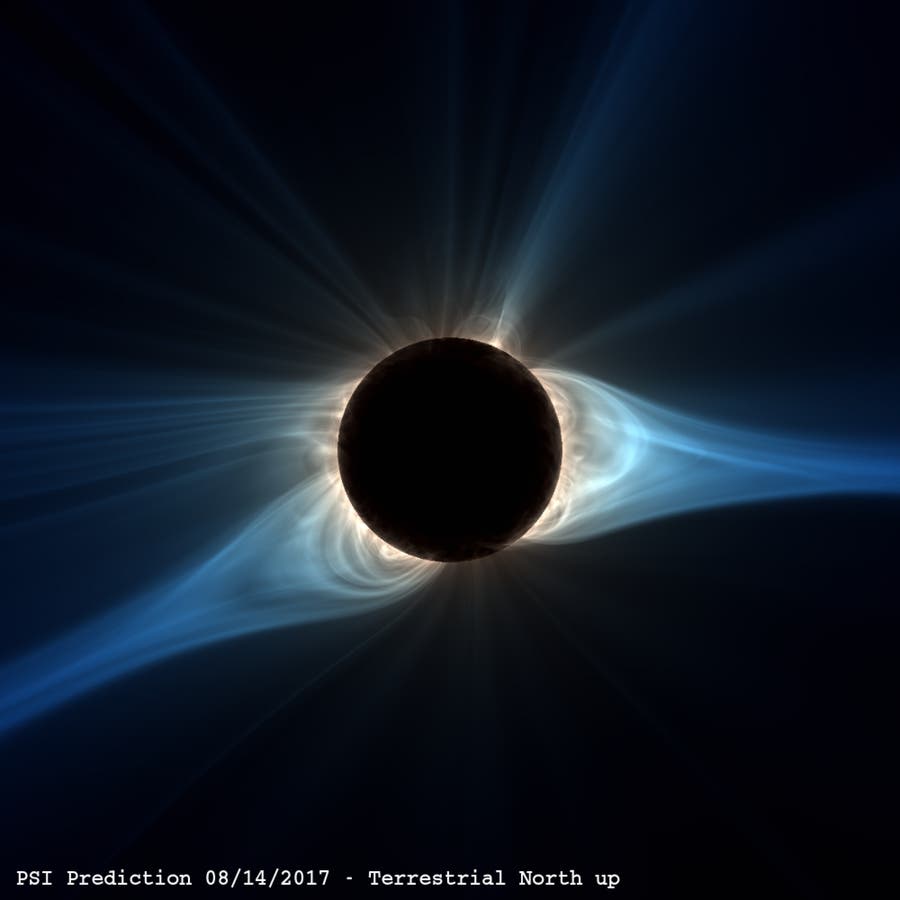
AUSTIN, TX — Did you plan on skipping the upcoming solar eclipse viewing parties on Aug. 21? Was your search for specially filtered glasses or welder's masks futile? Do you plan on staying indoors that day to avoid the gawking masses staring heavenward and/or the potential mayhem from the freaked-out masses unaware the moon's shadow is scheduled to obscure the sun come Aug. 21?
Well, worry not homebodies. A research team from Predictive Science Inc. used the Stampede2 supercomputer at The University of Texas at Austin’s Texas Advanced Computing Center (TACC) to forecast the corona of the sun during the upcoming eclipse, university officials said on Thursday. The findings shed light on what the eclipse of the sun might look like Aug. 21 when it will be visible across much of the U.S., tracing a 70-mile-wide band across 14 states, researchers added with palpable excitement.
This is a celestial version of a "spoiler alert." The images seen through this computer simulation yield a glimpse of the marvel that awaits us, so avert your gaze if you like surprises.
Find out what's happening in North Austin-Pflugervillefor free with the latest updates from Patch.
For the rest of us, these images help to broaden our understanding of the universe. Beyond their rarity, solar eclipses help astronomers better understand the sun’s structure, inner workings and the space weather it generates, university officials noted.
To achieve the simulation, researchers completed a series of highly detailed solar simulations timed to the moment of the eclipse using TACC’s Stampede2, Comet at the San Diego Supercomputer Center, and NASA’s Pleiades supercomputer. They modeled the sun’s surface and predicted what the solar corona — the aura of plasma that surrounds the sun and extends millions of kilometers into space — will look like during this eclipse.
Find out what's happening in North Austin-Pflugervillefor free with the latest updates from Patch.
“Advanced computational resources are crucial to developing detailed physical models of the solar corona and solar wind,” said Jon Linker, president and senior research scientist of PSI. “The growth in the power of these resources in recent years has fueled an increase in not only the resolution of these models, but the sophistication of the way the models treat the underlying physical processes as well.”
The researchers’ computer simulations were converted into scientific visualizations that approximate what the human eye might see during the solar eclipse, university officials explained. The simulations are among the largest the research group has performed, using 65 million grid points to provide great accuracy and realism, according to school officials.
A collection of the images can be found here and here.
University officials said the team used data collected by the Helioseismic and Magnetic Imager aboard NASA's Solar Dynamics Observatory and a combination of magnetic field maps, solar rotation rates and mathematical models of how magnetohydrodynamics (the interplay of electrically conducting fluids such as plasmas and magnetic fields) affect the corona.
Predictions about the appearance of the corona during an eclipse test complex, three-dimensional computational models of the sun against visible reality, officials added. In doing so, the accuracy of predicting space weather improves, a tactic that could have important practical ramifications.
In explaining their marvelous accomplishment, university officials suddenly take a dark turn, worthy of a Hollywood disaster movie, without the benefit of segue: "If a powerful solar storm such as the 1859 Carrington Event — which led to auroras being visible as far south as the Caribbean and caused telegraphs to short and catch fire — were to hit Earth today, it would cause more than $2 trillion in damages, according a National Academy of Sciences report."
What the?!? But there's a method for this madness as it relates to the simulations. Predicting the arrival of such a solar storm in advance would allow officials to take the most critical electronic infrastructure offline and limit the storm’s impact, scientists explain.
"But doing so requires understanding how the visible surface of the sun (the corona) relates to the mass ejections of plasma that cause space weather," scientists added after scaring the bejesus out of readers.
“With the ability to more accurately model solar plasmas, researchers will be able to better predict and reduce the impacts of space weather on key pieces of infrastructure that drive today’s digital world,” said Niall Gaffney, a former Hubble Space Telescope scientist and director of data intensive computing at TACC.
The researchers will present their results at the Solar Physics Division meeting of the American Astronomical Society on Aug. 22-24. The research was supported by NASA, the Air Force Office of Scientific Research and the National Science Foundation.
>>> Image: A visualization of the Sun's three-dimensional magnetic field. By tracing magnetic field lines at extremely high resolution, researchers highlight the inherent complexity of the Sun's magnetic field and its intimate connection to visible emission from the solar corona. Photo courtesy of Predictive Science, Inc.
Get more local news delivered straight to your inbox. Sign up for free Patch newsletters and alerts.