Politics & Government
City Documents Yield Reason For Red-Light Cameras' End
Of the more than $2.5 million in ticket revenue, city got to keep a tiny fraction.


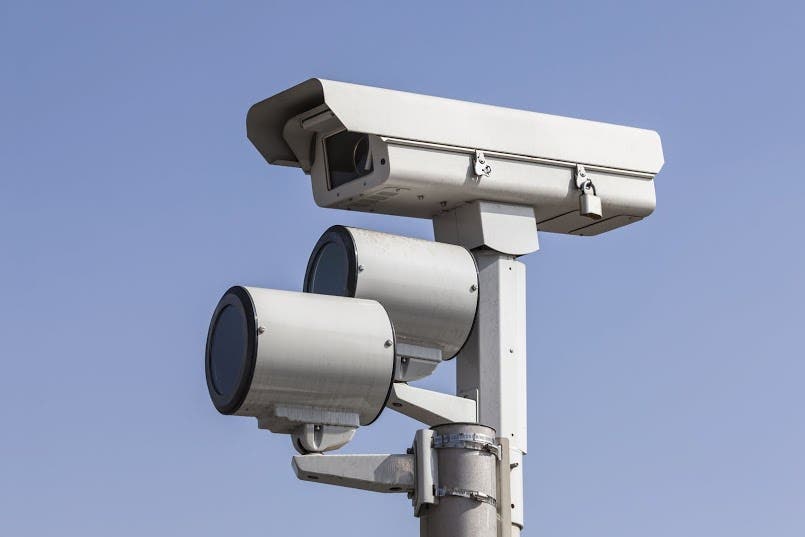
ROUND ROCK, TX -- Documents provided by Round Rock city officials to Patch following a recent State Open Records request dramatically illustrate why the city opted to pull the plug on its failed red light camera program recently, as Patch previously reported.
The short-lived camera project was supposed to promote traffic safety, acting as a deterrent against traffic scofflaws given the eye in the sky watching their every traffic maneuver at key intersections throughout the city.
Instead, the project launched in October 2011 left in its wake mounting motorist frustration and growing drivers’ defiance in paying camera-generated fines.
Find out what's happening in Round Rockfor free with the latest updates from Patch.
Worse, a tiny fraction of ticket-generating revenue was left for the city itself after having to hand over the lion’s share of revenue to Redflex, the contractor the city hired to operate and install the cameras. Then the state took its 50 percent cut, leaving the city with an even smaller slice of the pie.
All told, the city collected more than $2.5 million in revenue from the red-light program. But in the end, it got to keep a fraction of that amount before opting to end the program Dec. 31.
Find out what's happening in Round Rockfor free with the latest updates from Patch.
The requested documents provided by the city on Jan. 5 shed more light into the rough calculus that led to the project’s end.
Even those in the city clerk’s office weren’t too clear on figuring out how much it cost to install each of the ten cameras the city strategically set up on high-traffic areas of town.
An agreed-upon “fixed fee” of $4,287 per month for each approach was clear enough. But in figuring the installation fee per camera is when things got a little more complicated.
“The installation fee is a little more complicated, so I have pasted the text from the contract,” an official at the city clerk’s office sending the requested documents wrote in an email.
Indeed, the language related to installation fees is dense to say the least.
“Commencing on the expiration of the testing period for each Designated Intersection Approach, the City shall be obligated to pay Redflex a monthly installation fee,” reads the contract verbiage. “Such fee will be determined by dividing the reimbursable cost per approach, $35,000, by the number of months between the expiration of the testing period and the current term of the agreement.
“The reimbursable costs are limited to direct labor and direct material and do not include equipment costs and salvable material costs.”
In plain English, it means Redflex got most of the money generated from camera-generated traffic citations. And the requested documents bear that out.
From October 2011 to September 2012, the cameras helped generate $362,912 in ticket revenue--money the city deposited into a Chase Bank account, according to the documents.
Revenues were modest given the shortened time of operation from subsequent years; the city didn’t start collecting revenue from the cameras until March 2012, after expenses were allotted for their installation from October 2011 to February 2012, according to the documents.
Of the $362,912 collected, $327,328 were allotted for expenses. That left just $35,583 in revenue with half--$17,791--going to the state.
Albeit with different totals, it was pretty much the same story in subsequent years:
- From October 2012 to Sept 2013, the program was fully implemented and revenue grew exponentially to $800,599. Of that, $624,410 of that fell under expenses (i.e. Redflex’s take) leaving $176,188 in revenue. Half, $88,094, went to the state.
- From October 2013 to September 2014, there was $816,907 in total revenue; $777,331 in expenses; with net revenue of $39,576, half of which ($19,788) was sent to state coffers.
- From October 2014 to September 2015, $695,126 total revenue; $554,878 in expenses; net revenue of $140,247; state allotment of $70,123.
No definitive figures for the remaining months of 2015 leading to the program’s end were available.
According to the documents, the city installed its first red-light camera at the intersection of Forest Creek Drive and Red Bud Lane on Dec. 14, 2011. It was trained on southbound traffic.
In intervening months, it would install nine more:
- At the intersection of Interstate 35/Mays Street and U.S. Hwy. 79 at Palm Valley, southbound, on April 2, 2012.
- I-35/May Street and Hwy. 79/Palm Valley, westbound, April 2, 2012.
- Hwy 79/Palm Valley Boulevard at Sunrise Road, southbound, April 2, 2012.
- Hwy. 79/Palm Valley at A.W. Grimes Boulevard, eastbound, April 2, 2012.
- Hwy. 79/Palm Valley at A.W. Grimes Boulevard, westbound, April 2, 2012.
- I-35 northbound frontage road and Ranch-to-Market 620/Round Rock Avenue, northbound, May 9, 2012.
- I-35 southbound frontage road and RM 620/Round Rock Avenue, soutbound, May 9, 2012.
- RM 620/Round Rock Avenue and Deep Wood Drive, westbound, May 9, 2012.
- Red Bud Lane and Forest Creek Drive, northbound, May 11, 2012.
Get more local news delivered straight to your inbox. Sign up for free Patch newsletters and alerts.