Health & Fitness
'My Eyes Hurt': How To Know If Solar Eclipse Damaged Your Retina
If your eyes feel funny after watching the solar eclipse, you should see an eye doctor — even if you wore protective eyeglasses.


President Trump can’t have been the only person who ignored the one rule of solar eclipse viewing — don’t look directly at the sun — when he starred blithely at the shadowed orb Monday with his unprotected eyes. Eye doctors around the country are gearing up for a busy Tuesday.
Looking at the sun with naked eyes — whether during an eclipse or under normal conditions — allows ultraviolet and near-infrared radiation to penetrate the retina, resulting in a condition known as photic or solar retinopathy. But you won’t know if you’ve got it without consulting a specialist, because there is no pain associated with burns to the retina.
The only way to know for sure if you’ve burned your retinas is to get a checkup, though you may begin to notice changes in your vision within a day, according to the American Academy of Ophthalmology.
Find out what's happening in Across Americafor free with the latest updates from Patch.
In some cases, recovery from solar retinopathy may spontaneously occur in three to six months, experts say, but patients may also suffer permanent visual acuity deficits and other complications.
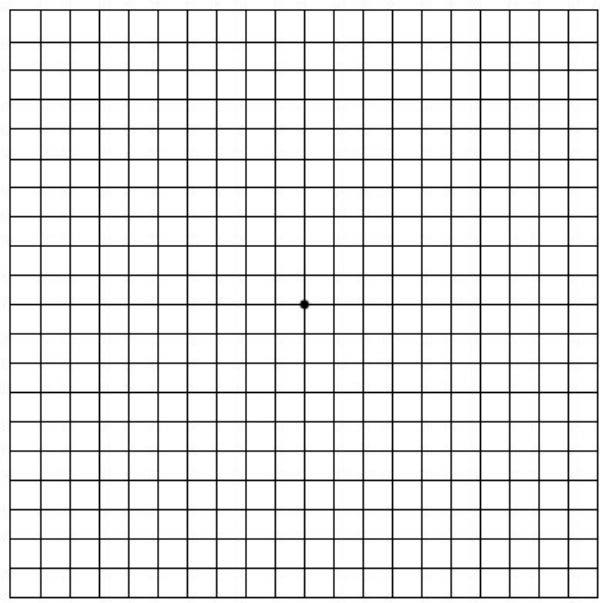
At-home diagnoses aren’t recommended, but one way to tell if you’ve damaged your eyes is to print an Amsler Grid, which eye doctors use to detect eye problems. If the lines appear blurred or wavy, you may have damaged your eyes — or you may have some previously undiagnosed problem resulting from damage to the macula or the optic nerve.
Find out what's happening in Across Americafor free with the latest updates from Patch.
In some cases, the eclipse-damaged retina can take on the appearance of the crescent-shaped sun that caused the burn.
“I always, always say if you notice something strange about your vision, see the eye doctor,” Adriane Santa Croce, an ophthalmic sonographer at the Scheie Eye Institute in Philadelphia, told Business Insider, noting that “the concerns about vision following an eclipse may uncover unrelated eye problems that people may not have addressed otherwise.”
If you merely glanced at the eclipse without protective eyewear, you’re probably OK.
“If you look at it for a second or two, nothing will happen,” Dr. Jacob Chung, chief ophthalmology at New Jersey’s Englewood Hospital, told USA Today. “Five seconds, I’m not sure, but 10 seconds is probably too long, and 20 second is definitely too long.”
And, no, it turns out, Trump wasn’t the only person who stared at the sun without protecting his eyes. In fact, “my eyes hurt” was a top search term in New York.
Data is beautiful. pic.twitter.com/o1ULhw0XKU
— Thomas McConaghie (@thisthomas) August 22, 2017
my eyes.... it bURRRRNNSS #SolarEclispe2017 pic.twitter.com/vvTTwmKU1m
— Sofia Alderete (@sofiaaalderete) August 21, 2017
Just watched the solar eclipse it was really cool but , are your eyes supposed to hurt after?! #SolarEclispe2017
— Colton Palmer (@icoltonpalmer) August 21, 2017
Didn't have the glasses so I looked at the eclipse for a second while behind a cloud. Hope I didn't ruin my eyes... #SolarEclispe2017
— Laura Zibbon (@lauranikkiz) August 22, 2017
Oh no. My eyes!!!!!! Why did I listen to everyone on Facebook and watch the eclipse! Nooooooooooooooooooo
— Tim Staggs (@Staggsfitness) August 21, 2017
uh i looked at the eclipse and my eyes hurt and it's making my head hurt
— stef(@ilyystef) August 21, 2017
I looked at the solar eclipse and I'm not sure if my eyes hurt or not. I feel weird
— Kerry Mew (@Mewlitia) August 21, 2017
President Donald Trump looks up toward the solar eclipse on the Truman Balcony at the White House on Aug. 21. (Photo by Mark Wilson/Getty Images News/Getty Images)
Get more local news delivered straight to your inbox. Sign up for free Patch newsletters and alerts.