Community Corner
Interstellar Visitor ‘Oumuamua' Shows No Sign Of Alien Life — Yet
Is the mysterious interloper 'Oumuamua evidence of life in another galaxy? Some scientists say its unusual shape suggests it's a spacecraft.


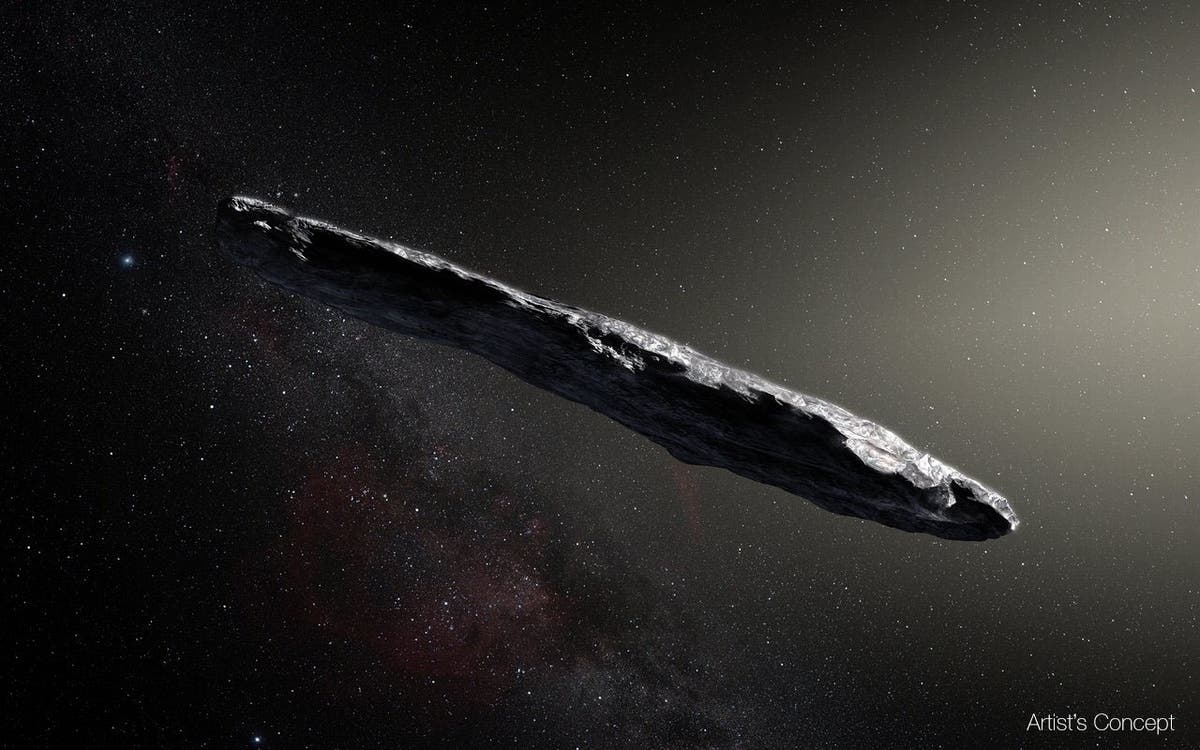
"Oumuamua," the red, cigar-shaped object astronomers in Hawaii say buzzed Earth and then sped away in this fall, could hold keys to life beyond our galaxy, according to researchers studying the mysterious interloper using an instrument on the Green Bank Telescope in West Virginia that can scan billions of individual radio channels at once.
The irregular shape of Oumuamua, which was discovered by the Pan-STARRS 1 telescope trained over the volcano Haleakala on the Hawaiian island of Maui, gives scientists pause. Asteroids are typically round, rather than thin and long. Oumuamua's shape is described as "an elongated cigar shape, hundreds of meters in length but with width and height perhaps only one tenth as long."
The interstellar visitor was classified by the International Astronomical Union as 1I/2017 U1, but the Pan-STARRS team dubbed it 'Oumuamua (pronounced oh MOO-uh MOO-uh), which is Hawaiian for "a messenger from afar arriving first."
Find out what's happening in Across Americafor free with the latest updates from Patch.
Oumuamua’s blistering fast speed of 196,000 miles per hour at its peak suggests it is not gravitationally bound to the sun and will speed back to whatever galaxy it came from, according to Breakthrough Listen, a project that aims to discover signs of extraterrestrial civilizations by searching stars and galaxies for radio signals and laser transmissions.
The unusual shape of Oumuamua piqued astronomers' interest, and though alien life is the least likely explanation for its origin, they began to wonder if it was sent by an advanced civilization. Russian billionaire Yuri Milner is spending $100 million over the next decade to fund the exploration.
Find out what's happening in Across Americafor free with the latest updates from Patch.
So, is ‘Oumuamua a spaceship? Probably not, though its needle shape “is the most likely architecture for an interstellar spacecraft because it would minimize friction and damage from interstellar gas and dust," Breakthrough Listen said.
It’s more likely that ‘Oumuamua is a naturally occurring asteroid, though there’s no consensus on that among the Breakthrough Listen scientists exploring the possibility that it could be a spacecraft artifact.
For now, ‘Oumuamua has been silent and researchers who scanned 'Oumuamua across four radio bands have found no evidence of artificial signals emitting from it, but researchers aren’t done studying it. Andrew Siemion, director of the University of California-Berkeley SETI Research Center, said it will take some time to analyze the data from the software developed for the Breakthrough Listen project.
The software is sophisticated enough to identify signals that may be coming from 'Oumuamua itself, but at the same time signals that may come from human technology on or around Earth.
Observations of 'Oumuamau, originally classified as a comet, revealed no signs of cometary activity after it slingshotted past the sun on Sept. 9, 2017, NASA said.
What astronomers do know is that 'Oumuamua is the first confirmed object from another galaxy that has entered our solar system. Astronomers had predicted such an occurrence, but it wasn’t expected when Institute for Astronomy postdoctoral researcher Rob Weryk began reviewing the Oct. 19 images captured by the telescope in Hawaii.
At first, Weryk and his colleagues thought the faint light zooming through space was a comet or asteroid from Earth’s solar system, but its hyperbolic orbit suggested it came from another galaxy, scientists have said of the “oddball” object.
Siemion said in the news release Thursday that even if no signal or other evidence of extraterrestrial technology is heard, observations will cover portions of the radio spectrum in which the object has not yet been observed. That data could provide important information about the possibility of water or ice in other galaxies, or the chemistry of a coma (gaseous envelope), neither of which have yet been identified.
Breakthrough Listen has already proved its value for traditional, non-SETI astronomy: In August 2017 it detected several dozen repeating fast radio bursts from a distant dwarf galaxy.
Photo credit: European Southern Observatory/M. Kornmesser
Get more local news delivered straight to your inbox. Sign up for free Patch newsletters and alerts.