Community Corner
A Message In A Bottle Speaks Of Pre-9/11 Hope And Innocence
Two Michigan beachcombers added a chapter to the lore of messages in bottles set adrift. The date on the one note was a chilling reminder.


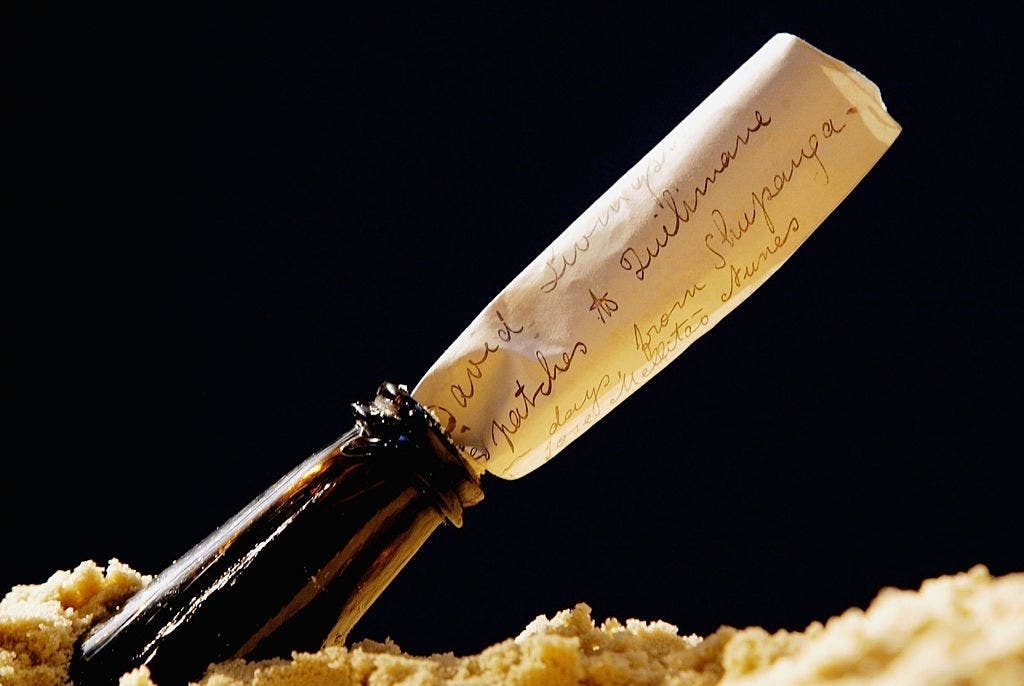
FENNVILLE, MI — Messages tucked inside bottles and thrown into the waters have fascinated humankind for centuries. These floating notes convey romantic yearnings, tell tales of adventure at sea and connect maritime penpals. On the shore of Lake Michigan recently, mother-and-daughter beachcombers Amy Gasaway and Amanda Butler were taken back to one of the most painful days in U.S. history.
“Open me,” read a sign on the Pepsi bottle with a bright yellow lid.
Inside, they found letters from an advanced-placement English class at Cascade High School in Clayton, Indiana.
Find out what's happening in Across Americafor free with the latest updates from Patch.
It wasn’t the content of the letters written by teacher Diane Flint and two of her students — the students shared their dreams for the future and Flint wrote that she hoped someone would write back — but the date: Sept. 10, 2001.
Flint and her students had no idea how profoundly the world would change the following day, or that 9/11 would become a symbol of terror and a loss of innocence.
Find out what's happening in Across Americafor free with the latest updates from Patch.
“I’m sure they had no clue whatsoever how the world was about to change in front of them,” Gasaway told news station WXMI of the messages in the bottle.
While enchanting floating notes have inspired movies, songs and lore handed down through the generations, these adrift messages started out with a more practical, scientific purpose.
History has it that the first-known bottled message was tossed into the sea in 310 B.C. by Greek philosopher Theophrastus, who wanted to prove the Mediterranean Sea was formed by the inflowing Atlantic Ocean, according to National Geographic.
One of 390 messages tossed in the sea by scientist George Bidder in August 1906 made a 110-year voyage until it washed on the North Sea island of Amrum, in Germany. It proved the value of such vessels for oceanographers who want to better understand the circulation patterns of the seas. It had traveled only a few hundred miles.
In another famous chapter in the history of messages in a bottle, the notes were shrouded in the mystique of international espionage. Suspecting floating notes were cryptic communications sent home by British spies or fleets, Queen Elizabeth I of England appointed an “Uncorker of Ocean Bottles” in the 16th Century and made it a capital crime for anyone else to open one.
Sometimes, the messages were an urgent call for rescue. On May 25, 1859, Dr. David Livingstone sealed a message in a bottle and threw it into the mouth of the Zambesi River in Africa, requesting provisions from any passing ships that found it. The bottle was unveiled for the first time at an auction at Christie’s in London, where it was offered as part of the sale of travel and natural history books and 20th century literature belonging to Quentin Keynes, the great grandson of Charles Darwin.
The stories about floating messages sometimes take an eerie turn. In 1935, about two centuries after treasure-hunting seaman Chunosuke Matsuyama of Japan were shipwrecked on an island in the South Pacific, the bottle they had set adrift with a message carved into coconut wood was found in the village where Matasyama had reportedly lived.
The messages can be incredibly sad, too.
Jeremiah Burke, a 19-year-old Irishman making his way to the United States for a better life, tucked a goodbye note inside a bottle of holy water his mother had given him after the RMS Titanic hit an iceberg on its maiden voyage in 1912.
“From Titanic, goodbye all, Burke of Glanmire, Cork,” it read.
World War I soldiers facing death tossed out bottles with messages saying goodbye to loved ones. When the Lusitania was torpedoed in 1915, a passenger set a bottle adrift with the haunting message:
“Still on deck with a few people. The last boats have left. We are sinking fast. Some men near me are praying with a priest. The end is near. Maybe this note will — ”
In Michigan, Gasaway and her daughter hope to connect with the teacher and her former students and learn what has happened in the years since innocence was shattered by the 9/11 terror attacks.
“It really makes you wonder, you know, what these young men have gone through since then," Gasaway told WXMI. “There’s been a lot of changes since 9/11, since they wrote these."
Get more local news delivered straight to your inbox. Sign up for free Patch newsletters and alerts.