Community Corner
Northern Lights Forecast Update: 'Solar Flare Factory' May Deliver Aurora This Week
A powerful series of solar flares, including an X8.3 class eruption, may cause visible auroras at lower latitudes than usual this week.


The sun fired off dozens of solar flares, including an X8.3 class eruption, over the past couple of days from a region that’s known as a “solar flare factory,” increasing chances for northern lights displays Thursday through Saturday.
The flares are coming from the monster sunspot AR 4366, the most significant solar feature of the current, high-activity Solar Cycle 25, and it is turning toward Earth. Forecasters from the National Oceanic and Atmospheric Administration’s Space Weather Prediction Center said Monday that they “expect more exciting activity from this region in the coming days.”
NOAA said another X1.5 flare peaked Tuesday but noted that flares of this magnitude “can be impulsive” — that is, they are quick to rise and fall, and may last for minutes or hours. A stronger X4.2 flare was released Wednesday.
Find out what's happening in Across Americafor free with the latest updates from Patch.
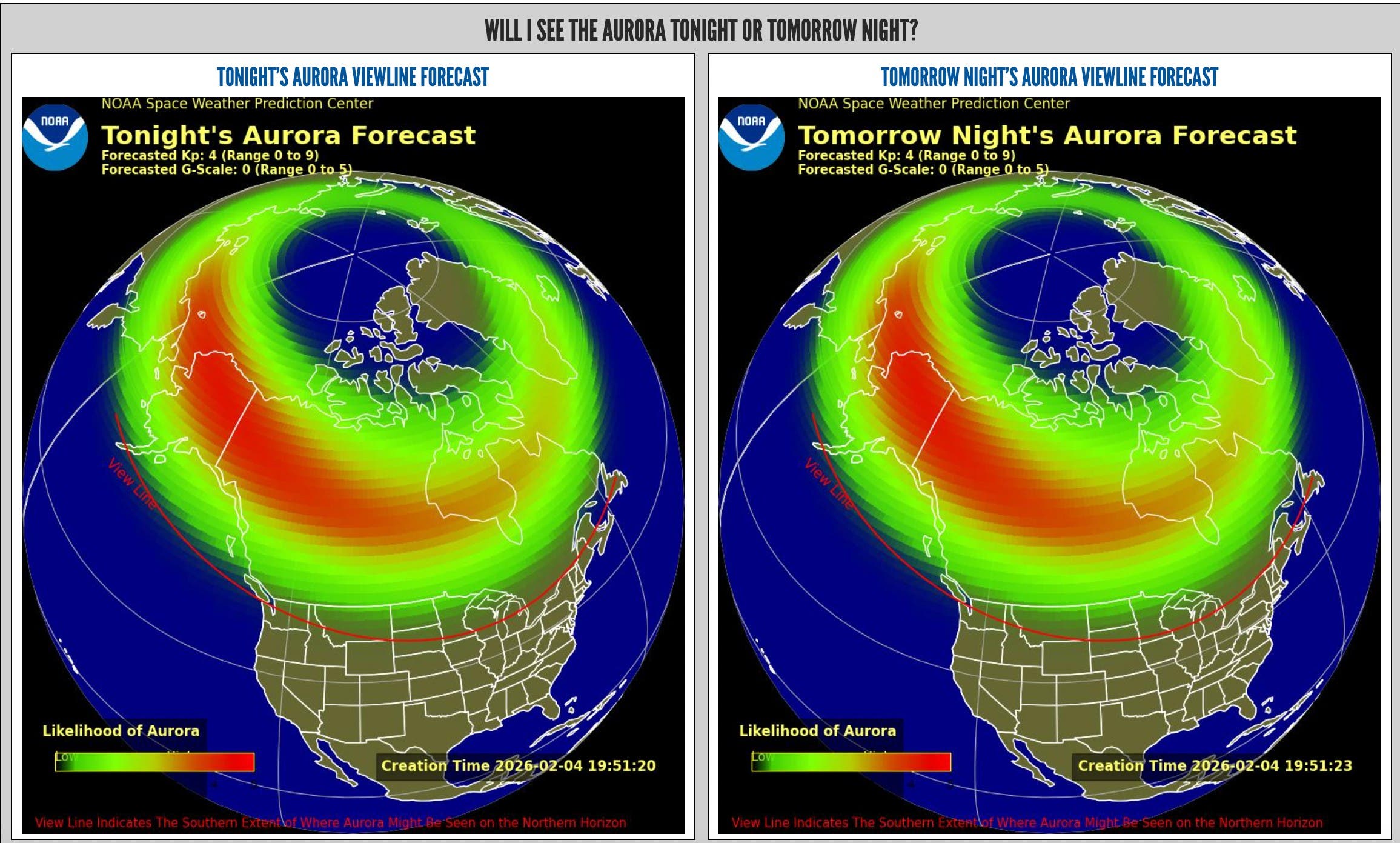
The aurora could push into about a dozen northern-tier states Wednesday and Thursday. On the map below, areas shaded in green have the best chances of seeing the northern lights, with good chances in aareasabove the thin red line.
The aurora borealis is the result of the solar wind, which consists of charged particles flowing from the sun that interact with Earth’s magnetic field. Although most of the particles are pushed away, some are channeled along magnetic field lines toward the poles. When these particles collide with oxygen and nitrogen atoms high in the atmosphere, they excite the gases. The subsequent release of energy from these gases is what causes the shimmering lights.
Find out what's happening in Across Americafor free with the latest updates from Patch.
Acclaimed Argentine astrophotographer Eduardo Schaberger Poupeau, who captured an image of sunspot AR 4366 on Monday, called it a “true solar flare factory,” noting it has “produced dozens of M-class flares and 5 X-class flares, including a powerful X8 event, all within a few days,” Spaceweather.com reported.
“This sunspot is just getting started,” the site said.
The time around the March 20 vernal equinox could be one of the last great chances to see intense aurora displays at lower latitudes in the Northern Hemisphere. As Forbes reported, that’s due to a combination of the sun calming from its 2024-2025 solar maximum, celestial mechanics and dark skies.
Is It A 100-Year Cycle?
Traditional thinking is that solar activity naturally waxes and wanes throughout the 11-year solar cycle, swinging from a calm period known as solar minimum to a more intense solar maximum.
The intensity of the Solar Cycle 25 maximum has surprised space weather scientists and forecasters. It has been one of the most active on record, and they’re not quite sure why. Some solar scientists think they’ve solved the riddle — that space weather isn’t influenced by a single solar cycle.
Their theory, published earlier this year in the journal Space Weather, is that the solar maximum is tied to the lesser-known Centennial Gleissberg Cycle, a longer-term period of solar activity that spans 80 to 100 years.
The cycle is named after German astronomer Wolfgang Gleissberg, who discovered the longer-term cycle hiding, in effect, behind the 11-year cycles of rising and falling solar activity about 70 years ago.
That suggests that whether one solar cycle is stronger than the other is not random, but part of the larger whole.
“Usually, over four solar cycles, the intensity of solar activity will increase,” Kalvyn Adam, a former researcher with the National Center for Atmospheric Research and lead author of the study, told Space.com. “Then it will reach its peak, and then it will go down over another four solar cycles.”
The researchers suggest this cycle may have “just turned over” and is starting anew, which is why solar maximum in Solar Cycle 25 was more difficult to pin down than initially expected.
Previous research, including a 2023 study and a 2024 paper, has suggested the CGC, as the long-term cycle is known, may have played a role in increased sunspot activity. But the new study is the first to suggest that the longer cycle’s minimum may be over.
If they’re correct, the ethereal curtains of green, red, pink, purple and yellow lights that have delighted people around the world could become more commonplace.
Pretty sky paintings aside, the research, funded with an Air Force Office of Scientific Research grant, has broad implications for the military, as well as others using satellite technology.
“This changing space climate will have implications for the design and operation of future satellite missions,” the authors said.
There’s broad disagreement among solar scientists about the validity of the theory.
Get more local news delivered straight to your inbox. Sign up for free Patch newsletters and alerts.