Community Corner
This Face-Recognition App Could Potentially Identify Diseases
Patch Local Innovators: Meet the Boston artist who hopes to make diagnosing disease as easy as taking a selfie with Facetopo.

By Heidi Legg
What happens when a tech artist and her gene-scientist husband try to wow the crowd at a “Nerd Nite” event in Kendall Square? They pitch an idea for an app to help fight disease by crowd-sourcing millions of 3-D digital maps of human faces. Facetopo was the brainchild of Boston documentarian and artist Alberta Chu and her husband Murray Robinson, whose brother was diagnosed with a rare disease that, like Down’s syndrome, can be detected in the face. In a Q&A with Patch, Chu says some day participants could "maybe trade pictures, or eventually, find a twin."
What is Facetopo?
“Every user who wants to participate creates a private account and is able to download the app on either IOS or Android where we provide instructions so that you can create a 3-D face map. We have almost 4,000 faces from everywhere but we need millions in order for this to be an actual big data project. Somehow, it's spreading. People are curious.”
Find out what's happening in Across Utahfor free with the latest updates from Patch.
How many faces do you need to move forward with your findings?
“Our milestone goal is 10,000 faces and, once we have that, we will publish our first face tree in the form of a dendogram, which is a way of looking at a large amount of biological information. It's a tree-shaped model that shows evolution. Our dendogram will mathematically compare a similarity between different faces.”
What exactly are you measuring or tallying?
“We create a topography map using about 80 dots on the face and then we measure the distance between each of the dots. The dots are in the same place on everyone's face but there are different measurements in between them. Using these measurements, we'll compare the mathematical differences and similarities between faces — they will emerge.”
Find out what's happening in Across Utahfor free with the latest updates from Patch.
Is this a purely scientific project or for commercial application?
“It's scientific but it also has a social aspect. Maybe it will be something that's going to connect people with others who look like them or share measurement. They can opt in and maybe trade pictures, or eventually, find a twin. Your face is genetic so there could be similarities between you and someone who looks very much like you. But because it is science research, we don't yet know. What we do know today is that genes are connected to behavior and disease. We don't yet know the accuracy of our mapping but there may be groupings and that is why we are starting to do this as a citizen science project.”
Does Apple’s announcement that they offer face recognition to unlock their iPhone 8 change things for you?
“When you use Facetopo, there's a privacy agreement and a user policy and you're the only one that can access your account. All you’re doing is donating the mass and the dot formation of your face to our big database, which is then analyzed. Nobody knows it's you. It's not connected to your identity; whereas, Apple knows it’s your phone. It's got your name on it. The phone has a number on it.”
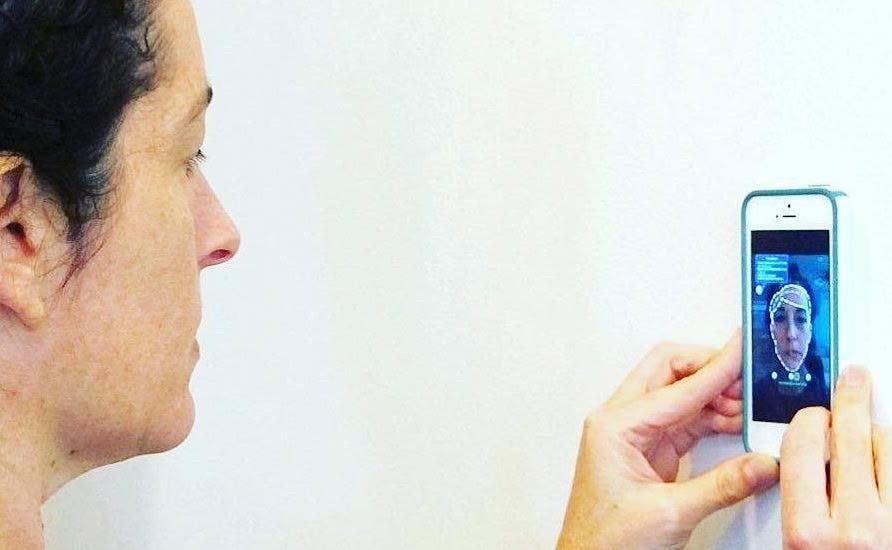
At a Facetopo pop-up called "Faces of Boston" at City Hall Plaza on October 15, a participant poses while 80 points on her face are measured in the app. Photo courtesy of Alberta Chu.
Who's working on Facetopo?
“Facetopo is a project I cofounded with my husband Murray Robinson, who is in genomics with a career in cancer research. He has an older brother that has a genomic syndrome. Back in the '70s, there was no official name for it other than mentally handicapped, and it hadn't been classified when he was young. Ten years ago two scientists, Anne Smith and Ellen Magenis, figured out his brother Kelly had something only 5,000 people have, now called Smith-Magenis Syndrome. These people have certain face markers and a fascination with electronics, and gregarious personalities, and it is genetic: He has a deletion of chromosome 17.”
So you and Murray believe the face is a gateway to medical research?
“We don't know any of this yet, but it could be a gateway to genomics or a gateway to learning something about yourself which is why people are interested in their genome. It's all there, that recipe for who you are, and we could discover a great deal.”
This reminds me of an interview I did in 2014 with Harvard’s genetic guru, Dr. George Church. He wants us all to give our genomes to his human genome project for similar research initiatives.
“He loves Facetopo. It's exactly what they're doing with Harvard, collecting DNA, but ours is with faces.”
How did the idea for Facetopo come about?
“I noticed that at the orthodontist office, they have those expensive cameras where your head is stationary and clamped in there and the camera moves around you. We wondered if we could design a user experience with the mobile phone. We've been in the iTunes store since March. We have created a fun selfie-filter when you make the Facetopo. We are encouraging users to take the 3-D image three times to ensure they're more accurate.”
What's the end goal?
“It's a big scientific question. All of our faces are blending. The races are blending and we are seeing migration patterns. Now that we have genomics, which is accessible and people can get their genome sequence, the big question is can your face be a proxy for getting your genome sequence?”
You believe society responds and adapts?
“Yes. I suppose the creepy part of facial recognition and surveillance is when there's some database of you. If people want to participate in scientific research that could yield information about what is in your face that could lead to advances in behavior and disease, that’s pretty cool. People who study psychology and faces have studied trustworthiness and perceptions of leadership and we probably could do this with our facial measurements.”
Why do you need to be 14 to participate?
“Your face changes at puberty. There's the child face and the adult face and 14 is the age where that happens.”
Where is the edge in Boston right now for new ideas?
“I think there's a lot of exciting stuff happening with public art in Boston right now. The city doesn't do a lot of funding of it but I think there are producers of public art that are able to raise money and there's a critical mass building in Boston around the arts and innovation and how that is a cycle with technology. I think it’s something that Boston maybe has on other places and it could be the thing that Boston does better than anyone else.”
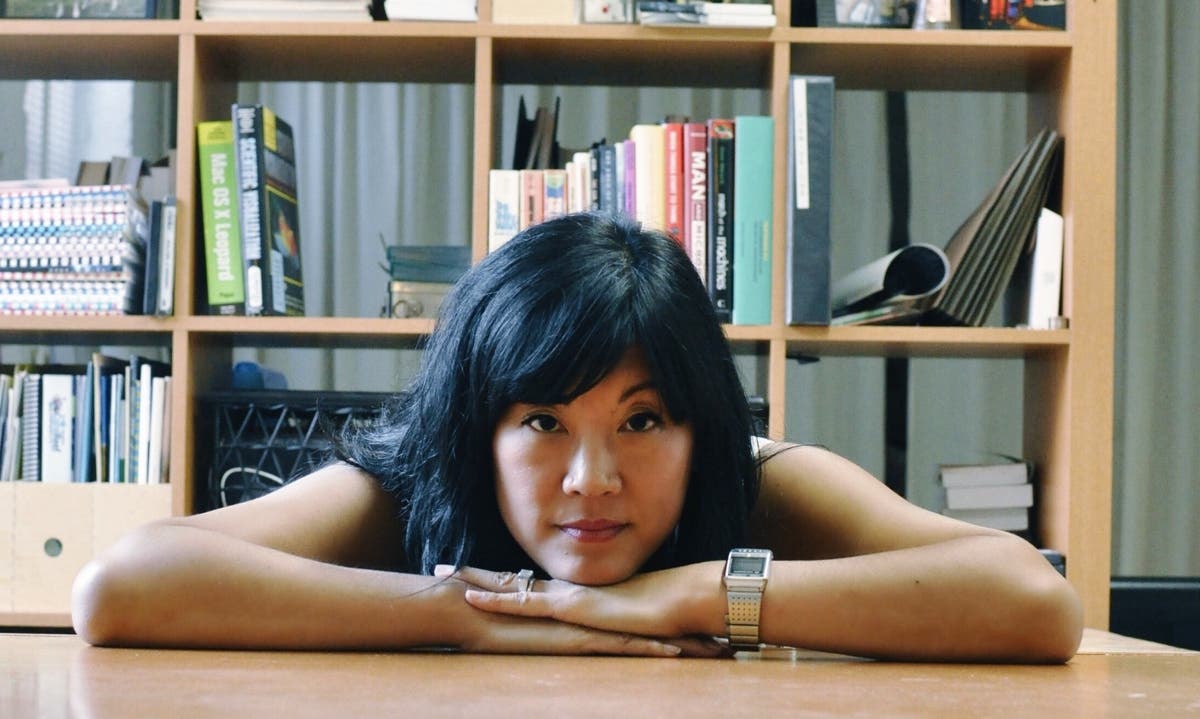
Alberta Chu in her Waltham Street studio in Boston’s South End. Photo by Grace Gulick/The Editorial.
Heidi Legg is founder of TheEditorial.com which publishes interviews on emerging ideas around us.