Schools
Arlington Students Meet NASA Astronauts, Hear About Next Moon Landing
Students at Arlington Science Focus School welcomed NASA astronauts and a Japan Aerospace Exploration Agency astronaut to the school Friday.


ARLINGTON, VA — Arlington Science Focus School welcomed NASA astronauts and a Japan Aerospace Exploration Agency astronaut to the school Friday morning as part of an Artemis Generation event where students got a chance to ask the astronauts questions.
Hosted by Rep. Don Beyer (D-8th), chairman of the U.S. House Science Committee’s Subcommittee on Space and Aeronautics, the event provided the students with an overview of NASA’s goals and missions, and a look at the space program known as Artemis.
Arlington Science Focus School, a K-5 public school in Arlington County, is designed to give children a deep understanding of science content and process through inquiry-based learning.
Find out what's happening in Arlingtonfor free with the latest updates from Patch.
The school heard from National Aeronautics and Space Administration Administrator Bill Nelson, NASA Crew-2 astronauts Shane Kimbrough and Megan McArthur, and Japan Aerospace Exploration Agency astronaut Akihiko Hoshide.
The Crew-2 astronauts recently returned from a six-month stay on the International Space Station.
Find out what's happening in Arlingtonfor free with the latest updates from Patch.
The astronauts answered several questions from the students, including how long it takes to adapt after they return to Earth from a long mission. McArthur said it takes about two days to get rid of the dizziness and up to two weeks for the aches and pains to go away.
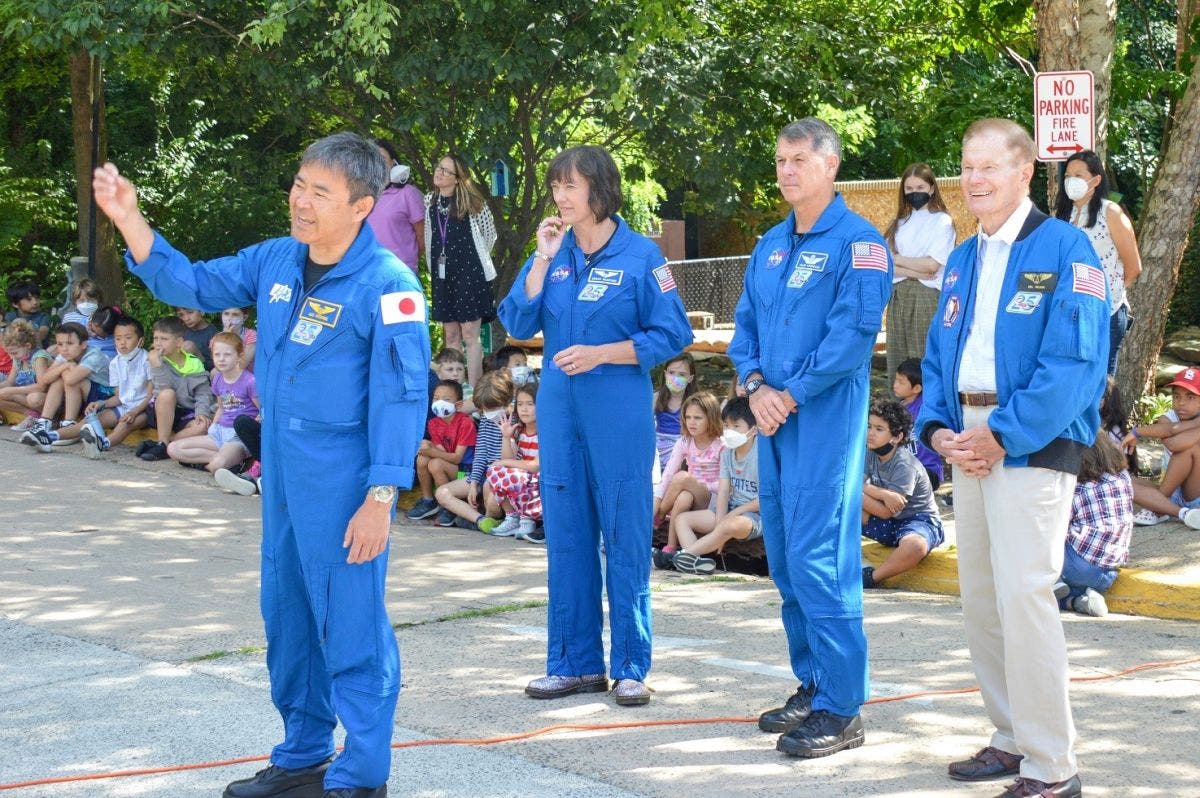
Asked about the risks of missions, Kimbrough said there are dangers with every mission. "We really trust the engineers and the scientists and the training that we get to make sure that we have looked at all the risks out there and tried to mitigate all that," he said.
Nelson told the students that NASA plans to send the next people to the moon, including the first woman, in 2025. The last time a crew landed on the moon was in 1972.
NASA wants to develop the Artemis program as a way to have a sustainable presence on the surface of the moon.
"We’re going to live and work and adapt on the surface of the moon in order to get ready to go all the ready to Mars," said Nelson, who while in Congress went through NASA training and traveled as a payload specialist on a Space Shuttle Columbia mission in January 1986.
"The moon is a three-day trip. Mars is about, on conventional propulsion, eight months. We’re going to try to speed that up with faster propulsion," Nelson told the students.
Get more local news delivered straight to your inbox. Sign up for free Patch newsletters and alerts.