Neighbor News
Sterling Park Began as Guilford Station in 1860
Railroad first brought prosperity to this eastern Loudoun dairy industry and farming community.



Sterling Park Began as Guilford Station in 1860
Railroad First Brought Prosperity to the Farming Community
Became Popular Place for Government Workers to Settle Down Outside Washington, D.C.
Find out what's happening in Ashburnfor free with the latest updates from Patch.
Sterling Park is the portion of Sterling with the zip code of 20164. The land was mainly created from just a few large farms. When construction of Dulles International Airport started in 1959, land prices began to rise. The extension of water and sewer lines to the airport began to alter the landscape. The price of land increased from an average of $125 per acre to $500. In 1961, Marvin T. Broyhill Sr. saw Sterling Park as a great investment opportunity and decided to buy its 1,762 acres for the price of around $2 million.
At this time, the still unpaved Church Road was the area's only public thoroughfare. Sterling Park was established east of Route 28 and a new road, today's Sterling Boulevard, was built to connect the community to Route 7. Homes were priced between $14,800 and $22,500 reached completion by 1967, $3,000 less than a comparable Fairfax County home. Sterling Park was one of the first planned communities in eastern Loudoun County. It became a popular place for government workers to settle down outside Washington, D.C, and eventually Park View High School was built in 1976.
Find out what's happening in Ashburnfor free with the latest updates from Patch.
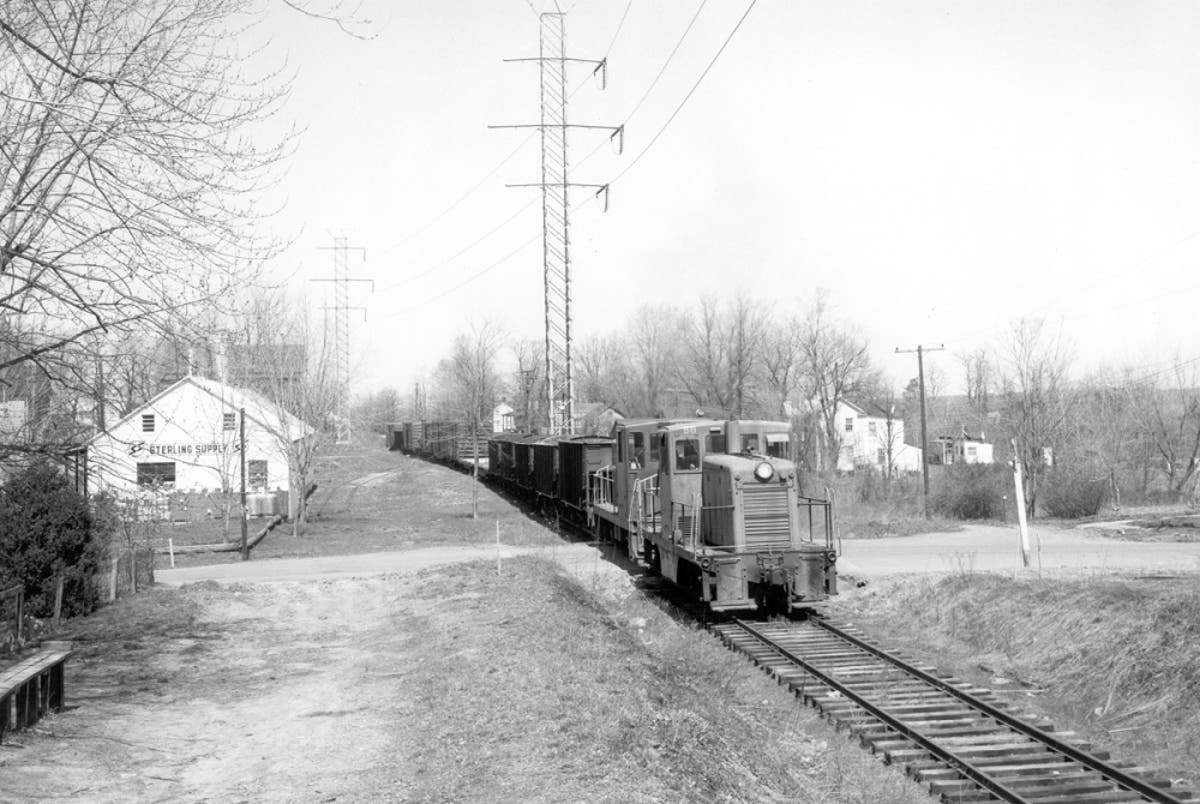
However, 100 years before Sterling Park was placed on Broyhill's, U.S. Steel and other developers’ drawing boards, Old Sterling had its own railroad station and served as a thriving commercial center for area farmers. The Alexandria, Loudoun and Hampshire Railroad originally called the Sterling rail stop “Guilford Station” when the railroad depot was first established in 1860. Optimistic that their line would be continued on to the Ohio River, stockholders changed the name to the Washington and Ohio Railroad Company in 1870. In 1872, the postmaster renamed the rail stop “Loudoun Station” as it was the first stop over the Fairfax/Loudoun county line. But the name never became fixed with the locals. Many residents found it confusing to have the train depot share the same name with the county.
J.P. Morgan purchased the line in 1883, according to local historian Eugene Scheel. The line would eventually come to be known as the Washington and Old Dominion (W&OD). Morgan had the station name changed one last time from “Loudoun” to “Sterling” in 1887. Some historians believe Sterling was named after Lord Loudoun's castle in Scotland. Some say Morgan or one of his directors chose the name Sterling because of Morgan's large banking interests, but no one knows for certain.
At one point in its history, Old Sterling had a total of five saloons, a blacksmith shop, a saddle shop, a grocery store and a family combination shoe store, bar and post office. Ruritan Circle (formally old Church Road), located just off Church Road, crossed the railroad tracks and was secured at one end by the Guilford Baptist Church (originally called Lebanon Grove) founded in 1857 and on the other end by the Methodist Church established in 1875. The village boasted cement sidewalks from the elementary school all the way to the Sterling Supply store.
In 1873, Lebanon Grove changed its name to “Guilford,” reflecting the name of the surrounding community. In 1880 Guilford Baptist, then located in the Guilford Station area, bought a 1.2 acre parcel of land on Church Road and built a new church in 1882. For 85 years, Guilford served as a circuit church, sharing a minister with Calvary Baptist Church and Mount Hope Baptist Church. Guilford was closed periodically in the 1940s and 1950s but remained open from 1954 to 2013. In the summer of 2013, Guilford merged with Sterling Park Baptist Church. After the merger, the congregation took Sterling Park Baptist Church as the name for its newly-unified local church located at North York Road.
In 1875, the newly established Methodist Church in Guilford began sharing a one-room frame building on West Church Road that served both as a public school and a community center. In 1879, the building and one acre of land was purchased for $200 to be used solely as a church. In 1887, the name of the community had now changed from Guilford to Sterling, thus the name of the church was changed to Sterling Methodist Church a short time later in 1890. In March 1897, the original church built in 1880 burned to the ground and a new building was soon erected on the same site in 1899. During this time the Methodists used the Baptist Church for worship until their church was rebuilt. The new church served as the sanctuary for the congregation until 1983 when the congregation moved into their new building at 304 East Church Road.
The area comprising the Sterling Community around the turn-of-the century was made up of predominately large family farms involved in either dairy or cattle production. The growth of the dairy industry in Loudoun County during this period was a direct result of the presence of the railroad and the ability to transport milk, cream and butter daily to markets in Washington.
Folks living in Old Sterling in the 1920s and 1930s remember it as a close-knit community with an intimate population of give or take 200 people. According to Eugene Scheel, these were the people referred to when folks talked about "goin' down the country,” as residents of Leesburg regularly did when they talked about Sterling. It was a sparsely populated area, also known as "The Redlands" for its sienna clay soils.
Education back then for many children from farm families ended after they graduated from the seventh grade in the two-room schoolhouse on Ruritan Circle. The schoolhouse opened for the spring semester in 1880 and operated continuously until 1947. Old Sterling resident Hugh Ball told me that he attended the school during its final year of existence. Those who chose to matriculate to high school had to travel to Ashburn, the next stop west on the railroad line. Anyone who wanted to pursue high school with commercial courses had to commute to Fairfax County and attend Herndon High.
The school building still stands today. Over the years, it has served as a rental unit, Sterling Schoolhouse Antiques successfully managed by Grandma Betty Geoffroy (1980-2007), an office for a landscaping company, a carpet cleaning service and a parking lot for a heavy equipment contractor. The building is also rented to a small Pentecostal Church. However the old schoolhouse still retains its interior treatments including the use of bead board, wood paneling, 15 foot tin-lined ceilings and the remaining field stone foundation.
The Washington and Old Dominion (W&OD) railroad tracks that divided the village were lined on the north by a row of houses and businesses and on the south by the railroad depot, a mill and a Southern States store on Railroad Avenue, which is now Ruritan Road. The Sterling Ruritan Club, chartered in 1951, is located at the end of this old thoroughfare. The Sterling Supply store on the corner of Ruritan Circle and Ruritan Road later became George Caylors' meat market, a convenience store and then the Sterling Mower Repair Shop. Sterling Mower was the last occupying tenant (1972-2001) of the old structure. The shop was moved across West Church Road into a new building on Shaw Road in 2001. The 137 year-old building serves as a storage facility and the office has been vacant ever since.
Next to Sterling Supply once stood a two-story residence built in the 1850s and known throughout the eastern Loudoun area as the Summer White House (owned by the Summers family). The residence served as a house turned hotel for many years. President James Buchanan, riding in a "coach and six," supposedly brought his family members there on weekends to escape the heat of the Washington summers in 1859 and 1860. Unfortunately this building became dilapidated; it was used for a short time as an antique shop and homeless shelter and was burned in a controlled fire 1989. It remains an empty lot. On the other side of the mercantile store on Ruritan Circle behind the IMI Furniture Store, there resided a small one-story building that served as the Sterling Post Office from the 1940s until the early 1960s. It was later used as a bargain store annex for quick sale items from the furniture store and was eventually torn down.
In 1971, the dilapidated Sterling Emporium on Ruritan Road was burned by the local fire company during a training exercise—a fate shared by the Sterling Hotel. No trace of the grain mill (burned in 1970), railway depot (burned in 1928), blacksmith shop or the various barrooms remain.
In the 1950s, children freely wandered the creeks and fishing holes around Broad Run and Cabin Branch Creek and participated in the community through school, church and 4-H Club events. The Methodist Church evening suppers on Church Road would bring out 15 people on a good weekday night. As time passed and the number of farm families began to sell off their land and residents moved east over to the new homes in Sterling Park, Old Sterling changed from a lively farming and commercial center into a ghost town cluttered with timeworn buildings.
Several factors led to Old Sterling’s demise in the early 1960s. The railroad only continued to remain in business in order to transport cement for the construction of runways at Dulles Airport which was mostly completed by 1962. The decline was further exacerbated when a modern office facility opened next to the Sterling Park Mall and was soon followed by more new shopping centers at Route 7 and Dranesville Road. The Old Sterling community's century old buildings were abandoned or demolished. The historic village became a relic of the past, left to time by its neighbors to the east.
I strongly urge anyone who is interested in Old Sterling's fading past to take a drive down West Church Road, either from Route 28 or Sterling Boulevard, to Ruritan Circle. There you can visit the old Guilford Baptist Church (now the Ethiopian Orthodox Church), the 1880 two-room schoolhouse, the 1860s Sexton/Grooms House and the Tavenner Wheelwright Shop. It may be your last chance to see these and other remaining old town relics that reside near the bike path that was once the railway that first brought prosperity to the place we now call Sterling.
If anyone is interested in obtaining more facts about Old Sterling, contact Mark Gunderman at gunderman2001@aol.com.