Neighbor News
Sterling Family Celebrates 4-Year-Old's Medical Miracle this Holiday
Ashley and Bryan Sobonya celebrate the health of their family this holiday season after daughter's heart condition spontaneously resolves
Ashley Sobonya never thought she would be able to have a child – let alone two. Because she had been diagnosed with Acute Lymphoblastic Leukemia as a child, Ashley knew that side effects from chemotherapy treatments would likely keep children out of reach.
Much to her surprise, 22 years later, Ashley and her husband, Bryan, welcomed Addison Grace Sobonya into the world in June 2012. Addison could not wait to make her introduction and was born 10 days early.
Addison was a healthy baby, but at 8 months old, her parents noticed frequent twitching in her arm and neck. The family’s pediatrician referred them to a neurologist at Children’s National Health System, but after a thorough evaluation, these “shudder episodes” were deemed normal. Addison’s heartbeat, however, was not.
Find out what's happening in Ashburnfor free with the latest updates from Patch.
On April 30, 2013, Thomas Hougen, MD, a cardiologist at Children’s National, diagnosed Addison with Ventricular Tachycardia (VT), and he soon introduced the family to electrophysiologist Charles Berul, MD, Co-Director of the Children's National Heart Institute and Division Chief of Cardiology at Children's National, to manage her continued care. VT is a life-threatening condition defined as an abnormal, fast-paced rhythm in the bottom chambers of the heart. Without proper medical care, VT can cause weakness, fatigue, dizziness, fainting, palpitations or even death.
“As first-time parents, who never thought they could become parents, we were terrified and clueless. Dr. Berul and his team sat down with us and answered our every question,” Ashley recalled. “They were patient and looked at our entire family’s needs. Dr. Berul even reassured me that my own battle with childhood cancer had nothing to do with Addison’s diagnosis. This awareness and self-forgiveness was an immense gift. As scared as we were, we felt secure in their care. We were in the best possible hands.”
Find out what's happening in Ashburnfor free with the latest updates from Patch.
The two primary ways to treat VT are with medications that suppress the arrhythmia or with ablation, which uses targeted energy to destroy just the area of the heart causing the abnormal heartbeat. To minimize patients’ exposure to radiation from X-rays, Children’s National experts pioneered a radiation-free 3-D mapping technology that allows physicians to precisely guide catheters (flexible tubes) during ablation procedures.
“During a cardiac ablation, we insert a catheter into a blood vessel and thread it into the heart. Once we locate the origin of the arrhythmia, we send energy through the catheter to stop the irregular electric signals,” explained Dr. Berul. “Simply put, we use our 3-D mapping technology to find and ‘zap’ the source of the problem.”
Because catheters are only designed for use in adults, Dr. Berul and his team decided to treat Addison with medication until she was at least 3 years old. But, her condition proved more challenging than most to control. They tried several different medications until identifying one that partially suppressed the abnormal rhythm until she was old enough for an ablation.
After three and a half years of taking medication every eight hours, Addison was scheduled for an ablation shortly after her fourth birthday in the summer of 2016. She couldn’t wait to take the “magical ride” (moving walkway), and the “magical elevator” to her room. “You don’t need to push buttons for [the] elevator,” she said. “It takes you where you need to go.”
When Addison arrived at her room, she wore her “fancy gown” (hospital gown), and began greeting all the nurses, residents and doctors who arrived. The next morning was ablation day. Addison was excited to see Dr. Berul and said she would “see him in the spaceship (in the operating room) soon.”
Once in the operating room, Addison practiced taking deep breaths in her mask. Little did she know, but her mom, dad and 12 doctors waited for more than an hour for her heart to have an abnormal contraction to ablate – hopefully resolving her heart condition – but it never came. Her VT spontaneously resolved on its own.
“She never once cried, never once feared where she was or what was happening,” Ashley said. “She was a warrior.”
Addison was discharged less than six hours later without an ablation or the need to take any more medication.
“There are certainly cases of spontaneous resolution of arrhythmias, but this timing was incredible as she’d had frequent arrhythmias constantly until the day of the procedure,” Dr. Berul said. “Medically, I can’t call it a miracle, but I can understand why others might.”
Since that day, Addison has seen Dr. Berul three times and is still clear of VT. She’s doing so well, in fact, that Dr. Berul now only sees the family every three months instead of the previously planned monthly checkups.
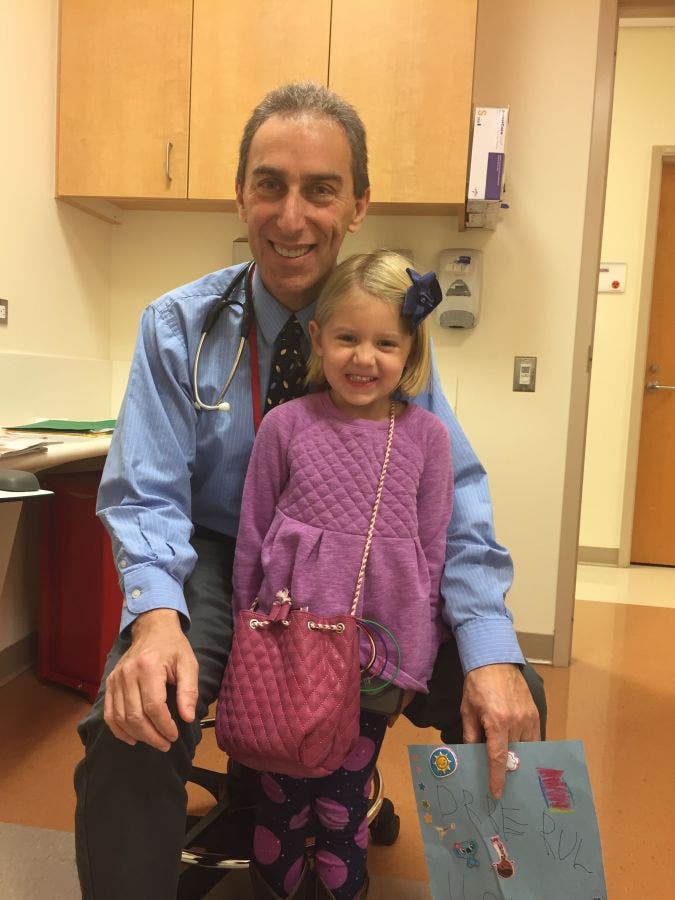
“Thanks to the doctors and nurses at Children’s, Addison has never had anxiety with Holter monitors, doctor visits, hospitalization, medication, IVs and routine checkups,” said Ashley, who is now a mom of two. “She loves Dr. Berul so much that every time she sees him, she brings him a handmade craft and a huge hug. She recently told me, ‘Dr. Berul loves me, and I love him.’”
Addison also tells her pre-school teachers she “wants to be a doctor, like Dr. Berul, and take care of hearts.”